If you have been following my posts for the past year, you are aware that I have been keenly interested in retrieval practice. I regularly incorporated retrieval practice (in the form of brain dumps) with my GATE/PreAP students last semester. Their reflections revealed the value of brain dumping on their long-term retention of information. Thus, I decided that I would fully roll out brain dumping to all of my world history classes this semester.
We are about five weeks into the quarter and my students have done four different brain dumps. The first three were small in nature as they focused on one main concept. The brain dump my students recently finished covered four main concepts: origin of Islam, Five Pillars of Islam, rules that guide a Muslim’s life, and a brace map of Sharia.
To recap, my students use pencil in their initial brain dump and pen for when they engage in collaborative learning with peers. NOTE: Some of my students used black pen which makes it hard to see the difference initial versus collaborative recall.
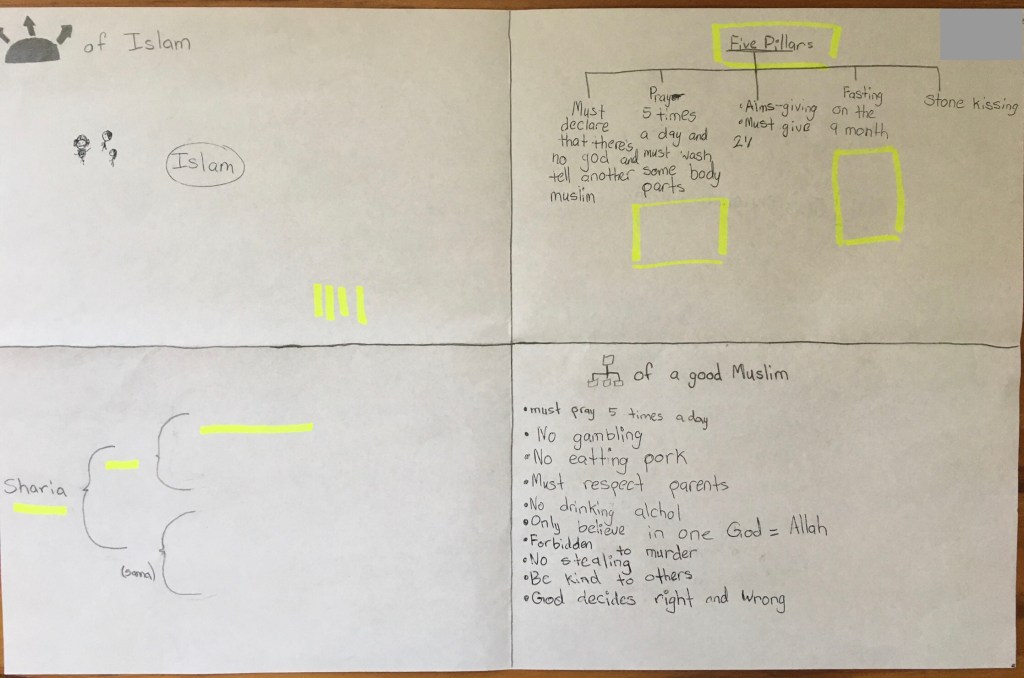
For this brain dump, I cued my students while they were discussing their learning with peers. I saw the faces of students light up as they remembered the information after my verbal cues (e.g., dates, key terms). Thus, I felt that by giving students hints without outright stating the answer was helping them to make stronger connections.
The last step was for students to pull out their notes and continue to add to the gaps in their brain dumps in pen. Luckily, the following student used red pen so it’s easier to see what they did and did not remember.
I told my students that what they wrote in pen were the things they needed to study as they were clearly not remembering those facts. Because I teach middle schoolers, I know that they don’t always have the best study skills or time management. Therefore, I stressed that they should ignore the pencil items and focus their attention on the pen.

After the quiz, I went through each student’s brain dump and looked at their performance. In the majority of the cases (approximately 90%) there was a direct correlation between what the student remembered on their own (pencil) and the questions they got right. A similar correlation was found between what students wrote in pen and the questions that they missed. I am assuming that the information written in pen or out-right missing (see first image) posed an issue for students because they:
- Did not spend enough time studying that information
- Did not have enough time to relearn the information
- Did not understand the information or how it was related to the concepts
- Were not in class when the information was presented and applied
- . . . ?
The next step is to pass the brain dumps back to students and give them access to the quiz questions. I want them to reflect on their brain dump and the effort they put forth on the quiz. Hopefully, they will see the correlation on their own as they prepare for the unit test.
Only time will tell.



 Living the Learning Curve