You don’t have to look very far to see AI mentioned in relation to education, teachers, students, learning, etc. While there are supporters and huge proponents of generative AI, there are also detractors as well as those who are a bit skeptical.
Supporters of generative AI tout the revolutionary changes that AI can bring to teaching and learning. Some evoke scenarios of students using generative AI to create engaging learning experiences (e.g., dialogue between historical figures, rewriting historical events/what if’s), while others point out how AI-use can promote the development of important skills (e.g., problem-solving, collaboration, responsible decision-making). Further, there are educators currently using generative AI for lesson planning as well as managing their work-flow.
On the other hand, detractors lament how generative AI can lead to cheating or dis-engaged learning with students simply typing in questions and letting AI do the work for them. Some also point out that generative AI responses can be biased, flat out incorrect, or can exacerbate existing inequalities. Additionally, there are educators who not interested in the “latest fad” to add to their already over-flowing plates.
Now, I am not an expert in generative AI. However, I do know about technology and change. In fact, I think the following quote is important to keep front and center:
“Getting a new idea adopted, even when it has obviously advantages, is difficult.”
Rogers, 2003, p. 1
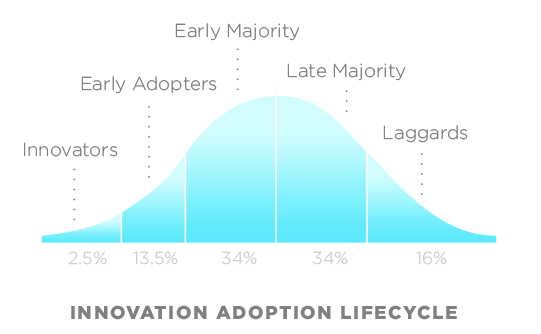
For proponents (i.e., innovators or early adopters), generative AI is a no-brainer. It’s exciting and revolutionary. But the rest (i.e., early majority, late majority, laggards) have legitimate concerns that need to be addressed before AI can make a lasting impression on teaching and learning. The following image is a breakdown of adopter categories as it relates to new ideas (in this case generative AI):
So, here is what I am proposing especially if you are an ardent supporter of generative AI and want your teachers and administrators to see the advantages and benefits for teaching and learning in the classroom:
- Keep the channels of communication open – be open to disagreements and don’t take it personally if people are not interested in AI
- Be a good listener – people who are hesitant about change have legitimate concerns – make a concerted effort to understand what those concerns are (Hall & Hord, 2014)
- Use baby steps + chunk the information – provide practical applications that are easy to digest – some colleagues may need just a little nudge, whereas others will want (need?) many reassurances that AI isn’t going to rock their world in a bad way
- Be a good listener – even after providing support, showing examples, modeling, some may still be unwilling – remember their concerns are legitimate
It is no mistake that I put be a good listener on the list twice because when it comes to change, railroading teachers (or people in general) is not going to get them to truly buy-in. If teachers are not ready to listen about the benefits of integrating AI into their teaching practices, then no amount of effort on your part is going to make a difference. To be clear, it’s important that you empathize with their situation.
Now, if you are interested in how you can facilitate the adoption of generative AI on your campus, I urge you to watch the following video as I believe this will help you to develop an empathetic mindset (Heath & Heath, 2010) for how you can effect change:
To be clear, I believe that generative AI can be a beneficial tool for teachers and students. However, I have yet to be convinced that it will revolutionize education and learning. So many innovations and technologies have come and gone in the classroom…some have made lasting impressions, while others have had little effect. Only time will tell.
References
Hall, G. E., & Hord, S. M. (2014). Implementing change: Patterns, principles, and potholes (4th ed.). Pearson.
Heath, C., & Heath, D. (2010). Switch: How to change things when change is hard. Crown Business.
Rogers, E. M. (2003). Diffusion of innovations (5th ed.). Free Press.
 Living the Learning Curve