A Guiding Light for the New Year: The #OneWord Challenge

This little guy inspires me to find the JOY in everything. 💚

New Year’s resolutions are extremely hard to keep. Take a minute to think about how many New Year’s resolutions have persisted for you…if you say “not many” or “none,” you are not alone! In fact, a health survey conducted by Forbes found that the “average resolution lasts just 3.74 months” (Davis, 2023).

When reflecting on past New Year’s resolutions, I am no different from the average person. So I decided to shift perspectives!

In 2018 I decided to choose one word that would guide my thoughts and actions for the year. The idea behind the #oneword challenge is that when you take stock of your life (past 365 days), how would you summarize it in one word? 

After hearing about this idea, I introduced the #oneword challenge to my middle schoolers and had them write their word in their agenda book (1) to keep themselves accountable and (2) as a reminder of the word they wanted to use to describe their year. Periodically, I would have students return to the page where their #oneword was written to reflect on whether their actions, words, and thoughts aligned to the one word they chose for themselves. To make sure that my students knew that I had skin in the game, I also participated in the #oneword challenge and shared my one word with them.

I even brought in a few good friends (middle school colleagues) to join me in the #oneword challenge. The more, the merrier. 😁

Having one word that guided my course of action, words, and thoughts came in very handy during the pandemic when my #oneword challenge almost became a sort of lifesaver. Suddenly separated from daily in-person contact and fear of the unknown added another layer of stress. But the #oneword that my friends and I each chose not only bonded us but also gave us something positive to focus on. Throughout 2020 and 2021, we would regularly share whether (or not) we were aligned by our #oneword which kept us accountable and gave us the opportunity to provide encouragement and support to each other as needed. 

And it was sorely needed.

Now the #oneword challenge is a bit different than creating a New Year’s resolution. I’ve found that choosing one word (e.g., trust, simplicity) instead of a resolution (e.g., regularly exercise, eat better) is more compassionate. It’s a mindset that guides one’s thoughts and actions. There is room for failure, opportunities for grace and empathy, and a chance for do-overs. After all, those who take on the #oneword challenge have 365 chances (or in the case of 2024, 366 chances – #leapyear) to live out their one word. But it’s not just enough to choose one word to describe your year; it’s important to think about why you’ve chosen that one word and how you plan to follow-through with it. By consciously thinking about your why and how, you are setting yourself up for success as you now have a game-plan. And, if you share your one word with friends, you now have an accountability system. 

Full disclosure, there are some days where the #oneword is front and center in my life, and there are other days (or consecutive days) where the #oneword is notably absent. Last year, my #oneword was present, as in I wanted to be present in the moment and not think about the past or future. But last year was a crazy year with family and personal obligations pulling me in a multitude of different directions. I found myself going down quite a few dark and long rabbit holes, but when I remembered my #oneword, it brought me back to my goal of being present, being in the moment. It reminded me to take a breath and just be

Aside from using #oneword to guide my thoughts, words, and actions, an indelible benefit of sharing my #oneword with friends is that when we get together at the end of the year, we share our ups and downs, our challenges and triumphs, the good, bad, and the ugly of our year. While we spend time in introspection, we also have a chance to build each other up, to remind each other that the #oneword is a guiding light and not an all or nothing deal. While we may not have lived by our #oneword for all 365 days, if we can define the pivotal moments of our year by our #oneword or even lessons on how we can do better with our #oneword going forward, then that’s what matters most in my book.

This year, I shared my #oneword challenge with a wider group of friends and family. It brought a smile to my heart to know their #oneword and the reason for choosing it for 2024. To what extent they will have achieved their #oneword challenge remains unknown, but you can bet that I’ll be reaching out to them come December 2024 to reflect on our respective #oneword journeys.

In case you’re wondering, my #oneword for 2024 is JOY. It was inspired by the Bible verse James 1:2 which begins with the phrase “Count it all joy.” I chose this #oneword because no matter what life throws my way this year, I want to find joy in all of the things. I won’t pretend that it will always be easy to find joy, but I am putting it out there to the universe that I will make a concerted effort to find joy no matter the circumstances. I will reframe my thoughts and find the silver-lining, if need be. To help with this, each day I plan to write down one thing that brought joy–with the idea that by December 31, I will have 366 reasons for being joyful with the life I have.

For today, my JOY is sharing the #oneword challenge with you. ❤️

References

Davis, S. (2023, December 18). New year’s resolutions statistics 2024. Forbes Health. https://www.forbes.com/health/mind/new-years-resolutions-statistics
Diffusion of Innovations: AI adoption

You don’t have to look very far to see AI mentioned in relation to education, teachers, students, learning, etc. While there are supporters and huge proponents of generative AI, there are also detractors as well as those who are a bit skeptical.

Supporters of generative AI tout the revolutionary changes that AI can bring to teaching and learning. Some evoke scenarios of students using generative AI to create engaging learning experiences (e.g., dialogue between historical figures, rewriting historical events/what if’s), while others point out how AI-use can promote the development of important skills (e.g., problem-solving, collaboration, responsible decision-making). Further, there are educators currently using generative AI for lesson planning as well as managing their work-flow.

On the other hand, detractors lament how generative AI can lead to cheating or dis-engaged learning with students simply typing in questions and letting AI do the work for them. Some also point out that generative AI responses can be biased, flat out incorrect, or can exacerbate existing inequalities. Additionally, there are educators who not interested in the “latest fad” to add to their already over-flowing plates.

Now, I am not an expert in generative AI. However, I do know about technology and change. In fact, I think the following quote is important to keep front and center:

“Getting a new idea adopted, even when it has obviously advantages, is difficult.”

Rogers, 2003, p. 1

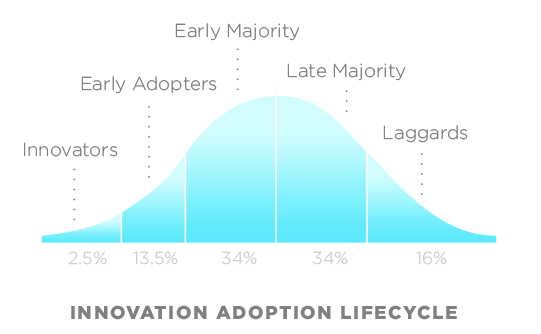
For proponents (i.e., innovators or early adopters), generative AI is a no-brainer. It’s exciting and revolutionary. But the rest (i.e., early majority, late majority, laggards) have legitimate concerns that need to be addressed before AI can make a lasting impression on teaching and learning. The following image is a breakdown of adopter categories as it relates to new ideas (in this case generative AI):

So, here is what I am proposing especially if you are an ardent supporter of generative AI and want your teachers and administrators to see the advantages and benefits for teaching and learning in the classroom:

  • Keep the channels of communication open – be open to disagreements and don’t take it personally if people are not interested in AI
  • Be a good listener – people who are hesitant about change have legitimate concerns – make a concerted effort to understand what those concerns are (Hall & Hord, 2014)
  • Use baby steps + chunk the information – provide practical applications that are easy to digest – some colleagues may need just a little nudge, whereas others will want (need?) many reassurances that AI isn’t going to rock their world in a bad way
  • Be a good listener – even after providing support, showing examples, modeling, some may still be unwilling – remember their concerns are legitimate

It is no mistake that I put be a good listener on the list twice because when it comes to change, railroading teachers (or people in general) is not going to get them to truly buy-in. If teachers are not ready to listen about the benefits of integrating AI into their teaching practices, then no amount of effort on your part is going to make a difference. To be clear, it’s important that you empathize with their situation.

Now, if you are interested in how you can facilitate the adoption of generative AI on your campus, I urge you to watch the following video as I believe this will help you to develop an empathetic mindset (Heath & Heath, 2010) for how you can effect change:

To be clear, I believe that generative AI can be a beneficial tool for teachers and students. However, I have yet to be convinced that it will revolutionize education and learning. So many innovations and technologies have come and gone in the classroom…some have made lasting impressions, while others have had little effect. Only time will tell.

References

Hall, G. E., & Hord, S. M. (2014). Implementing change: Patterns, principles, and potholes (4th ed.). Pearson.

Heath, C., & Heath, D. (2010). Switch: How to change things when change is hard. Crown Business.

Rogers, E. M. (2003). Diffusion of innovations (5th ed.). Free Press.

The Importance of Belonging: Maslow Before Blooms

The idea of belonging is not a new concept for me. I’ve always felt the need to belong to something larger than myself as it gave me a purpose but also a sense of safety and acceptance.

My background in psychology coupled with my time in the classroom solidified my resolve to share with fellow educators the need to focus on ways to instill a sense of belonging for students.

Having worked in two different Title I schools, I learned first-hand just how hard life was for my neediest of students. My heart hurt to hear that a student lived in a garage with their entire family, that they lived with their grandparents because both parents were in jail, that they slept on a couch because they don’t have a bed let alone a bedroom…I could go on and on.

And I learned real fast that there’s only so much that I had control over. I couldn’t control what happened outside of my classroom, but within the four walls of my classroom, I could made intentional decisions to cultivate a sense of belonging for my students.

The challenge of how to help students who are disconnected from school and academics can be addressed in 5 steps:

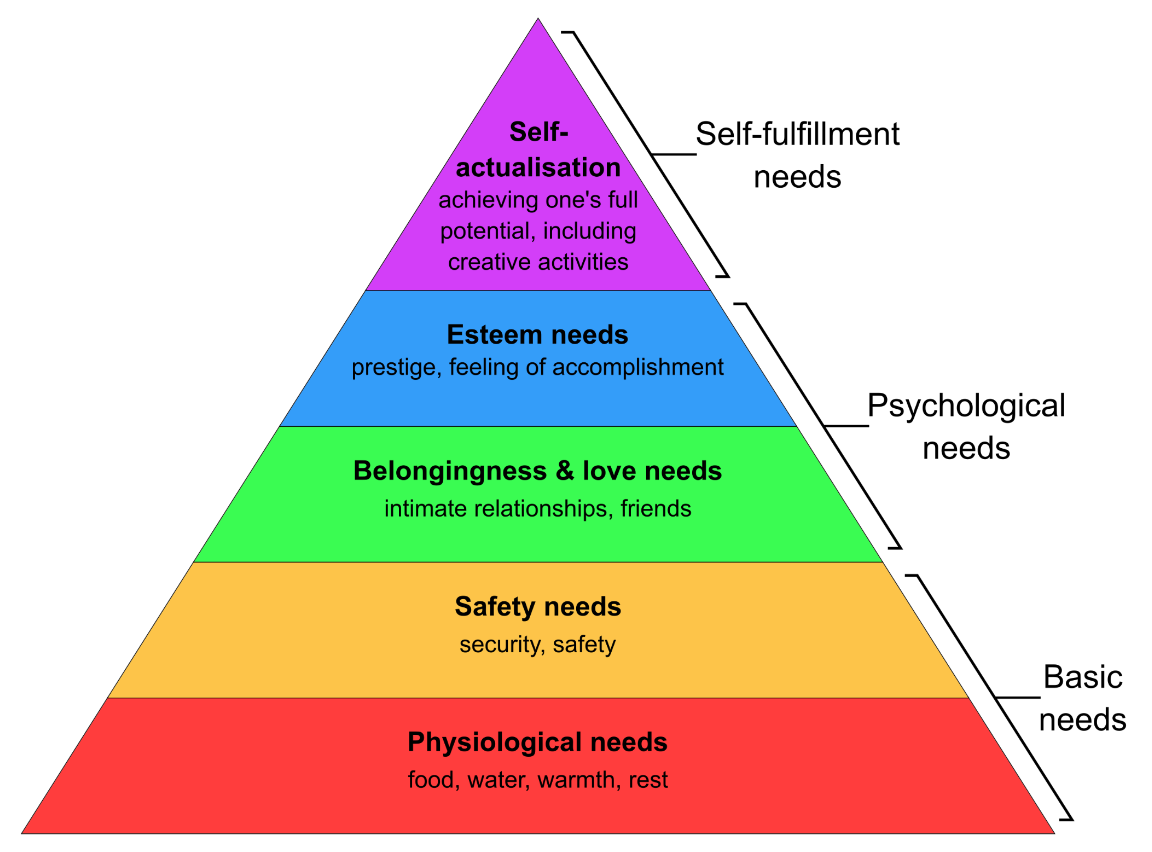
  • Acknowledge that certain needs have to be met in order for learning to occur, you cannot control everything, but you can control some things
  • Identify students who may need additional emotional support structures
  • Hone your empathy skills and provide ways for your students to develop empathy for others as well
  • Build a warm classroom environment where students feel welcome 
  • Cultivate opportunities for students to develop a sense of belonging in your classroom and with their peers with the hope that they can carry this feeling with them when they leave your classroom

I’m not saying that any of these steps are a silver bullet. But I can assure you that I’ve used each and every one of them in my classroom and it made a difference for my students. How do I know? They told me. Some of them mentioned it in passing, others wrote me letters, some emailed me a thank you, a few gave small tokens of their appreciation, while others came by for a quick hug before leaving for high school. All of these meant so much to me because I felt that all of my efforts were working. Maybe it didn’t work for every single student. But it worked for some. And that’s all that mattered.

In the words of Rita Pierson, I wanted to Be a Champion for my students. And I made that an intentional decision each and every day.

If you want to learn more, please check out a webinar that I recently hosted. The Importance of Belonging can be found on EdTechTeacher’s YouTube Channel. Please feel free to leave comments or reach out with your own stories and solutions. As I previously mentioned, I’ve always felt the need to belong to something larger than myself…and being part of the educational community is something that will always be near and dear to my heart.

Thanks for reading!