NOTE: This blog post was created with the assistance of Gemini.
I’d like to take a moment to address the persistent challenge of technology integration that “sticks”. All too often, promising edtech initiatives fail to achieve long-term impact — leaving schools with underutilized resources, frustrated faculty, and wasted instructional time (to the detriment of student learning).
Justin Reich, in his book “Iterate: The Secret to Innovation in Schools,” proposes a paradigm shift away from large-scale, one-time implementations towards a model of continuous, incremental improvement. This iterative approach emphasizes the value of small, manageable experiments, which allows for real-time adaptation and refinement based on observed outcomes. This methodology acknowledges that technological change is a dynamic process, requiring flexibility and responsiveness to evolving needs.
An easy way to visualize what this model of continuous, incremental improvement might look like is to use the Deming Cycle: Plan-Do-Study-Act (https://deming.org/explore/pdsa/).
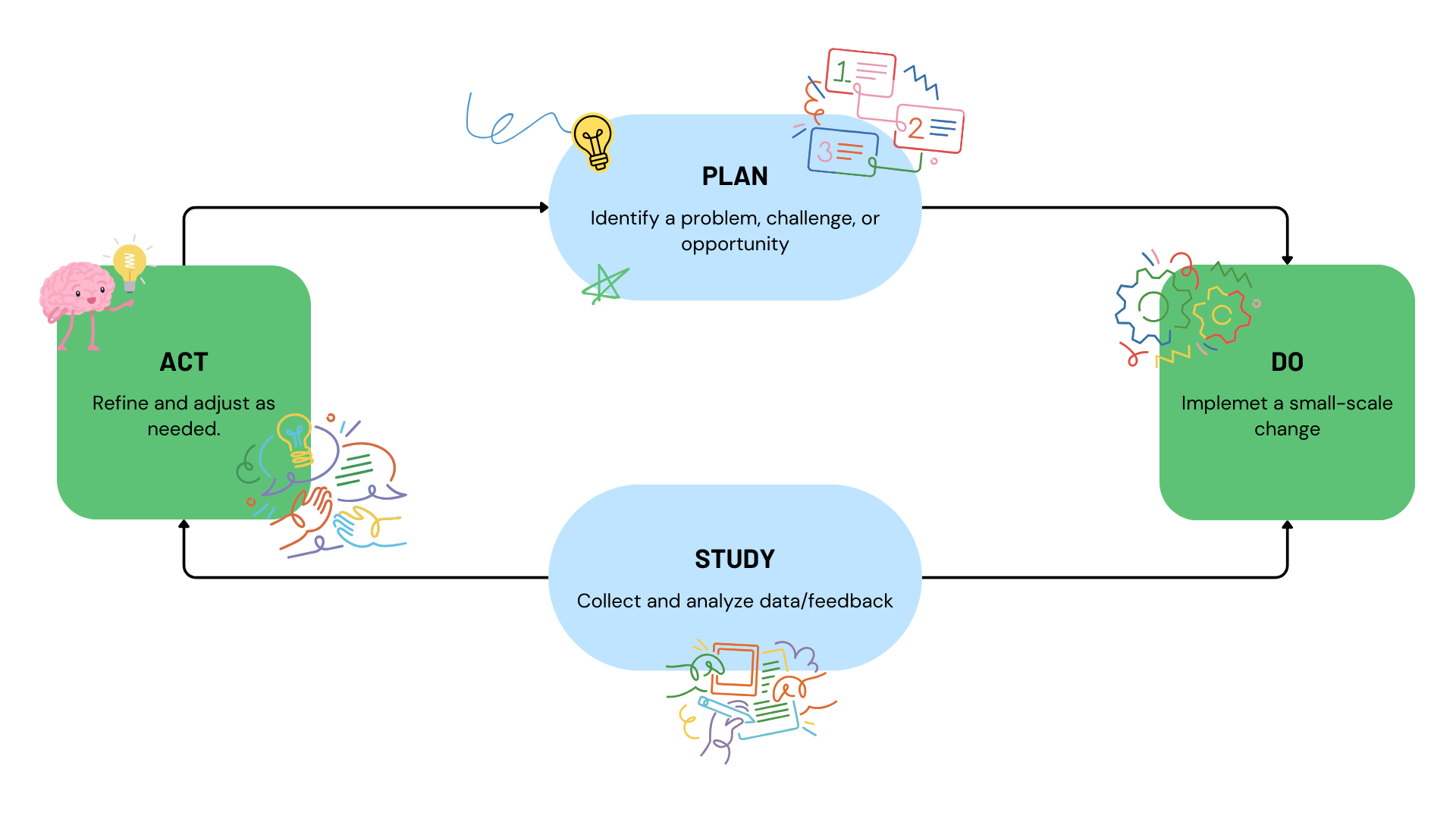
The key here is to focus on small-scale change*. For example, instead of pushing for school-wide adoption of an edtech product or tool, encourage a small group of teachers to pilot that tool in their classrooms, AND give them enough time to use that tool with their students. Gather feedback from both the teachers and students about the challenges, benefits, next steps, etc., of using that tool for teaching and for learning (yes, I am purposely differentiating the two). And then have the teachers reconvene to discuss the data/feedback and refine as needed. Then start the cycle again.
*To be clear, the small-scale change needs to address a problem or challenge that teachers and students are facing. So, you need to begin by having teachers come together to share challenges they are facing and then narrow it down to one they would like to address first. However, identifying a problem isn’t as easy as it sounds. I will explain in a follow-up post.


 Living the Learning Curve