Empathy: A Necessary Skill (Part 1)

I recently wrote an article for the Social Studies Review about two types of assignments I have my students complete that help them understand and hopefully develop empathy for various historical figures. One of the assignments focused on the use of emojis to encourage students to connect emotions to certain key events in the life of a historical figure.

Because I am always looking for ways to improve my instructional practices, I combined the Developing Historical Empathy emoji assignment (from the article) with an Open Mind template. My goal was to narrow the focus to emotions at pivotal times in the story of Muhammad and the origin of Islam.

To begin, I had students brainstorm emotions (in general).
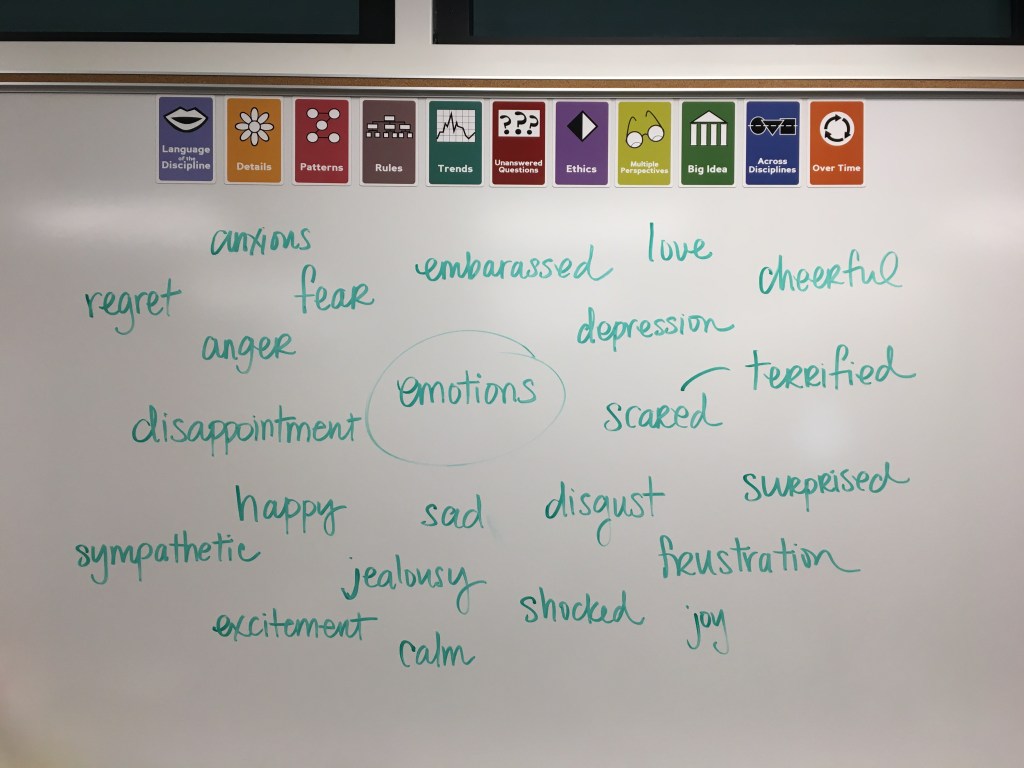
Interestingly (and completely off-topic), I sensed a theme of emotions as relayed by my students from all six periods of world history. I was thankful that some students shared positive emotions to help lighten the mood.

From there, I explained that they were now going to step into the shoes of Muhammad and imagine the various emotions he went through from his tough childhood, revelations from the angel Gabriel, being run-out of town, and eventually returning to his hometown, Makkah.

The assignment was to come up with a minimum of four emotions (thoughts and feelings), draw/label the emotion, cite textual evidence, and explain how the textual evidence supports their thinking or understanding.

As Muhammad left no written records, what the students come up with is purely conjecture. But that’s okay…because the goal is for students to learn how to empathize with the plight of others.

“Empathy is seeing with the eyes of another, listening with the ears of another and feeling with the heart of another”

Alfred Adler
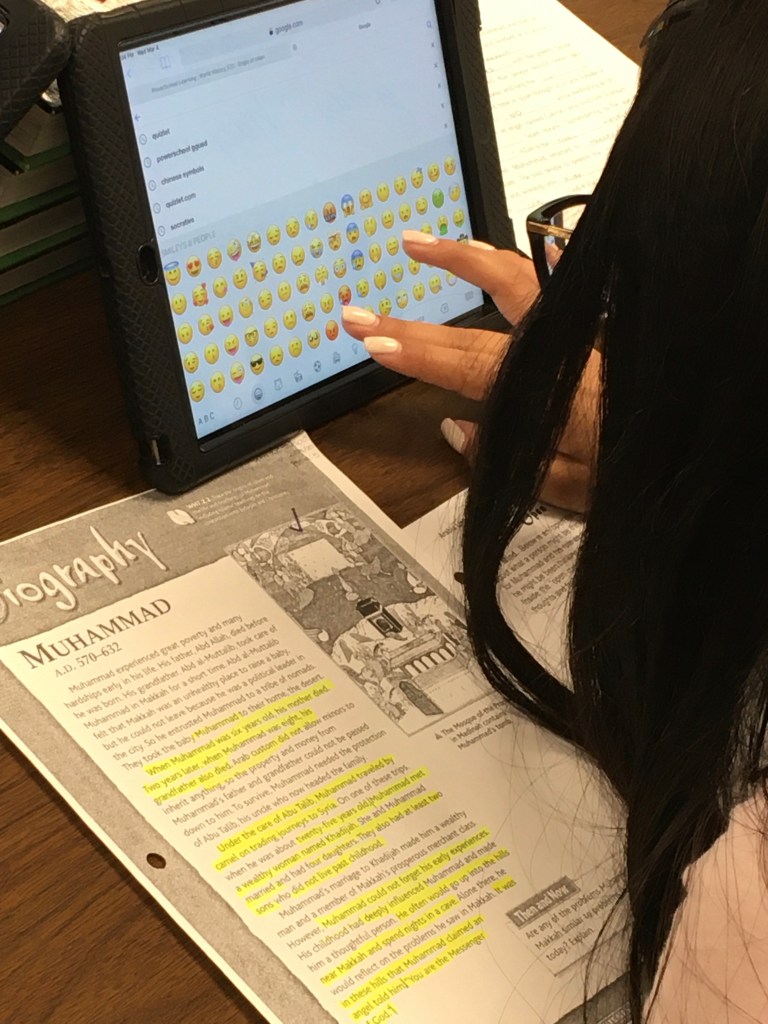
Because I believe in student choice, I like to give them several options for assignments. In this case, I suggested that students use the emojis from the iPad keyboard as a starting place as they reread the various sources on Muhammad’s life. Students could draw those emoji, name the emotion, cite textual evidence, and explain the connection.
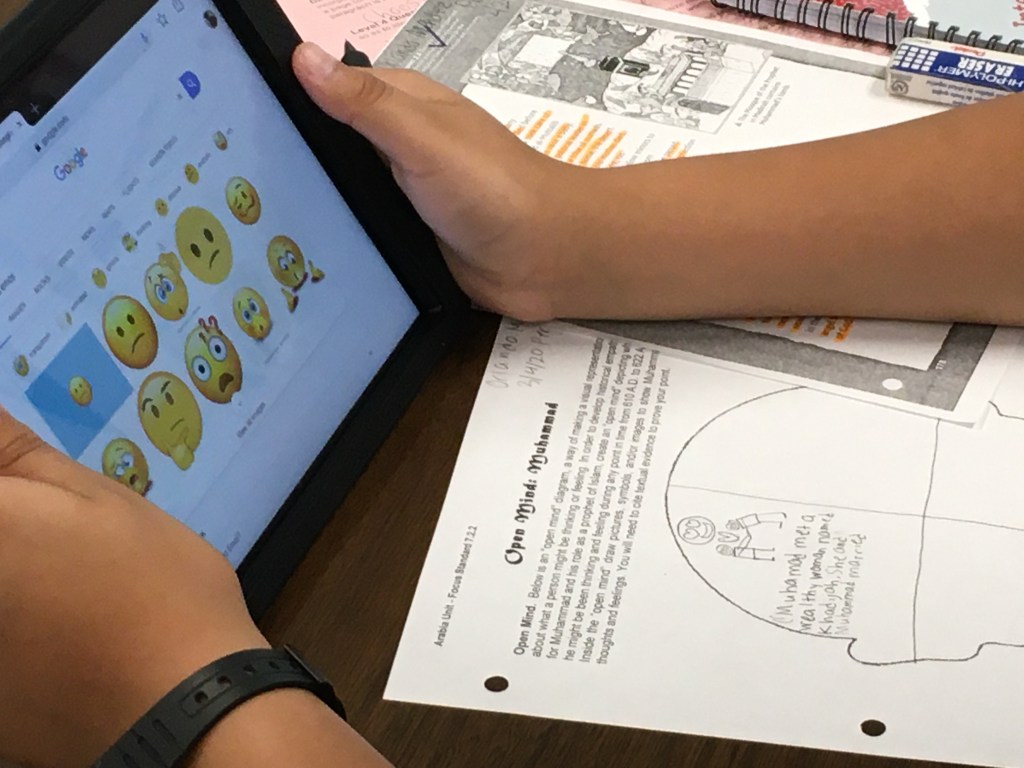
The other option was to use simple drawings that used body-language to convey emotions. Students still need to name the emotion, cite textual evidence, and explain the connection.
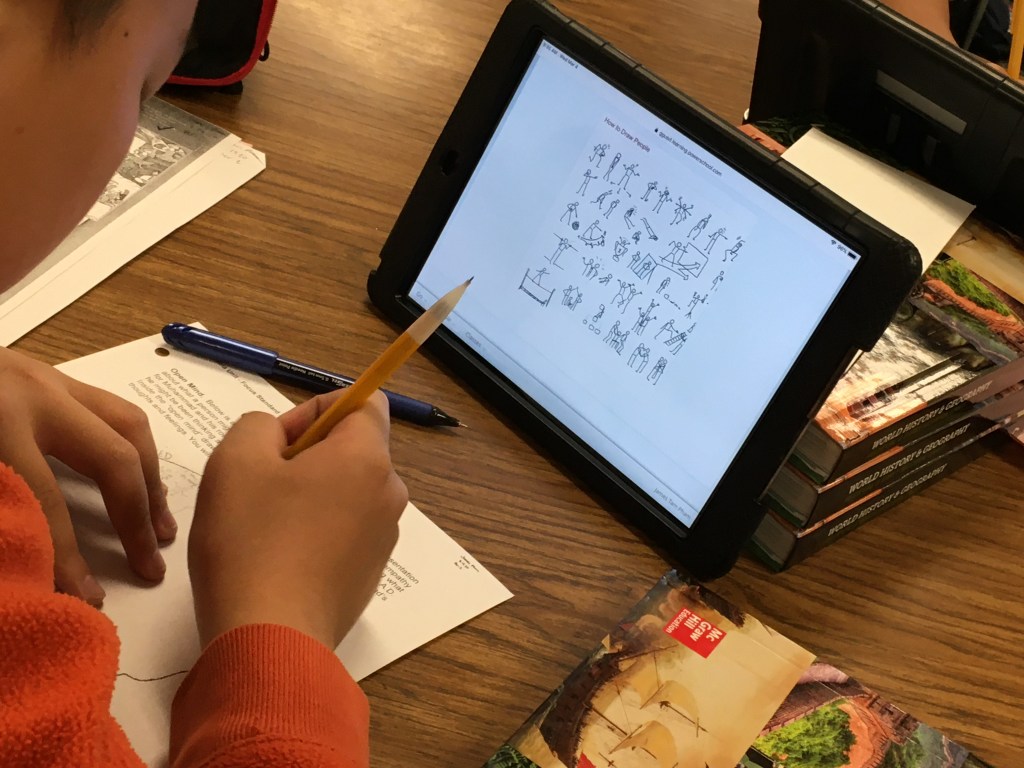
For the artists in the room (and I have some phenomenal artists!), I stressed that they do not have to feel constrained with choosing from the emoji keyboard or simple drawings of body language.

What I noticed today (Day 1) was that students who could identify with certain emotions had an easier time connecting the emotion to the textual evidence. Now, this is completely anecdotal, and I should have more concrete evidence on Monday when the Open Mind is due, but I’m thinking that students who have lost a parent or loved one will be able to better empathize with Muhammad’s upbringing as an orphan. I also suspect that students who have experienced bullying may be able to personally identify with Muhammad when he and his followers were run out of Makkah.

“Learning to stand in somebody else’s shoes, to see through their eyes, that’s how peace begins. And it’s up to you to make that  happen.  Empathy is a quality of character that can  change the world.”

Barack Obama
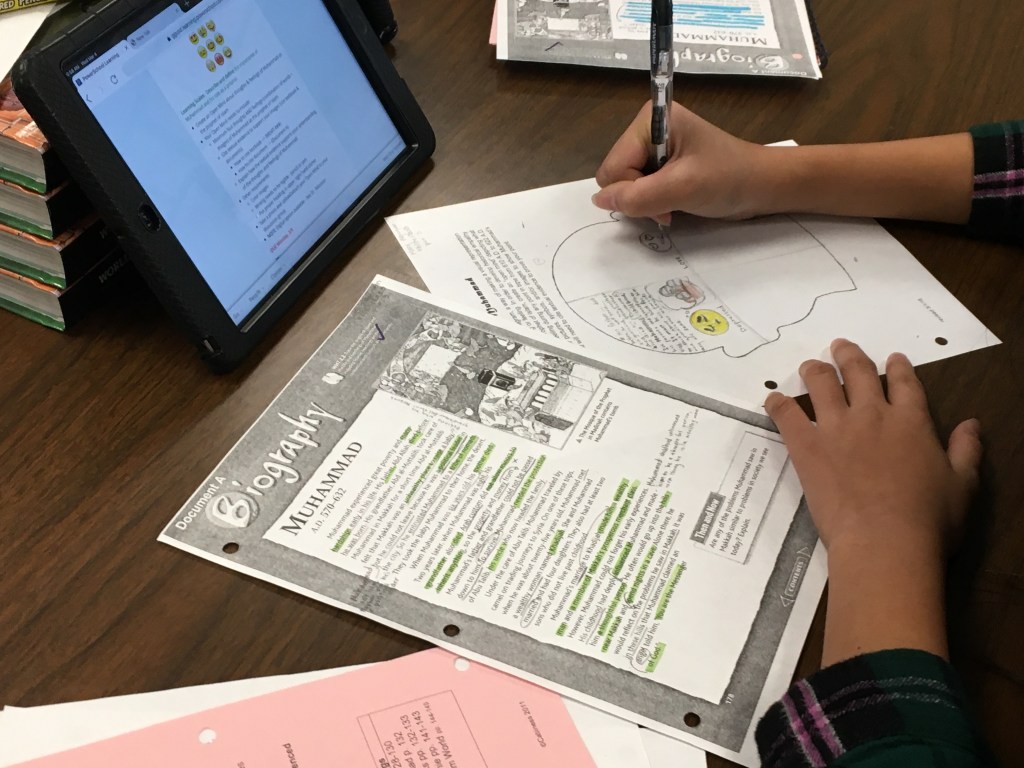
However, even if students have not experienced personal loss or threatening behavior, they can certainly empathize with the various hardships in the life of Muhammad. My students have quickly learned that talking with their peers is a good support system, and I suspect that they will be able to help each other gain a better understanding of Muhammad’s life by walking in his shoes.

The newest layer to this assignment is for students to add a personal connection by reflecting on their life in comparison to Muhammad’s and how what they learned may impact them in the future. This written reflection will hopefully provide insight on whether this type of assignment has the potential to help students develop empathy (or not) and whether empathy is a skill that can be transferred to other situations.

Stay tuned.
Brain Dumping Data Analysis

If you have been following my posts for the past year, you are aware that I have been keenly interested in retrieval practice. I regularly incorporated retrieval practice (in the form of brain dumps) with my GATE/PreAP students last semester. Their reflections revealed the value of brain dumping on their long-term retention of information. Thus, I decided that I would fully roll out brain dumping to all of my world history classes this semester.

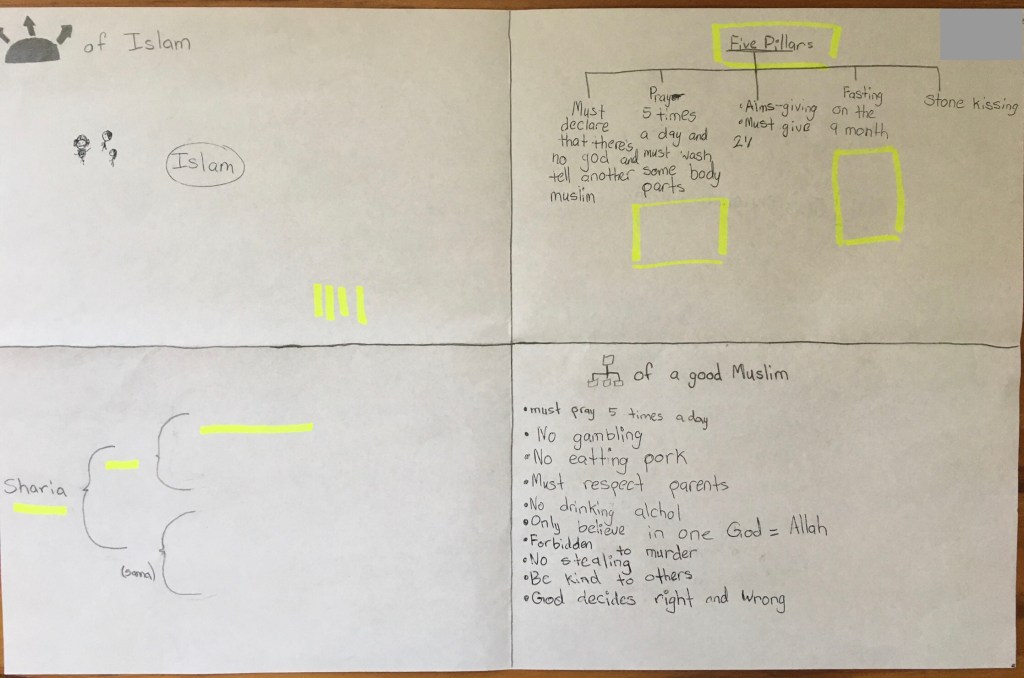
We are about five weeks into the quarter and my students have done four different brain dumps. The first three were small in nature as they focused on one main concept. The brain dump my students recently finished covered four main concepts: origin of Islam, Five Pillars of Islam, rules that guide a Muslim’s life, and a brace map of Sharia.

To recap, my students use pencil in their initial brain dump and pen for when they engage in collaborative learning with peers. NOTE: Some of my students used black pen which makes it hard to see the difference initial versus collaborative recall.

For this brain dump, I cued my students while they were discussing their learning with peers. I saw the faces of students light up as they remembered the information after my verbal cues (e.g., dates, key terms). Thus, I felt that by giving students hints without outright stating the answer was helping them to make stronger connections.

The last step was for students to pull out their notes and continue to add to the gaps in their brain dumps in pen. Luckily, the following student used red pen so it’s easier to see what they did and did not remember.

I told my students that what they wrote in pen were the things they needed to study as they were clearly not remembering those facts. Because I teach middle schoolers, I know that they don’t always have the best study skills or time management. Therefore, I stressed that they should ignore the pencil items and focus their attention on the pen.

After the quiz, I went through each student’s brain dump and looked at their performance. In the majority of the cases (approximately 90%) there was a direct correlation between what the student remembered on their own (pencil) and the questions they got right. A similar correlation was found between what students wrote in pen and the questions that they missed. I am assuming that the information written in pen or out-right missing (see first image) posed an issue for students because they:

  • Did not spend enough time studying that information
  • Did not have enough time to relearn the information
  • Did not understand the information or how it was related to the concepts
  • Were not in class when the information was presented and applied
  • . . . ?

The next step is to pass the brain dumps back to students and give them access to the quiz questions. I want them to reflect on their brain dump and the effort they put forth on the quiz. Hopefully, they will see the correlation on their own as they prepare for the unit test.

Only time will tell.

Brain Dump #1

My world history class (500-1500 C.E.) is a semester-long course. Don’t get me started on how, why, or the injustice around that as that’s a story for another time. One of the benefits of teaching a semester course is the ability to course-correct half-way through the school year. I don’t have to wait until August to start anew. I can do that in January (at the half-way point in the school year).

Having implemented brain dumping with my GATE/PreAP students, and reading their reflections on the benefits of that on their ability to retain information, I decided to institute regular brain dumps across all of my six world history courses this semester. I don’t have the GATE/PreAP class this semester, so all of my world history classes contain a heterogeneous mix of high-achievers, English language learners, and special education students. I see this as a positive because these students were randomly assigned to my classes so I should be able to get a good idea of the impact of brain dumping on the ability of my student to retain information over the long-haul.

Friday marked the introduction of brain dumping to my students. This was a timed exercise in which students were given three minutes to dump the contents of their brains onto a blank piece of white paper using only pencil.

The second part was another three-minute timed exercise in which students shared their brain dumps with their group. Anything they did not have on their mindmap, they could add in pen. The point being, what was written in pencil are things they remember and the items written in pen are those they need to spend a bit more time on since they did not remember it without prompting.

I collected their first brain dumps because when we do another one on this same topic, I will pass out their first attempt so that they can (hopefully) see growth over time.

What I loved hearing from the conversations of students is the fact that many remembered the details of the various themes of geography after being reminded by their group. This realization served to lend value to this process as believe students gained confidence in the knowledge that they had the information in their brain, they just had to activate it.

One may ask why use valuable class time for this exercise if you only have 20 weeks to teach 1000 years of history. And I would ask: How can we afford not to? Isn’t the whole point of education to help students learn the content so they can apply it to their lives?

This is a valuable strategy to employ with your students. If you consistently apply it, I believe you will soon find yourself in agreement with me: Brain dumps are worth it.