AI Positioned Along SAMR Spectrum
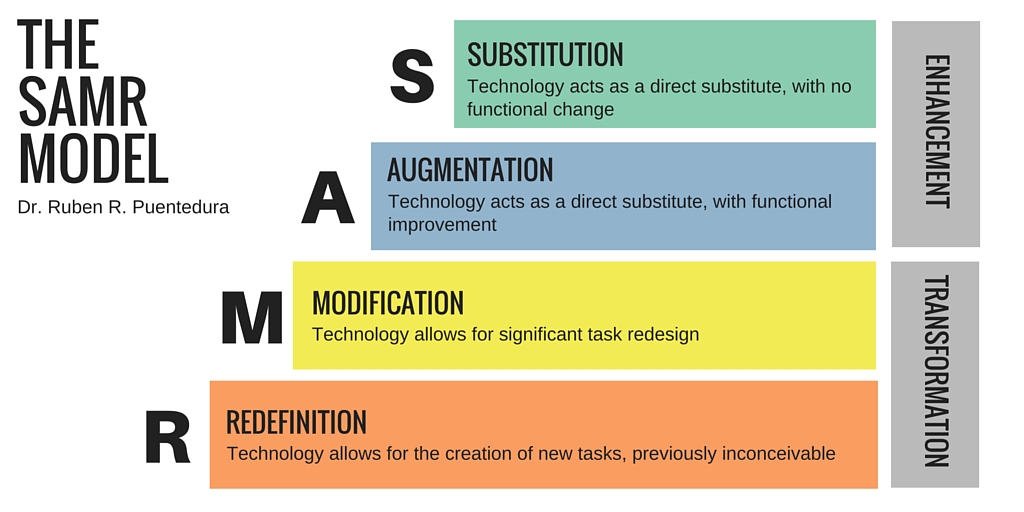
The SAMR model (Puentedura, 2015) is a valuable framework for teachers considering technology integration. It helps us think about how and why we use technology, moving from simple substitution to transformative redefinition. Many educators are asking, “Where does AI fit in?” The answer is: Across the entire spectrum.
AI is a technology tool, and like any tool, its application can range from basic replacement to innovative redesign.
Let’s illustrate this with a practical ELA lesson:
Learning Objective: Students will be able to clearly articulate the reasons why cell phones should be allowed or banned in schools. Students will create a PSA.
- Substitution: Students use AI-powered voice typing in Google Docs to draft a persuasive essay on cell phone use in schools. This replaces traditional typing but doesn’t fundamentally change the task. AI’s Role: Speech-to-text functionality.
- Augmentation: Students use an AI grammar and style checker (like Grammarly or a similar feature within a word processor) to refine their essays. The AI can suggest stronger word choices, identify areas needing more detail, and check for clarity and conciseness. This enhances the writing process by providing automated feedback, making it more efficient and effective. AI’s Role: Automated feedback and analysis.
- Modification: Students engage in a structured debate with an AI chatbot about the pros and cons of cell phones in schools. The AI can present arguments for both sides, challenge student thinking, and provide relevant data or research. Students then use insights from this debate to revise and strengthen their essays. This significantly alters the learning task by providing an interactive and dynamic learning experience. AI’s Role: Facilitating interactive learning and providing information.
- Redefinition: Students use AI to brainstorm innovative ways to advocate for their chosen stance on cell phone use. The AI can suggest different media formats for their PSA (e.g., interactive infographics, short videos, social media campaigns), help generate creative content ideas, and even assist with basic video editing or graphic design. Students then collaborate with peers who share the same opinion to create a PSA that leverages these AI-powered insights and share it publicly on their school’s social media accounts. This transforms the task by enabling students to create something entirely new and impactful, potentially reaching a wider audience and using tools that would have been previously unavailable. AI’s Role: Creative content generation, media format suggestions, and basic production assistance.
Addressing Concerns about Skipping Levels
It’s true that some students might try to jump straight to redefinition. However, each level of SAMR offers unique learning benefits. To encourage a more comprehensive approach, teachers can:
- Structure the lesson progressively: Require students to complete activities at each level before moving on.
- Use formative assessments: Check for understanding and skill development at each stage.
- Encourage reflection: Have students document their learning process at each level, explaining how the different AI tools helped them.
- Emphasize the value of each stage: Explain how each level builds upon the previous one, ultimately leading to a richer and more meaningful final product.
AI is a Powerful Tool, not a Replacement for Teaching
AI is not the antithesis of learning. It’s a powerful tool that can enhance and transform the learning experience. Teachers play a crucial role in guiding students’ use of AI, ensuring that it’s used effectively and ethically. By understanding how AI can be integrated across the SAMR spectrum, educators can empower students to become not just consumers of technology, but creators and innovators.
NOTE: I used Gemini to provide some lesson ideas that incorporated AI use according to the SAMR model AND I also uploaded my original draft to Gemini to help me make this post concise and more to the point. With just a little bit of tweaking, this post reflects my original intent: To show how the SAMR model can help teachers determine to what extent technology can be used to transform the learning process.
References
Puentedura, R. R. (2015). SAMR: A Brief Introduction [Weblog]. http://hippasus.com/blog/archives/227 / http://hippasus.com/rrpweblog/archives/2015/10/SAMR_ABriefIntro.pdf



 Living the Learning Curve