Both gratifying and frustrating is my penchant for perfection. It began with pressure from my Japanese mom to make sure that I always gave my best in all of my endeavors. And while I can honestly say that I give my best most of the time, I have to admit that sometimes I’m so tired that I give just enough.
Don’t tell my mom.
Being the oldest sibling, I also felt (still feel?) the need to set a good example for my brother. And so I made sure to do my best for him, too. But I think…no, I know, that the pressure to excel contributed to my need for control…over basically everything.
I don’t kid myself that I can control what goes on around me. But I can certainly control my thoughts and actions. This reality comes in quite handy as a classroom teacher and doctoral student. In fact, I think one of the reasons why my dissertation adviser (@skprosser) and I hit it off so well is our innate need to control things. We are two controlling peas in the same pod.
But what does that mean for me as a teacher?
As the new school year quickly approaches (trust me when I say that I’m relishing the last few days of summer), I am reminding myself that though I need to set the standard for my students…I also need to show them the humanity behind my craziness. Though I constantly feel the need to be perfect, to give my best in all of my endeavors, I also need to be okay with giving just enough when the situation warrants. And I need to help my middle schoolers (those little perfectionists in the making) to see the same thing. Perhaps more importantly, I need to help my middle schoolers to see the humor in imperfection, no matter how much pressure parents put on us…I mean them.
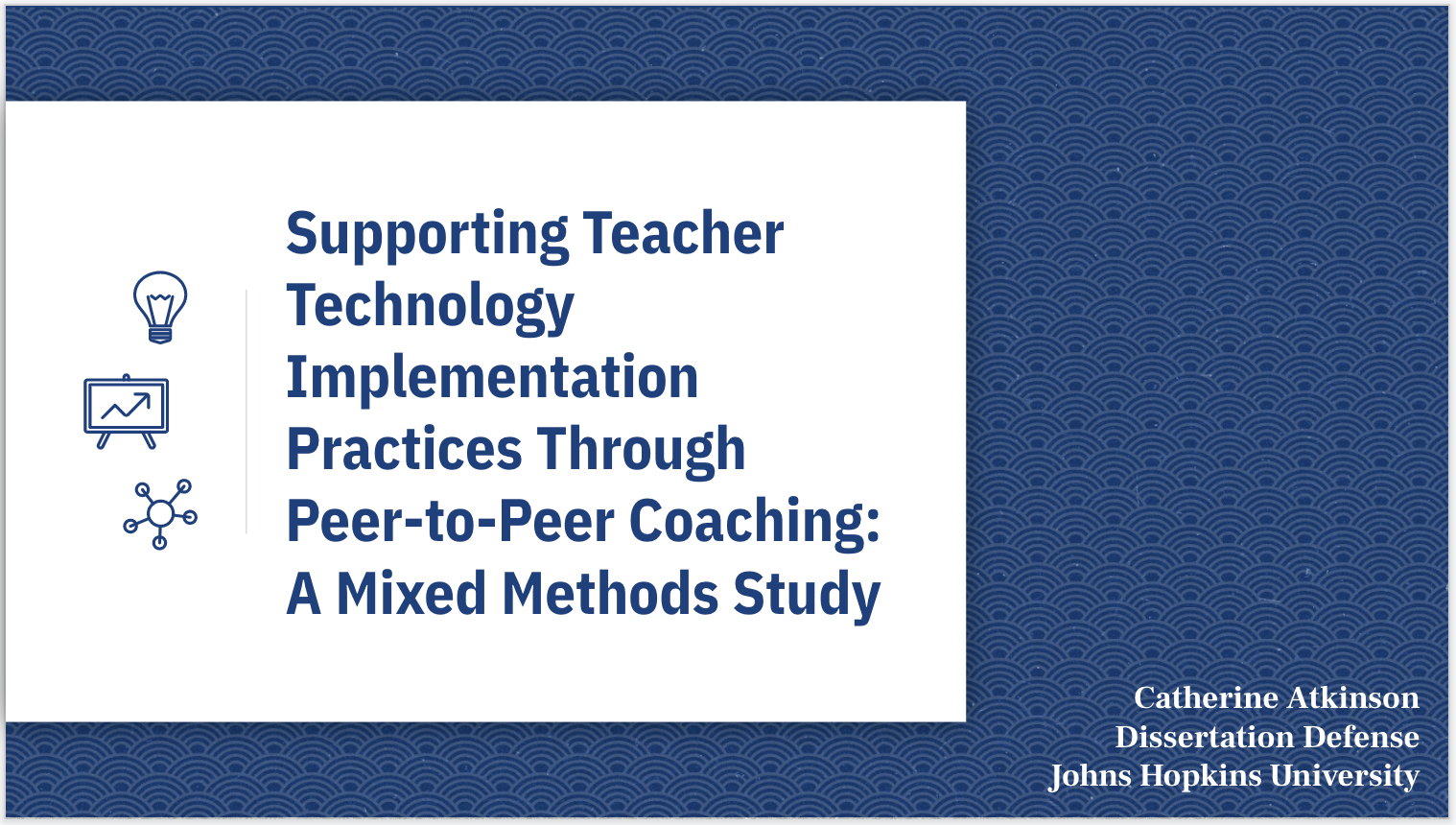
It has been approximately nine days since I defended my dissertation on my study titled “Supporting Teacher Technology Implementation Practices Through Peer-to-Peer Coaching: A Mixed Methods Study.” It was the culmination of three years of work, and it was worth every single minute.
The purpose of my study was to investigate if peer coaching would influence teacher technology practices. The focus stemmed from what I saw and heard regarding how teachers and students used technology in the classroom.
Working at a Title I school, we were able to purchase quite a bit of technology over the years. With the introduction of the SBAC, our mode of testing switched from scantrons to technology devices. Because we now had even more technology in the hands of teachers and students, I felt the need to share with teachers ways to integrate technology so that students would learn with it, instead of from it. In other words, my vision was for technology to serve as a tool for learning, and not the end itself.
But the questions remained: How to go about supporting teachers so that they see why change was necessary? And how to go about making that change?
All too often (and usually after a one-shot workshop), teachers are expected to implement the change and then student achievement scores would naturally increase. Easy, right?
When this video came across my Twitter feed, my first thought was “This is really cute” . . . and then I realized that this is the reality of poorly-designed PD when teachers aren’t given the proper support structures.
If school leaders want teachers to change their instructional practices, then they have to provide professional learning opportunities that include the following:
Active Learning
Content-based Focus
Sustained Duration
Coherence
Collective Participation
These five components are from the work of Desimone and Garet (2015) and served as the framework for my dissertation study. Other researchers (Darling-Hammond, Hyler, & Gardner, 2017; Jensen, Sonnemann, Roberts-Hull, & Hunter, 2016) have offered their own list of must-haves for PD, and they more or less include the same components.
What is missing from most PD is follow-up support–sustained duration. It seems obvious that in order for change to occur, learners need a strong support structure. When you equate it to effective classroom practices with students, as teachers, we know that one lesson on a particular topic or skill is not enough to effect change. We have to provide multiple opportunities for students to practice and refine their learning. Talking at students does not equate to learning.
So why do we expect that from teachers who attend PD?
And why is this such a hard concept for school leaders, program facilitators, and PD providers to understand?
My dissertation study showed promise in using peer coaches to help teachers change their instructional practices to include meaningful learning with technology. The 8-month study included multiple opportunities for teachers to ask for and receive support from peers. Both novice and expert users of technology seemed to benefit for this symbiotic relationship. As the teachers came from multiple disciplines (i.e., English language arts, history, mathematics, science), they were also exposed to various ways that technology could be used to support student learning. The next step is to see if this informal support network can be sustained for the upcoming school year. #fingerscrossed
What I’ve learned from the research and my dissertation study is aptly summed up by a quote from George Couros:
If we want people to take risks, they have to know we are there to catch them and support them.
(Couros, 2015, p. 7)
We cannot expect change to take hold if we don’t, first, provide support for the change-makers.
References
Couros, G. (2015). The innovator’s mindset. San Diego, CA: Dave Burgess Consulting.
Darling-Hammond, L., Hyler, M. E., & Gardner, M. (with Espinoza, D.). (2017). Effective teacher professional development. Palo Alto, CA: Learning Policy Institute. Retrieved from http://learningpolicyinstitute.org/product/teacher-prof-dev
Desimone, L. M., & Garet, M. S. (2015). Best practices in teacher’s professional development in the United States. Psychology, Society, & Education, 7, 252–263. doi:10.25115/psye.v7i3.515
Jensen, B., Sonnemann, J., Roberts-Hull, K., & Hunter, A. (2016). Beyond PD: Teacher professional learning in high-performing systems. Washington, DC: National Center on Education and the Economy. Retrieved from http://www.ncee.org/wp-content/uploads/2015/08/BeyondPDWeb.pdf
Ever since I saw this tweet, I’ve been mulling over what I think about changing the name of teacher to learning engineer.
In short? I think it’s lame.
In education, so many buzzwords come and go, with little to show for it. And I think “updating the job title” is a waste of time.
What I know for a fact (because I am a classroom teacher, and I’ve been doing this job for 24 years) is that teachers wear a lot of hats. A lot. We have always been more than what the title teacher suggests. We not only impart knowledge; we guide our students to their own discoveries. We encourage students when they struggle; we hug them when they are sad. We are the morning greeters, and the ones who wave to them as they leave campus at the end of the day. We have snacks for those who are hungry, and money for those who need the occasional bus fare. We provide food, gift cards, and items for families in need, and we provide a sympathetic ear when parents are up to their wits end with their child. We are designers, planners, assessors, and participants. We come early in the morning, stay late after school, and, more often than not, we are fielding emails from students in the evenings and on the weekends. We decorate our classrooms to give students a warm and welcome place to learn; we spend time putting together our thoughts for student awards. We prepare our classrooms for Back to School Night; we put on a happy face during Open House (even though we’ve been up since 5AM in the morning). We attend workshops and conferences to help us grow as practitioners, with many of us taking the next step by earning an advanced degree. A degree, mind you, that is paid for by our own hard-earned money and earned while also working full-time in the classroom and balancing a busy family life.
I don’t need nor want accolades for what I do. I didn’t write that long list so that people would feel sorry for me or think that I’m some kind of hero.
I’m not a hero.
I do all of that because I am a teacher.
Not sure how the title learning engineer even comes close.

 Living the Learning Curve