Inquiry-based Reflection

It’s been a few years since I’ve been to ISTE, but I love the fact that I can follow the sessions through snapshots posted by those in attendance. If you are interested in following along do a search in Twitter using #iste18 or #notatiste18.

I’ve been following Eric (@E_Sheniger) for I don’t know how many years, and I have to say that what he posts is #spoton. Take the image above as an example. Without a doubt, these are great questions to use as educators reflect on their teaching and role in whatever capacity they serve within their organizations. But what resonated with me is the fact that these questions can also be applied when considering culturally relevant teaching.

In particular, I like the first three questions. Let me tweak them a bit:

  • What evidence do we have to demonstrate the impact of technology and innovation within our multicultural school environment?
  • How are we making learning culturally relevant for our diverse student body population?
  • How do we implement and support rigorous and culturally relevant learning tasks that help our students become future ready?

Going back to my previous post regarding the total school environment, the “curriculum should recognize and reflect students’ multiple identifications” (Banks, 2016, p. 30). Because my doctoral research focuses on technology integration, I think we need to consider how technology and innovation can be used to support a multicultural learning environment. An interesting article I recently read highlighted the fact that immigrant students are using technology to develop their own identities as well as cultivate a strong connection with families from their home countries. Lam (2012) challenges educators to develop an understanding of “role of digital media in immigrant students’ learning experiences outside of school…[in order to] develop digitally connected forms of pedagogy that are also culturally responsive” (p. 63).

We cannot deny the role of technology in the lives of students today. So why not harness that power for educational use? The literature reveals a significant gap between how students use technology outside of school versus inside of school (Bryant, Coombs, & Pazio, 2014; Ertmer, Ottenbreit-Leftwish, Sadik, Sendurur, & Sendurur, 2012; Hall, 2010). Perhaps the development of culturally responsive teaching practices can help bridge that gap for our culturally diverse and immigrant students?

Let’s put that discussion on the table, shall we?

References

Bryant, P., Coombs, A., & Pazio, M. (2014). Are we having fun yet? Institutional resistance and the introduction of play and experimentation into learning innovation through social media. Journal of Interactive Media in Education, 2014, 1–8. do:10.5334/jime.ad

Ertmer, P. A., Ottenbreit-Leftwich, A. T., Sadik, O., Sendurur, E., & Sendurur, P. (2012). Teacher beliefs and technology integration practices: A critical relationship. Computers & Education, 59, 423–435. doi:10.1016/j.compedu.2012.02.001

Hall, G. E. (2010). Technology’s Achilles heel: Achieving high-quality implementation. Journal of Research on Technology in Education, 42, 231–253. doi:10.1080/15391523.2010.10782550

Lam, W. S. E. (2013). What immigrant students can teach us about new media literacy. Phi Delta Kappan, 94, 62–65. doi:10.1177/003172171209400416
Total School Environment

If you are familiar with research behind educational reform movements, then you are aware that in order for change to occur and be sustainable, it must be systemic (Tyack & Cuban, 1995). Change that happens in a vacuum will not last (Fullan, 2007). Grassroots change can only go so far. Top-down change, well…I’m sure we’re all well aware about how that goes. My point is, in order to change to occur, and I’m talking about real educational reform, then all stakeholders must be part of the process from the very beginning. True reform is not about implementing policy, but rather it “means changing the cultures of classrooms, schools, districts, [and] universities” (Fullan, 2007, p. 7). When considering educational reform issues such as technology integration (my dissertation focus) or multicultural education (focus for my summer blog series), well then it’s even more important to look at the entire system. My limited knowledge of systemic change on a broad level prevents me from being able to offer much in that area. However, because I have been a classroom teacher for 23 years and have held various leadership positions both at the school and district level, I believe I can offer some suggestions on how to go about starting the process at the school site (more to come on that in subsequent blogs).

Multicultural education (as mentioned in a previous blog) has a variety of meanings which may differ depending on the organization. However, what one cannot deny is the fact that the definition of multicultural education is quite broad (Banks, 2016). As such, when considering what multicultural education looks like (or should look like) at a school, then one must begin by examining to what extent does the total school environment reflect monoethnic or monocultural practices of the dominant group (Banks, 2016; Nieto, 2008)?

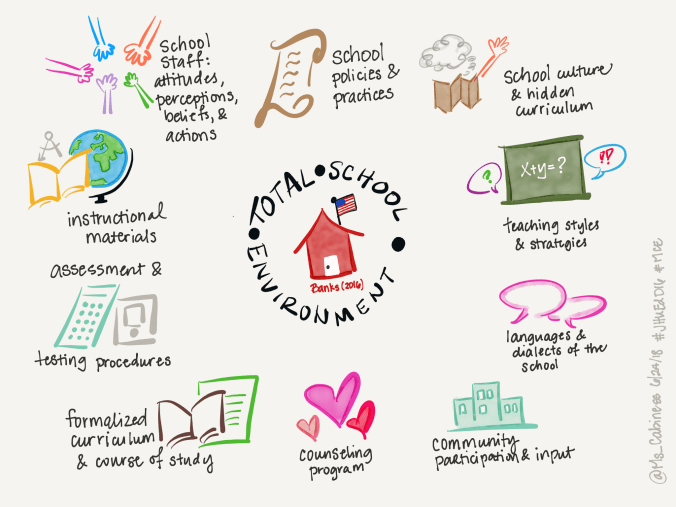
The following image displays the elements that influence the total school environment (Banks, 2016):

Paper.JHU Sketchnotes.5.png

Thus, when considering where to begin when integrating or implementing multicultural education, the answer is…everywhere. The process involves change across the total school environment. So, take a look at the sketchnotes to determine, where can you help influence the process? What other stakeholders do you need to include? How can you get them on the same page? Without a shared meaning or understanding of multicultural education across all stakeholders, believe me, your efforts will feel more like herding cats. And that’s a whole different profession.

References

Banks, J. A. (2016). Cultural diversity and education: Foundations, curriculum, and teaching (6th ed.). New York, NY: Routledge.

Fullan, M. (2007). The new meaning of educational change (4th ed.). New York, NY: Teachers College Press.

Nieto, S. (2008). Affirmation, solidarity and critique: Moving beyond tolerance in education. In E. Lee, D. Menkart, & M. Okazawa-Rey (Eds.). Beyond heroes and holidays (pp. 18–29). Washington DC: Teaching for Change.

Tyack, D., & Cuban, L. (1995). Tinkering toward utopia: A century of public school reform. Cambridge, MA: Harvard University Press.

Full Circle

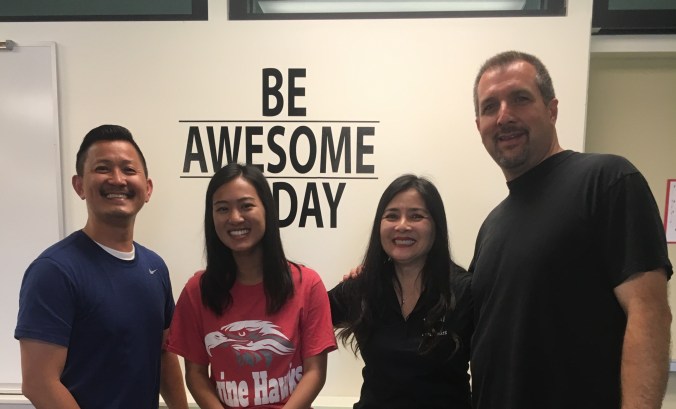
#bestThe end of the school year is always hectic and this year proved no different. Negotiations between our association (union) and district resulted in a school calendar in which the last day of school for the students was also the last day for teachers. I say this because in the photo, I’m sure our smiles cannot hide how tired we were and I’m also using that as a reason for the delayed post since the last day of school for us was June 15.

I write this blog with both excitement for the future yet also a bit of sadness. You see, in the photo, is our history department (Vo, Lauren, me, and Sanchez). The photo tells the story of a long journey that begin in the spring of 1998 or maybe it was 1999 when a student teacher from California State University, Long Beach (CSULB) approached my principal to ask if he could do some observations as part of his credential program. It was a serendipitous meeting that ended up with him connecting with me after I moved to a different middle school (within the same district) to be my student teacher. That student teacher is one on the left in the picture (Vo) and his two master teachers are on the right (Sanchez and me). At the conclusion of his student teaching semester, one of the history teachers at our school chose to retire which created an opening for a new teacher.

As the master teachers, Sanchez and I sat on the interview panel of history teacher after history teacher who applied for the full-time world and U.S. history position. If you are familiar with the history teaching profession, then you know that it’s hard to find a full-time history position. After the last candidate left the room, we had a pointed discussion with our administrator who wanted to hired a seasoned teacher. We fought to hire our student teacher. As you can see, we won because remember, he’s the one on the left. =)

Fast forward to fall 2016. Because all of us are graduates of the credential program from CSULB (#gobeach), we tend to get our share of student teaching candidates who request to observe our classrooms. Lauren (@Ms_ltnle) and her friend (another student in the credential program) spent several days observing all three of our classrooms. I didn’t recognize her at first, but Lauren eventually revealed that she was a former student of mine 11 years ago. Come to find out, I also had her little sister and brother. Yikes, I’m old. But I digress.

Come fall of 2017, Lauren contacts Vo because she wants to student teach at our school. As a former student, this puts her in a good place because our district is all about the home-grown aspect of former students coming back to give back. As in the past, Sanchez and I took the lead as master teachers for Lauren with Vo providing much needed personal and professional support for her.

It was a fun-filled, crazy busy semester. In fact, I wanted to blog about our experience (e.g., the laughter, growing pains, misunderstandings, epiphanies, puns), but I just didn’t have time. I posted pictures and tweeted things out here and there, but that’s about all I could do during the semester. But long story short, Lauren rocked her student teaching semester. She was responsible for teaching two world history classes (mine) and one U.S. history class (Sanchez). And I’ll be honest, she rocked it. Lauren brought with her the passion for helping children and the love for creativity in the learning process. Make no mistake, this was not an easy teaching assignment. The three of us are on top of our game. Our department is highly collaborative; we have strong personalities–basically we’re like a tight-knit family. On top of that, our department has been 1:1 (student-to-iPad ratio) for many years now, so we offer our students a blended approaching to learning with technology playing an integral part of the process. So Lauren had to quickly learn how to juggle classroom management, content attainment, and sound technology pedagogical practices basically from Day 1. She approached those challenges head-on (it helped that she subbed for us quite a bit the semester before so she was familiar with how we use technology). And I’m proud to say that she is ready for her own classroom as well as the challenges and joys that come with it. Unfortunately, we don’t have a history position at our school to offer her because Sanchez and I would fight for her like we did for Vo. So, alas, Lauren has to expand her search for a full-time history position. We look forward to seeing which district will benefit from all that she has to offer.

In closing, I want to bring it back to why this post is both exciting yet sad for me to write. It’s exciting because what you see in the photo is a legacy of what teachers do and who we are. And it’s sad because we’re going to miss having Lauren around. Having said that, I’m excited that this photo represents a department that boasts two master teachers, two home-grown student teachers, one former student, and better yet FOUR history teachers.

We’ve come full-circle, my friends.

#gobeach #csulb #ggusd #lovemymiddleschoolers #bestprofessionever