A Look at Diversity Wheels

Being a culturally responsive educator includes the practice of introspection. In fact, it’s important to consider to what extent does your classroom or teaching practices reflect culturally responsive teaching? The five essential components of culturally responsive teaching are as follows:

  • Developing a cultural diversity knowledge base,
  • Designing and incorporating culturally relevant curriculum & strategies,
  • Demonstrating cultural caring & building a community of learners,
  • Fostering cross-cultural communications, and
  • Cultivating cultural congruity into instructional practices (Gay, 2002)

Part of the introspective process regarding the development of a cultural diversity knowledge base can include the consideration of visuals such as the diversity wheel from Johns Hopkins University & Medicine’s Diversity Leadership Council. “The center of the wheel represents internal dimensions that are usually most permanent or visible. The outside of the wheel represents dimensions that are acquired and change over the course of a lifetime. The combinations of all of these dimensions influence our values, beliefs, behaviors, experiences and expectations and make us all unique as individuals” (Johns Hopkins Diversity Leadership Council, n.d.).

DiversityWheel_Small

Though an argument can be made as to whether some of these dimensions belong in the center or outside of the diversity wheel. Other perspectives might include the notion of how some of these dimensions are, in fact, fluid and thus, can belong at some points within the center and at others in the outside.

A quick Google search produced many examples of diversity wheels from different types of organizations (e.g., schools, churches, private companies). Consider the one from Northcentral University (2018):
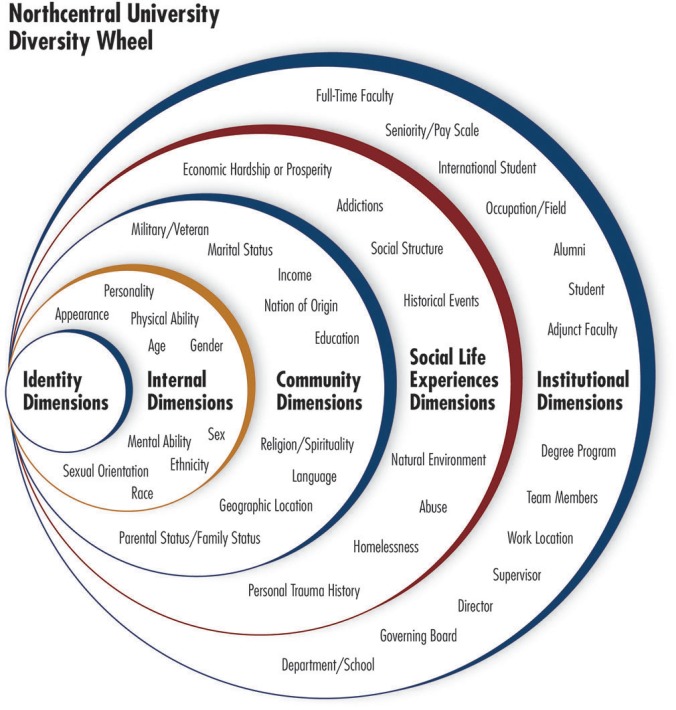
PrintThis diversity wheel aligns with Bronfenbrenner’s (1977; 1994) nested model of the ecological systems approach. In this case, the individual is the focal point from which radiates the varied types of influences upon the individual organized in concentric circles (from narrow to broad).

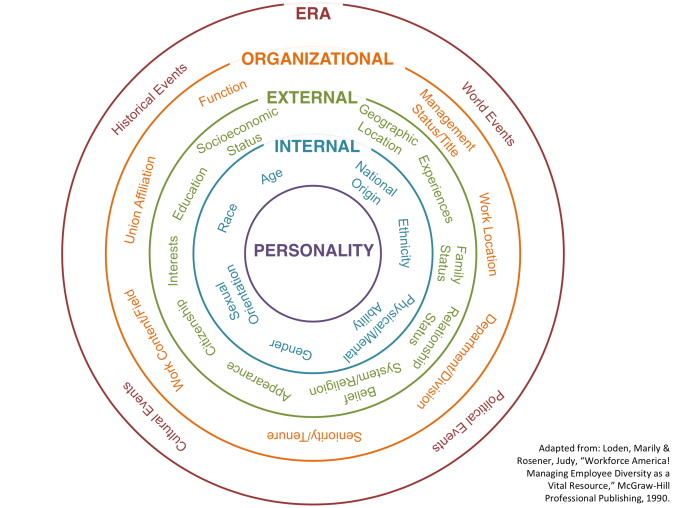
Another example of a diversity wheel comes from the Cultural Competence Learning Institute (2018):
Dimensions-of-Diversity ASTCv2.png

This diversity wheel also begins with the individual as the focal point with concentric circles representing the broader influences on one’s personality.

The point of displaying these types of diversity wheels is to show the various ways one can look at diversity. To bring the point back culturally responsive teaching practices, what this means is that we, as educators, need to take time to consider who we are and how that affects what we do in our respective classrooms. We cannot deny the fact that an increasingly diverse student population walks through our doors each and every day. Thus, it is important for us to develop explicit knowledge and understanding of cultural diversity so that we can better meet the needs of our diverse student body (Gay, 2002).

References

Bronfenbrenner, U. (1977). Toward an experimental ecology of human development. American Psychologist, 32, 513–531. doi:10.1037/0003-066x.32.7.513

Bronfenbrenner, U. (1994). Ecology models of human development. In T. N. Postlewaite & Husen, T. (Eds.), International encyclopedia of education (2nd ed., Vol. 3, pp. 1643-1647). Oxford, England: Elsevier.

Cultural Competence Learning Institute. (2018). Group activities. Retrieved from the Association for Science-Technology Centers website: http://community.astc.org/ccli/home

Gay, G. (2002). Preparing for culturally responsive teaching. Journal of Teacher Education, 53, 106-116. doi:10.1177/0022487102053002003

Johns Hopkins Diversity Leadership Council. (n.d.). Diversity wheel. Retrieved from from Johns Hopkins University & Medicine Diversity Leadership Council website: http://web.jhu.edu/dlc/resources/diversity_wheel/index.html

Northcentral University. (2018). Diversity wheel. Retrieved from Northcentral University website: https://www.ncu.edu/about-ncu/who-we-are/diversity


Melting Pot or Salad Bowl?

If you were a product of the 70s (and now I’m dating myself), then you are well acquainted with the School House Rock series that were part of the Saturday morning cartoon line-up.

When I taught U.S. History, I used this video as an introduction to get my students to think about whether they viewed our nation as a melting pot or salad bowl. My teaching positions have afforded me the opportunity to work with a diverse group of learners based on race, ethnicity, socio-economic status, gender, disability, and giftedness*. As such, I was curious as to how my students viewed the interconnectedness (or not) of our pluralistic society.

In fact, Banks (2016) calls for educators to consider the fact that schools today exist “within a pluralistic democratic nation [and] should help students develop clarified, reflective, and positive cultural identifications” (p. 28). To begin this process, teachers need to determine the lens through which students view themselves and their role at school and within the larger community. One way to start the conversation might be to play this video and give students a graphic organizer with which to organize and justify their perspectives. In the past, I have used the Big Idea template where students would write the generalization at the top and then including supporting details/statements in the pillars below.

This type of activity may be a good way to discern students’ perspectives on the make-up of this great county we call America. To make this more relevant and personal, I think another good option is for students to take this activity home and complete it with their parent/guardian and even siblings. This way students would also begin to have conversations with their family about who they are, where they come from, and how they view their role in the family and larger community. And no, this type of conversation doesn’t only apply to the history classes. Each and every teacher has a duty to ensure that the education we provide to our students is culturally inclusive, meaningful, and engaging. But that’s a topic for a different blog post.

*The terms used here are defined in Banks, J. A. (2016). Cultural diversity and education: Foundations, curriculum, and teaching (6th ed.). New York, NY: Routledge.

What is Multicultural Education?

This summer, I will be posting a series of blogs about multicultural education and what that means for my context as well as my role and responsibility as an educator. The term multicultural education is fluid in that the meaning alters as it serves the purpose of various organizations, districts, schools, and classrooms. The definition is also organic in that as our society becomes increasingly and deeply connected in a global way, policy makers, educators, and the like seek to determine what multicultural means within the context of time. As such, I begin my quest to define multicultural education in this point in time within the context of my role as a doctoral student and classroom teacher.

Below are the definitions of multicultural education from a variety of resources:

Multicultural education is a philosophical concept built on the ideals of freedom, justice, equality, equity, and human dignity as acknowledged in various documents, such as the U.S. Declaration of Independence, constitutions of South Africa and the United States, and the Universal Declaration of Human Rights adopted by the United Nations. It affirms our need to prepare students for their responsibilities in an interdependent world. It recognizes the role schools can play in developing the attitudes and values necessary for a democratic society. It values cultural differences and affirms the pluralism that students, their communities, and teachers reflect. It challenges all forms of discrimination in schools and society through the promotion of democratic principles of social justice” (The National Association for Multicultural Education, 2018).

Multicultural education is set of strategies and materials in education that were developed to assist teachers when responding to the many issues created by the rapidly changing demographics of their students. It provides students with knowledge about the histories, cultures, and contributions of diverse groups; it assumes that the future society is pluralistic. It draws on insights from a number of different fields, including ethnic studies and women studies, but also reinterprets content from related academic disciplines. Multicultural education, also viewed as a way of teaching, promotes principles such as inclusion, diversity, democracy, skill acquisition, inquiry, critical thought, value of perspectives, and self-reflection” (Wikipedia, 2018).

“Most common understanding of multicultural education is that it consists largely of additive content rather than a set of structural changes in content and process…it has often been interpreted in either a simplistic or a monolithic way” (Nieto, 2008, p. 18).

“Most multicultural education theorists [refer multicultural education] to mean an education that is designed to help all students, including White mainstream students, to acquire the knowledge and skills needed to function effectively in a diverse society or nation-state” (Banks, 2016, p. 71).

References

Banks, J. A. (2016). Cultural diversity and education: Foundations, curriculum, and teaching (6th ed.). New York, NY: Routledge.

Nieto, S. (2008). Affirmation, solidarity and critique: Moving beyond tolerance in education. In E. Lee, D. Menkart, & M. Okazawa-Rey (Eds.), Beyond heroes and holidays (pp. 18-29). Washington, DC: Teaching for Change.

The National Association for Multicultural Education. (2018). Definitions of multicultural education. Retrieved from The National Association for Multicultural Education website: https://www.nameorg.org/definitions_of_multicultural_e.php

Wikipedia. (2018). Multicultural education. Retrieved from Wikipedia website: https://en.wikipedia.org/wiki/Multicultural_education