Diffusion of Innovations: AI adoption

You don’t have to look very far to see AI mentioned in relation to education, teachers, students, learning, etc. While there are supporters and huge proponents of generative AI, there are also detractors as well as those who are a bit skeptical.

Supporters of generative AI tout the revolutionary changes that AI can bring to teaching and learning. Some evoke scenarios of students using generative AI to create engaging learning experiences (e.g., dialogue between historical figures, rewriting historical events/what if’s), while others point out how AI-use can promote the development of important skills (e.g., problem-solving, collaboration, responsible decision-making). Further, there are educators currently using generative AI for lesson planning as well as managing their work-flow.

On the other hand, detractors lament how generative AI can lead to cheating or dis-engaged learning with students simply typing in questions and letting AI do the work for them. Some also point out that generative AI responses can be biased, flat out incorrect, or can exacerbate existing inequalities. Additionally, there are educators who not interested in the “latest fad” to add to their already over-flowing plates.

Now, I am not an expert in generative AI. However, I do know about technology and change. In fact, I think the following quote is important to keep front and center:

“Getting a new idea adopted, even when it has obviously advantages, is difficult.”

Rogers, 2003, p. 1

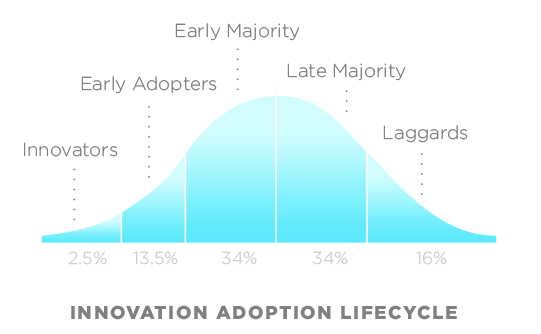
For proponents (i.e., innovators or early adopters), generative AI is a no-brainer. It’s exciting and revolutionary. But the rest (i.e., early majority, late majority, laggards) have legitimate concerns that need to be addressed before AI can make a lasting impression on teaching and learning. The following image is a breakdown of adopter categories as it relates to new ideas (in this case generative AI):
So, here is what I am proposing especially if you are an ardent supporter of generative AI and want your teachers and administrators to see the advantages and benefits for teaching and learning in the classroom:

  • Keep the channels of communication open – be open to disagreements and don’t take it personally if people are not interested in AI
  • Be a good listener – people who are hesitant about change have legitimate concerns – make a concerted effort to understand what those concerns are (Hall & Hord, 2014)
  • Use baby steps + chunk the information – provide practical applications that are easy to digest – some colleagues may need just a little nudge, whereas others will want (need?) many reassurances that AI isn’t going to rock their world in a bad way
  • Be a good listener – even after providing support, showing examples, modeling, some may still be unwilling – remember their concerns are legitimate

It is no mistake that I put be a good listener on the list twice because when it comes to change, railroading teachers (or people in general) is not going to get them to truly buy-in. If teachers are not ready to listen about the benefits of integrating AI into their teaching practices, then no amount of effort on your part is going to make a difference. To be clear, it’s important that you empathize with their situation.

Now, if you are interested in how you can facilitate the adoption of generative AI on your campus, I urge you to watch the following video as I believe this will help you to develop an empathetic mindset (Heath & Heath, 2010) for how you can effect change:

To be clear, I believe that generative AI can be a beneficial tool for teachers and students. However, I have yet to be convinced that it will revolutionize education and learning. So many innovations and technologies have come and gone in the classroom…some have made lasting impressions, while others have had little effect. Only time will tell.

References

Hall, G. E., & Hord, S. M. (2014). Implementing change: Patterns, principles, and potholes (4th ed.). Pearson.

Heath, C., & Heath, D. (2010). Switch: How to change things when change is hard. Crown Business.

Rogers, E. M. (2003). Diffusion of innovations (5th ed.). Free Press.
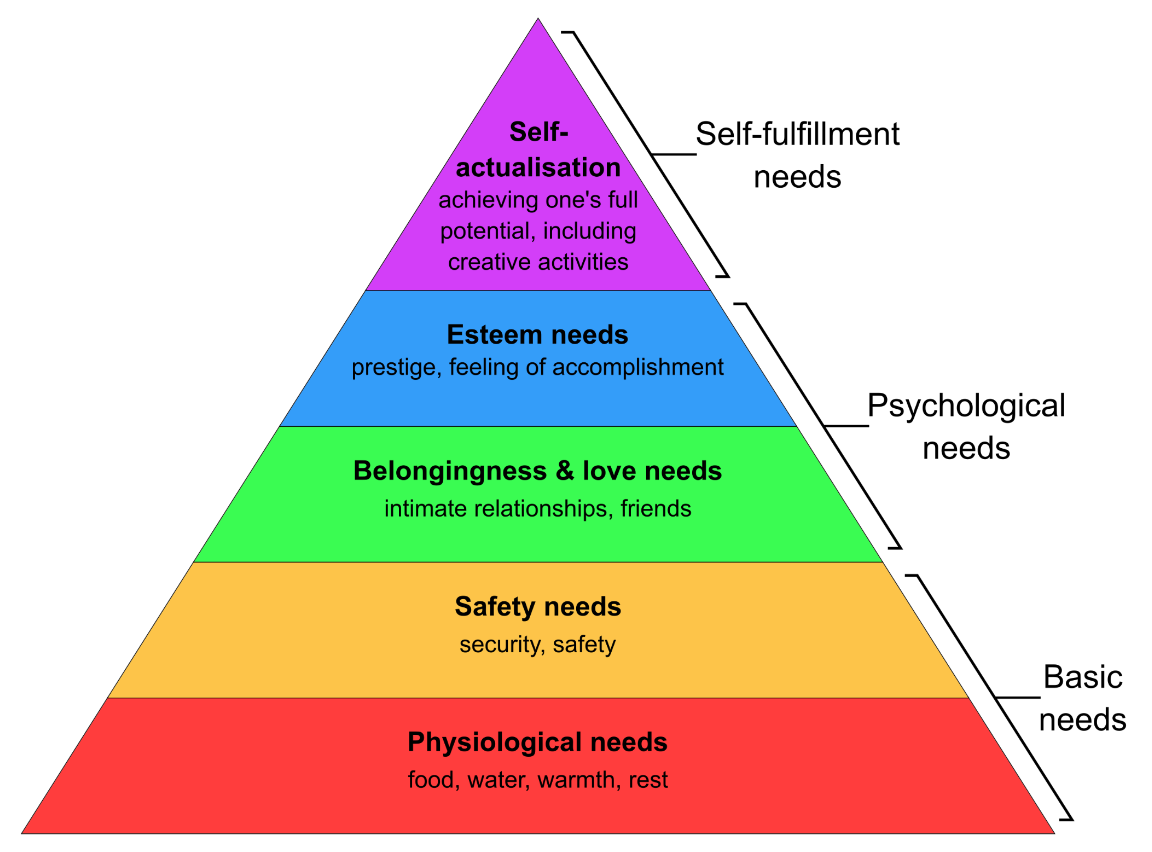
The Importance of Belonging: Maslow Before Blooms

The idea of belonging is not a new concept for me. I’ve always felt the need to belong to something larger than myself as it gave me a purpose but also a sense of safety and acceptance.

My background in psychology coupled with my time in the classroom solidified my resolve to share with fellow educators the need to focus on ways to instill a sense of belonging for students.

Having worked in two different Title I schools, I learned first-hand just how hard life was for my neediest of students. My heart hurt to hear that a student lived in a garage with their entire family, that they lived with their grandparents because both parents were in jail, that they slept on a couch because they don’t have a bed let alone a bedroom…I could go on and on.

And I learned real fast that there’s only so much that I had control over. I couldn’t control what happened outside of my classroom, but within the four walls of my classroom, I could made intentional decisions to cultivate a sense of belonging for my students.

The challenge of how to help students who are disconnected from school and academics can be addressed in 5 steps:

  • Acknowledge that certain needs have to be met in order for learning to occur, you cannot control everything, but you can control some things
  • Identify students who may need additional emotional support structures
  • Hone your empathy skills and provide ways for your students to develop empathy for others as well
  • Build a warm classroom environment where students feel welcome 
  • Cultivate opportunities for students to develop a sense of belonging in your classroom and with their peers with the hope that they can carry this feeling with them when they leave your classroom

I’m not saying that any of these steps are a silver bullet. But I can assure you that I’ve used each and every one of them in my classroom and it made a difference for my students. How do I know? They told me. Some of them mentioned it in passing, others wrote me letters, some emailed me a thank you, a few gave small tokens of their appreciation, while others came by for a quick hug before leaving for high school. All of these meant so much to me because I felt that all of my efforts were working. Maybe it didn’t work for every single student. But it worked for some. And that’s all that mattered.

In the words of Rita Pierson, I wanted to Be a Champion for my students. And I made that an intentional decision each and every day.

If you want to learn more, please check out a webinar that I recently hosted. The Importance of Belonging can be found on EdTechTeacher’s YouTube Channel. Please feel free to leave comments or reach out with your own stories and solutions. As I previously mentioned, I’ve always felt the need to belong to something larger than myself…and being part of the educational community is something that will always be near and dear to my heart.

Thanks for reading!

Operationalizing the Variable

While at Johns Hopkins, I had to take several research methods courses to ensure that I knew not only how to conduct research, but how to define, collect, and analyze data. One of my professors (I took two of the three research methods courses with her because she’s nothing short of amazing but that’s a story for another time) always reminded us to operationalize the variable. Now, I realize that if you’re not in the research world that phrase may not mean anything to you, but for those of us who are studying change and program effectiveness in schools…this phrase means everything.

To operationalize the variable means to define it in clear terms–preferably in terms that can be measured.

By operationalizing the variable, it should be clear to everyone exactly what you mean.

If the variable is clearly defined, then it makes it easier to determine if change occurred.

To be clear, just because you operationalized the variable doesn’t mean that the program or change initiative worked. A lot of factors can and do influence change. However, to determine what changed, to what extent change occurred, and what possibly contributed to the change, one needs to start with clearly defined variables.

For example, if one wanted to measure the effectiveness of a program change, then one needs to:

  • Identify a problem of practice (what it the gap? what are potential drivers to the problem?)
  • Design and conduct a needs assessment (how do you know it’s a problem? what does the literature reveal?)
  • Operationalize the variables (what is it that you want to see changed?)
  • Clearly define the instruments (what is going to measure the change? how will data be collected? when will data be collected? how will the data be analyzed? who will analyze the data?)
  • Clearly define the program or intervention (what is change initiative? foundational theory of change? program details? duration? who is the target of the program initiative? what are the proposed proximal, short, and long-term outcomes?)

All of that is the bare minimum. I didn’t include all of the steps, but I’m sure by now you get the gist that conducting a program evaluation is not a simple or quick task.

For the evaluation to mean anything, however, it is imperative that all of the variables are defined–that is, operationalized.

I bring this up because I’ve been doing research on social-emotional learning and culturally responsive teaching. And, although these two can certainly work in tandem to build a warm and supportive classroom community, they can (and in my opinion should) be implemented separately if one wants to truly measure change.

Definition: social-emotional learning is the “process through which all young people and adults acquire and apply the knowledge, skills, and attitudes to develop healthy identities, manage emotions and achieve personal and collective goals, feel and show empathy for others, establish and maintain supportive relationships, and make responsible and caring decisions” (CASEL, n.d.).

Definition: culturally responsive teaching uses “cultural characteristics, experiences, and perspectives of ethnically diverse students as conduits for teaching them more effectively” (Gay, 2002, 106).

One of the biggest problems I see in education is the morphing of definitions. We’ve all been privy to buzzwords in education–most of these which likely started with the best of intentions, but because many of the terms were not clearly defined–operationalized–educators, parents, community, general public, and the media have put their own spin on it. They’ve redefined the terms according to their understanding or they’ve taken similarities in terminology and made the assumption that the terms basically mean the same.

And therein rests the problem.

So, what initially appeared to be something that might actually effect change, instead became watered-down, redefined, or morphed into something quite different or less effective than what was intended.

Now, I’m not saying that teachers and schools cannot implement two different frameworks, pedagogies, theories, etc. at the same time. Heck, we’ve been doing that (and more) for years. But doing so makes it impossible to know what exactly changed, to what extent it changed, and even what caused the change.

And if the end result isn’t what one expected, what happens? The theory, pedagogy, framework, or strategy is scrapped and something new is put into place.

And what a shame since many of these theories, pedagogies, frameworks, and strategies are backed by research. Evidence that it can work. But we’re hard pressed to know if it could work in certain situations since educators were juggling multiple and competing initiatives–so it’s hard to tell what changed, what caused the change, or even why didn’t the expected change occur.

So, if you truly want to see if a (new) program is effective, then it’s critical to (1) operationalize the variable and (2) remove competing initiatives.

I would love to not see social-emotional learning or culturally responsive teaching reduced to buzzwords. Each of these has its merits, and I truly believe that they can effect positive change in the classroom. However, these need to be implemented with fidelity but more importantly, clearly defined for everyone at the outset so that there’s no confusion as to what the terminology means.

References

CASEL. (2022). Fundamentals of SEL. Collaborative for Academic, Social, and Emotional Learning (CASEL). https://casel.org/fundamentals-of-sel

Gay, G. (2002). Preparing for culturally responsive teaching. Journal of Teacher Education, 53(2), 106 – 116. https://citeseerx.ist.psu.edu/viewdoc/download?doi=10.1.1.294.1431&rep=rep1&type=pdf