What’s Best for the Kids

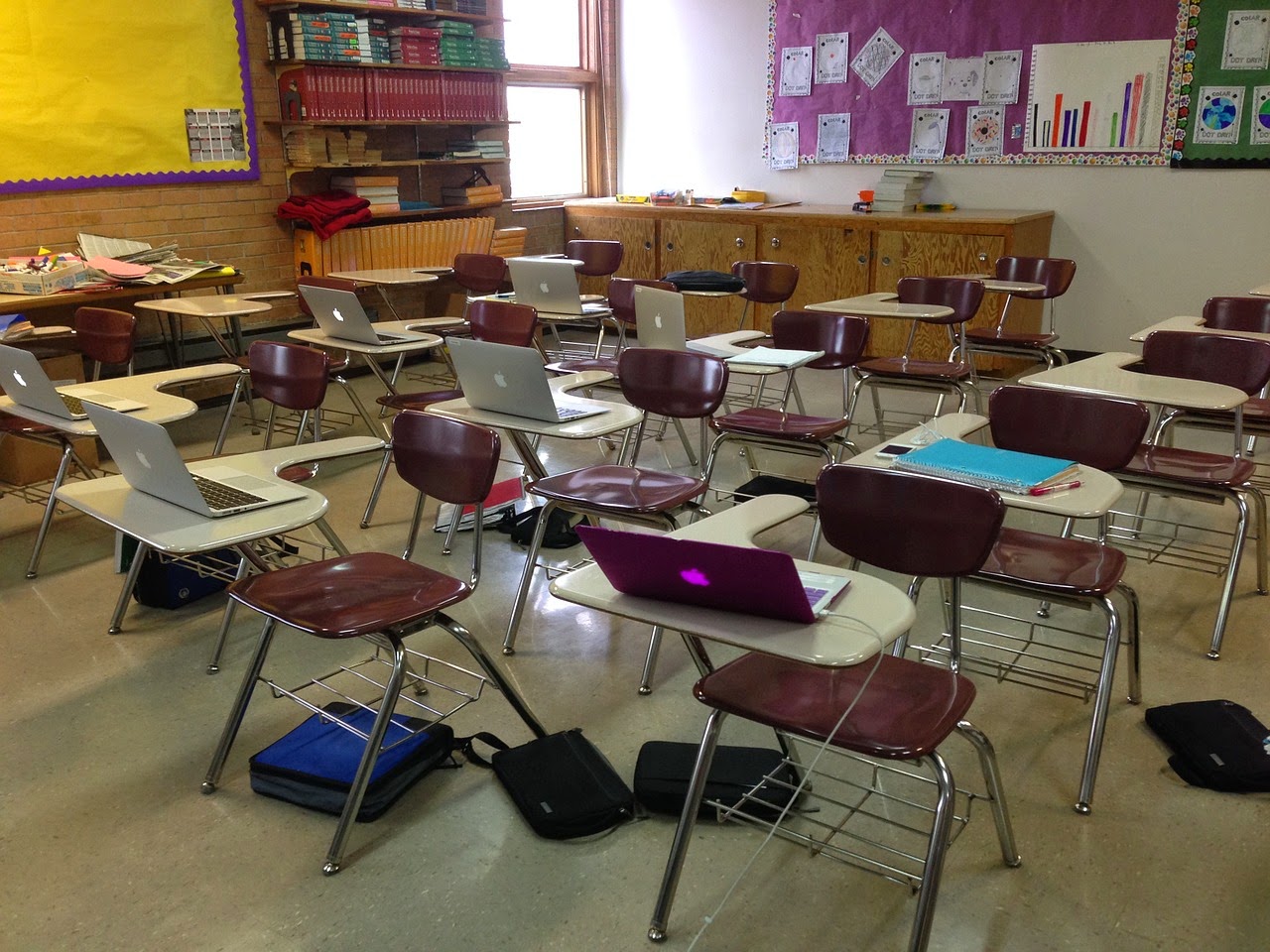
We are coming to the end of the second week of SBAC and CST testing.  Our schedule has been modified to give students two or three block periods within which they will take the math or ELA portion of the SBAC and the CST science exam.

As a history teacher, I’m not testing.

And that makes me happy.

But what’s really troubling to me is the fact that we have significant numbers of students who are not finishing the SBAC test.  Our school has allocated more than the minimum number of suggested minutes for each test.  We’ve modified our schedule so that instructional time has been equally distributed across the various disciplines.  But the problem that I think we’re going to have is that next week when we’re supposed to be done with SBAC…our students will need to continue to finish portions.

Why is the test taking so long?

Apparently they are going to finish the test in their ELA or math class…the same class in which they were taking the SBAC in the first place.  But this will take away from valuable instruction time.  The ELA and math classes have already lost instructional time to accommodate the SBAC test.

Since I’m not testing and since I’ve only seen practice questions, I can’t say for sure why this test is taking so long to complete.  But I’m wondering why students have to take a test that is so long in the first place.  The attention span of middle school students isn’t very long…they have a difficult time sitting still…their minds are whirling around with various thoughts…and they are freaking out about the changes in their body due to puberty.  So why? Why must they be subjugated to a test that is taken during a 2 1/2 hour block period?  It’s ridiculous.  I’m waiting for one of them to lose their minds when they come to my class after taking a computerized test for 2 1/2 hours.

I don’t blame them for coming to my class mentally exhausted from taking the SBAC.  And our department has done our best to make sure that we plan activities in our history classes that are not necessarily mentally taxing, but most definitely engaging, activities that allow students to talk with each other and get out of their seats.

I understand that the state needs “data” to justify funding for education.  But every year, I feel like the amount and nature of testing is increasing…and that not only takes away from instructional time but I just don’t think that it’s in the best interests of the kids.

I don’t have a solution.

I’m just at a loss.
Collaborative Writing & Historical Thinking

Last week, a couple of colleagues and I hosted #sschat.  Our topic was collaborative writing and historical thinking – two things that we all believe are essential skills for our students to learn and practice in our classes.

Teaching writing is hard.  Teaching writing for history is a whole other ball game.  In the history classes, there is little benefit for students simply regurgitating information from the textbook or class discussions….which is why we make a concerted effort to create questions that require students to use higher order thinking skills such as analysis, synthesis, and evaluation.  

And I’m not saying that other history teachers don’t do the same.  

But we used to require less than we do now.

We’ve upped the ante.

Because we have our learning scales, our department has created leveled questions for students.  Level 4 questions require analysis.  Level 5 questions require synthesis and/or evaluation.

Currently my students are focusing on analytical writing.  They are starting with what looks like a basic question:

  1. The men counted in the land had to serve in the army (p. 303).  Should all men be required to serve in the army?  If not, then who should be excused.  Why?
  2. Top government officials were “given farmers to work the land” (p. 303).  What is the ethical issue here?  Explain.
  3. How should a hierarchy be organized?  Should it be organized based on power?  Wealth?  Importance/usefulness?  Intellect?  Explain.
  4. Should government jobs be passed down to a son or other relatives?  Or should one have to pass an examination in order to get a government job?  Explain the pros and cons.

But as they are writing on the GoogleDoc, I’m posing questions to make them think deeper about the topic. Students have a difficult time elaborating on an idea and explaining themselves. And they aren’t going to get better if we don’t give them practice.

The twist is that students are writing on a GoogleDoc that is shared with peers who sit at their table throughout the day. I like this option because it exposes students to different points of view and writing styles. It also gives them an audience and sets the purpose.

Tomorrow, students will select a peer’s response and review it for accuracy and clarity. Hopefully by reviewing a peer’s response, students will be able to reflect on their own post to see if they are not only answering the question, but utilizing analysis skills in their writing.

For the Love of Learning

I think that sometimes educators underestimate students’ desire to learn and better themselves.  And I’m including myself in that mix.  But I’m always trying new things in my classes to see which students will rise to the occasion.
The picture I included here is one that I also posted on our class Instagram account which was pushed out to Twitter.  I wanted to shout from the mountain tops that these students were writing JUST TO WRITE!
I’m not kidding.
I told all my students that they needed practice in how to write like a historian.  Meaning…they needed to learn to cite evidence to support their statements.  But more than that, they needed to be able to analyze primary and secondary sources in order to be able to effectively use them in their writing.
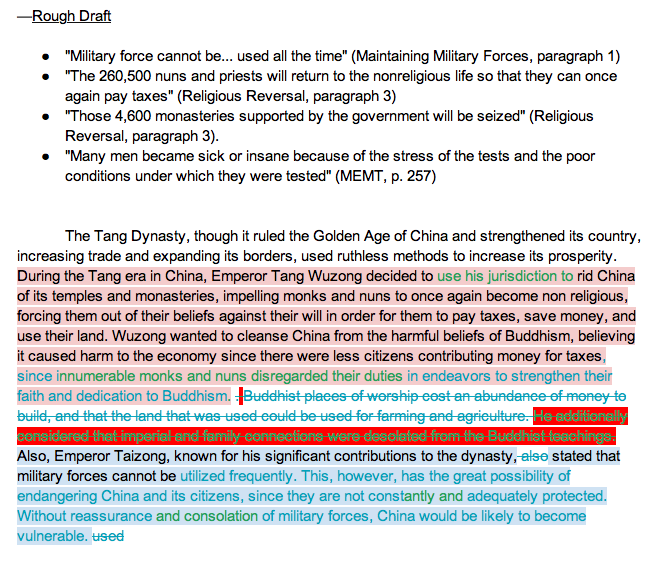
So I gave them three primary sources.  I told them that as a group (self-selected) that they had to choose which Big Idea they wanted to prove:  “The Tang dynasty used (ruthless/ingenious) methods to strengthen China’s government, expand its borders, and increase its economy.”  I pushed the assignment out through Google Classroom.  Then the students decided who was going to be the owner of the document and from there he/she shared the document with their peers.
The students then tackled the primary sources, annotating as necessary as they looked for evidence to prove their Big Idea.  Some students started with bullet points, but others delved right into writing a full paragraph.  It was a site to behold.
Now keep in mind, this was an optional assignment.  Students are typically not required to do Level 4 (analysis/synthesis) or Level 5 (evaluation) writing assignments.  Student choice for leveled learning opportunities is the crux of the history program at our school.  We use a revised version of Marzano’s learning scales so that it’s VERY clear what students need to demonstrate mastery of in order to earn a specific grade.  
Click HERE to go to a wiki resource that contains the learning scales for World History.
Students who want to earn an A or B in the history classes need to write and write well.  As I tell students on their first day of World History, “We don’t give a lot of extra credit in our class.  You will not pass this class with extra credit.  You will, however, pass this class with blood, sweat, and tears…not necessarily in that order.”  There’s always a bit of nervous laughter from students that follow.
The purpose of collaborative writing assignments is to give students practice in writing with their peers.  And not just writing individual sentences strung together, but actually writing together in which they are actually editing each other’s posts and leaving comments for each other.  This type of synchronous and asynchronous collaboration is exposing students to the 21st century classroom.  Not only are students learning how analyze primary and secondary sources, but they are utilizing the thinking skills of a historian as they find evidence to prove their thesis or in this case the Big Idea.  Students are not only practicing digital literacy skills but also History’s Habits of Mind.  And we wouldn’t have it any other way.