Passion Projects

It’s been awhile since I posted, but time has completely flown by this year! And, I am FINALLY getting a chance to enjoy this new chapter in my professional career as a learning consultant.

Finally.

Although the start of 2022 was a continuation of challenges from 2020 and 2021, it also afforded me the opportunity to make some rather large changes professionally. This was not a bad thing.

Leaving the classroom (and my kids) behind at the end of the semester in January was hard. And I’d be lying if I didn’t admit that I missed being with them. Because my good friends are still holding down the fort at my old school, I was privy to the activities and other things that were happening on campus. And I was also able to see some of the end-of-the-year pictures which brought tears to my eyes as I saw my 8th graders (some of whom I taught as 7th graders, too) smiling as they enjoyed the last dance of the school year and wearing the biggest grins as they walked across the stage at Commencement. It made my heart happy to know that they (that we) survived the last two years with a shifting school schedule and policy/mandates. And, I loved the sweet messages from my 7th and 8th graders in the send-off video my dear friend and Journalism advisor put together for me. =)

After I made the decision to leave the classroom, it gave me time to really think about what it is that I wanted to do . . . next. I was fortunate find two different companies who offered me projects that kept me busy. I’ve done a bit of curriculum writing, research, and tons of professional development workshops. (And I’ve had the chance to work with people from a variety of organizations whose goal is to make learning fun, engaging, and meaningful for students. Yay!) Most of these projects were within my comfort zone–with a few that were solidly at the edge of my zone of proximal development. Luckily for me, I have mentors who provided guidance and encouragement throughout this journey thus far.

Surround yourself with a village. You will not regret it. =)

Now, as the summer draws to a close and the new school year gets underway . . . I have had to readjust my mindset because for the past 27 years, I’ve only known the rush, the craziness, and the exhaustion of the start of the school year. But to be honest, I don’t miss that part at all.

One of the benefits of consulting is that I get to choose my schedule. The projects to some extent dictate deadlines, but I love that I can sleep in, have a leisurely breakfast, and walk the puppy before settling in to work. This new adventure has been a bit scary because there are so many unknowns, but I have to say that having a supportive husband and an awesome circle of friends has made this transition easier to manage.

I am truly blessed.

The start of a new school year still feels like the start of something new to me. And, I am really looking forward to finding more passion projects. =)
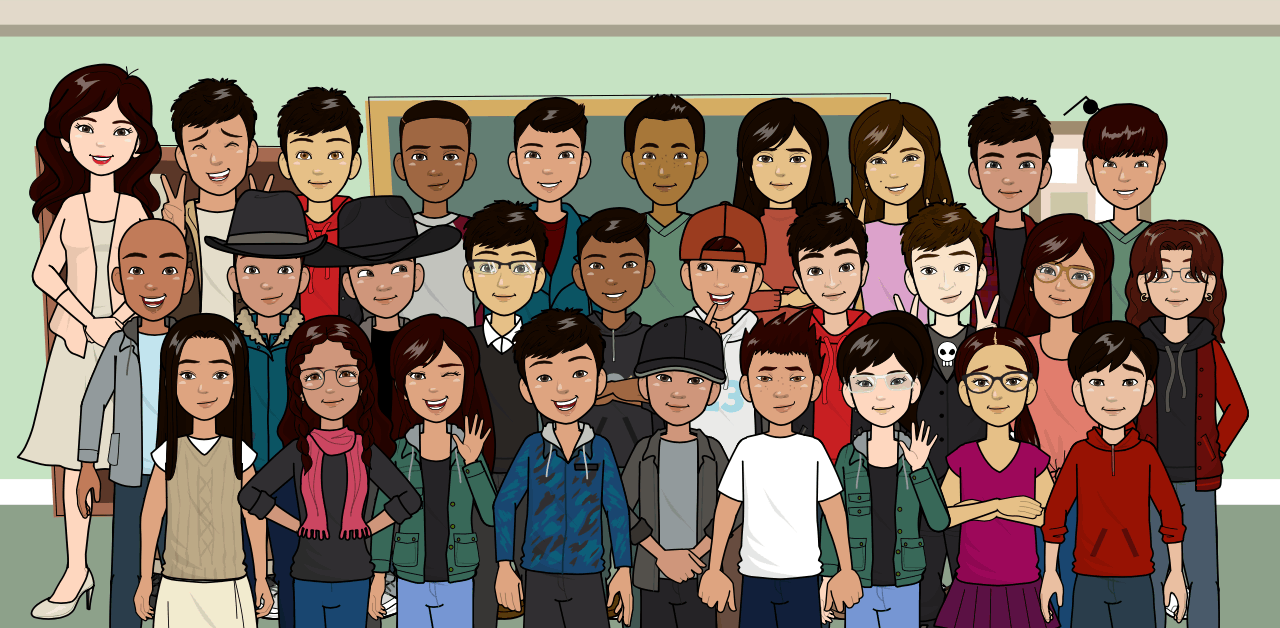
Instilling a Sense of Belonging

My awesome Period 5 World History class

This society is broken. I mean, just look around…many people (adults and children) are feeling isolated and alone. Why is that? I don’t think we can solely blame the pandemic on this. Social media was already influencing how users perceived themselves as they compared their lives with others. As adults, you’d think that we have the skills to be able to separate fact from fiction–but not everyone has these skills. But this post isn’t about adults…it’s about children.

Having taught middle schoolers for the past 27 years, I can attest that the pressure to be perfect has only increased for these impressionable kids. They are looking at snapshots of a person’s life…comparing their reality with the fantasy. And no amount of talking is going to convince these kids that they need to only be concerned about their personal growth and achievements and not others’.

What is needed is a concerted effort by everyone to provide these impressionable kids with the skills necessary to look beyond the fiction and focus on what’s important–being a better version of themselves today than yesterday.

The first two administrators that I had as a young teacher pointed out that I was able to build a good rapport with my students. I used to think “thanks for the kudos!” but over time I gained a better understanding of why it’s so important to build rapport and relationships with my students.

Having taught in Title I schools for my entire career, I came across too many kids who:

  • Came from broken homes
  • Were being raised by a grandparent
  • Lived below the poverty line
  • Slept on a couch because they didn’t have bed
  • Shared a living space with their family in a garage-conversion
  • Did not have a warm breakfast
  • Lacked proper shoes or clothing for the weather
  • And the list goes on and on…

Yet, these kids showed up to school day in and day out.

So, what I made a goal for myself to greet each and every student who came through my door. Sometimes I stood at my door during the passing period so that I could chat with my kids outside; other times, I would walk around the room as the kids got settled in their desks and I would offer a compliment or ask them how they were doing. If I didn’t get a chance to touch base with a student before class started, I made a concerted effort during class to talk with them–sometimes it was class-related and other times I simply gave them a compliment or positive praise.

I can’t remember where I heard this…it was probably a TED Talk, but I recall an educator saying that it’s so important for teachers to greet their students because sometimes that’s the only positive interaction that child may have for the entire day.

And that thought makes me so sad.

But I can’t change their home life, and I cannot control what happens outside of my classroom. But I can control what happens inside my class–regardless if that’s a physical classroom or a virtual learning space.

One of the means that I used to build community was through the creation of a class photo in Pixton. In middle school, we don’t have class pictures–and it’s so easy for students to feel lost or alone in a school of 800 – 1200 kids. But being the competitive person that I am, I always try to instill in my students that our class period is THE BEST and that we’re a little family who takes care of each other. We begin with a class identity and then we work on a world history “family” identity that transcends class periods. I want kids to feel like they belong somewhere.

We begin developing our family identity through the creation of avatars that can be put together in a class photo. This is where Pixton is amazing. Students can choose different options to create an avatar that is personalized to how they are in reality or even their alter-ego. Then all I have to do is go through Pixton to create a class photo of all those avatars.

Take a look another look at a Pixton class photo of my incredible Period 1 World History class–notice how their individual personalities shine through the simple creation of an avatar.

My incredible Period 1 World History class

I used these class photos in our LMS and it served as the banner image in our Google Classroom as well. This way, students always saw that they were apart of something bigger than themselves.

If you haven’t tried Pixton yet, I encourage you to do so! It free (yay!) and it’s so easy to use. There are other features in Pixton that you and your students can use to support their learning, but for me, Pixton was the means to begin building a sense of belonging for my middle schoolers.

If you’re interested in learning more about how I build a sense of belonging with my students, please check out a workshop I am hosting through EdTechTeacher: Building Community in Your Classroom – SEL in Action. This three-day virtual workshop is July 11, 12, and 14. I hope to see you there!

And if you cannot make it, please don’t hesitate to reach out. I am happy to share the various things I used to help build a sense of belonging for my students.

Let’s Prioritize Creativity

I was lucky. As a young child in elementary school, I had the privilege of being accepted into the gifted program with phenomenal teachers. Their passion for learning and love for children were evident everywhere you looked. But more importantly, these teachers infused creativity into everything they did. 

For example, in 3rd grade, my teacher used sentence phrases to help us write short stories. It was a hodgepodge of phrases that we put together as the inspiration for our stories. From those stories, she had us hand-draw pictures to go along with the storyline. Afterwards, she took those stories and had them published into two hardback books. One that went into the school’s library, and the other one went home with us. So, basically, I wrote and illustrated my first book in the 3rd grade. 

Another example was in the 4th grade. To help us learn how to write letters but also to understand how the U.S. Postal System worked, my teacher set up a post office in our classroom. Yes, we had the post office window and mailbox! We got to write letters to our friends, address them, put a stamp on it, submit them to the post office, and have the postmaster deliver the letters to us within the same day. We all took turns being the postmaster so we could experience sorting, stamping, and delivering the letters. Who knew that the U.S. Postal Service could be run by a bunch of giggly 4th graders?

My last example occurred in my 6th grade class. When learning about California state history, my teacher planned a trip for us to fly to Sacramento so we could see with our own eyes our State Capitol. We toured the Capitol building and went by the governor’s mansion. She made history come alive for us while also giving us real-world experience with traveling on a plane and being away from home for a few days. 

These three examples show how creativity in the classroom not only can leave lasting impressions on a child, but they also exemplify how teaching should be in the classroom for everyone – not just gifted students and certainly not just for elementary-aged children.

When I became a teacher, my goal was to make learning fun and creative for my middle school kiddoes. Luckily for me, I started back in 1995 before standardized testing became the barometer of learning that it is today. And, I had quite a bit of autonomy as California did not have history standards at the time, but rather teachers used a framework that allowed for more voice and choice for teachers and students.

My point is that creativity should be a priority in the classroom. And, I don’t mean at the expense of important literacy skills either. Students can learn in creative ways, and they can acquire and practice reading, writing, listening, and speaking skills in the process. I know this because that’s exactly how I structured my classes…after all, I learned from the best.

If you’re interested in how I infused creativity into my instructional practices, please join me for my session “Let’s Get Appy – Creativity in the Social Science Classroom” on June 27, 28, 30 or August 1, 2, 4. This virtual workshop is part of the summer series hosted by EdTechTeacher, and if you’re not interested in this particular session (no hard feelings, I promise!), there are 30+ other sessions offered by a phenomenal team of educators. Please check out the EdTechTeacher website for more information.