A Guiding Light for the New Year: The #OneWord Challenge

This little guy inspires me to find the JOY in everything. 💚

New Year’s resolutions are extremely hard to keep. Take a minute to think about how many New Year’s resolutions have persisted for you…if you say “not many” or “none,” you are not alone! In fact, a health survey conducted by Forbes found that the “average resolution lasts just 3.74 months” (Davis, 2023).

When reflecting on past New Year’s resolutions, I am no different from the average person. So I decided to shift perspectives!

In 2018 I decided to choose one word that would guide my thoughts and actions for the year. The idea behind the #oneword challenge is that when you take stock of your life (past 365 days), how would you summarize it in one word? 

After hearing about this idea, I introduced the #oneword challenge to my middle schoolers and had them write their word in their agenda book (1) to keep themselves accountable and (2) as a reminder of the word they wanted to use to describe their year. Periodically, I would have students return to the page where their #oneword was written to reflect on whether their actions, words, and thoughts aligned to the one word they chose for themselves. To make sure that my students knew that I had skin in the game, I also participated in the #oneword challenge and shared my one word with them.

I even brought in a few good friends (middle school colleagues) to join me in the #oneword challenge. The more, the merrier. 😁

Having one word that guided my course of action, words, and thoughts came in very handy during the pandemic when my #oneword challenge almost became a sort of lifesaver. Suddenly separated from daily in-person contact and fear of the unknown added another layer of stress. But the #oneword that my friends and I each chose not only bonded us but also gave us something positive to focus on. Throughout 2020 and 2021, we would regularly share whether (or not) we were aligned by our #oneword which kept us accountable and gave us the opportunity to provide encouragement and support to each other as needed. 

And it was sorely needed.

Now the #oneword challenge is a bit different than creating a New Year’s resolution. I’ve found that choosing one word (e.g., trust, simplicity) instead of a resolution (e.g., regularly exercise, eat better) is more compassionate. It’s a mindset that guides one’s thoughts and actions. There is room for failure, opportunities for grace and empathy, and a chance for do-overs. After all, those who take on the #oneword challenge have 365 chances (or in the case of 2024, 366 chances – #leapyear) to live out their one word. But it’s not just enough to choose one word to describe your year; it’s important to think about why you’ve chosen that one word and how you plan to follow-through with it. By consciously thinking about your why and how, you are setting yourself up for success as you now have a game-plan. And, if you share your one word with friends, you now have an accountability system. 

Full disclosure, there are some days where the #oneword is front and center in my life, and there are other days (or consecutive days) where the #oneword is notably absent. Last year, my #oneword was present, as in I wanted to be present in the moment and not think about the past or future. But last year was a crazy year with family and personal obligations pulling me in a multitude of different directions. I found myself going down quite a few dark and long rabbit holes, but when I remembered my #oneword, it brought me back to my goal of being present, being in the moment. It reminded me to take a breath and just be

Aside from using #oneword to guide my thoughts, words, and actions, an indelible benefit of sharing my #oneword with friends is that when we get together at the end of the year, we share our ups and downs, our challenges and triumphs, the good, bad, and the ugly of our year. While we spend time in introspection, we also have a chance to build each other up, to remind each other that the #oneword is a guiding light and not an all or nothing deal. While we may not have lived by our #oneword for all 365 days, if we can define the pivotal moments of our year by our #oneword or even lessons on how we can do better with our #oneword going forward, then that’s what matters most in my book.

This year, I shared my #oneword challenge with a wider group of friends and family. It brought a smile to my heart to know their #oneword and the reason for choosing it for 2024. To what extent they will have achieved their #oneword challenge remains unknown, but you can bet that I’ll be reaching out to them come December 2024 to reflect on our respective #oneword journeys.

In case you’re wondering, my #oneword for 2024 is JOY. It was inspired by the Bible verse James 1:2 which begins with the phrase “Count it all joy.” I chose this #oneword because no matter what life throws my way this year, I want to find joy in all of the things. I won’t pretend that it will always be easy to find joy, but I am putting it out there to the universe that I will make a concerted effort to find joy no matter the circumstances. I will reframe my thoughts and find the silver-lining, if need be. To help with this, each day I plan to write down one thing that brought joy–with the idea that by December 31, I will have 366 reasons for being joyful with the life I have.

For today, my JOY is sharing the #oneword challenge with you. ❤️

References

Davis, S. (2023, December 18). New year’s resolutions statistics 2024. Forbes Health. https://www.forbes.com/health/mind/new-years-resolutions-statistics
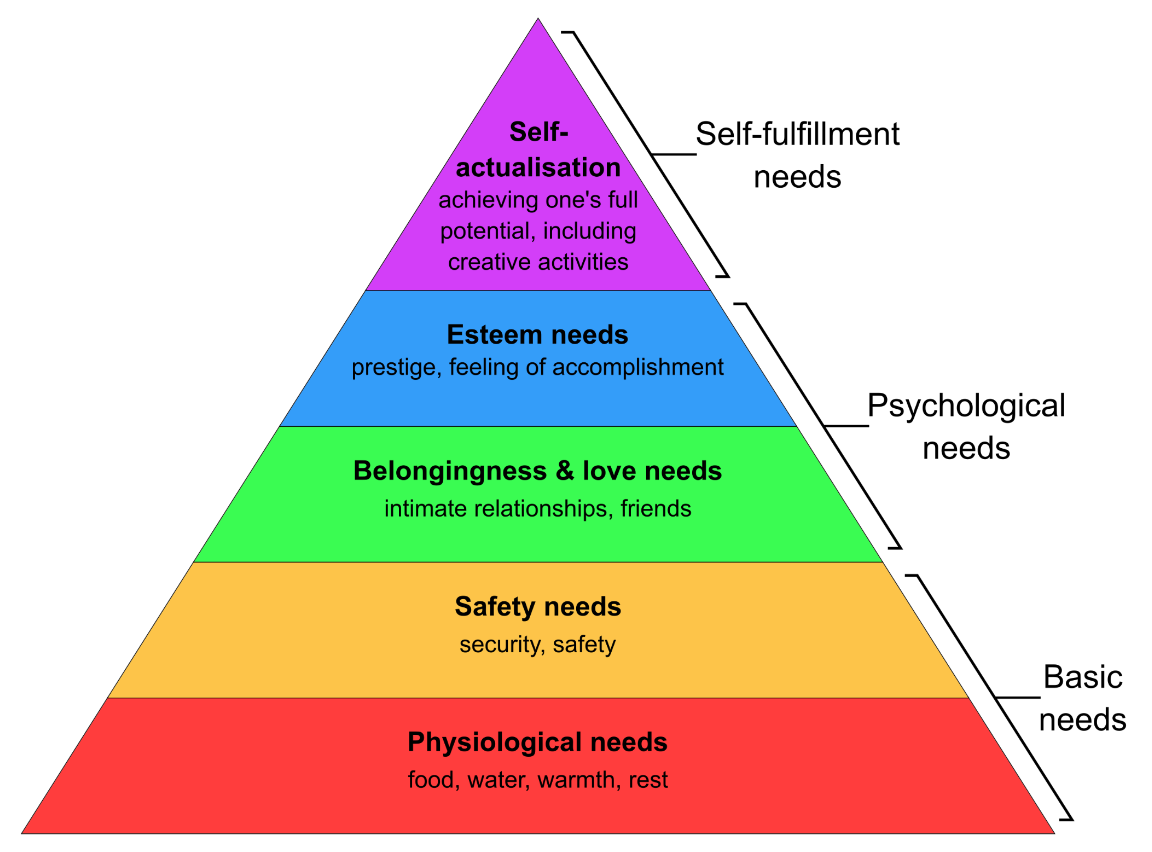

The Importance of Belonging: Maslow Before Blooms

The idea of belonging is not a new concept for me. I’ve always felt the need to belong to something larger than myself as it gave me a purpose but also a sense of safety and acceptance.

My background in psychology coupled with my time in the classroom solidified my resolve to share with fellow educators the need to focus on ways to instill a sense of belonging for students.

Having worked in two different Title I schools, I learned first-hand just how hard life was for my neediest of students. My heart hurt to hear that a student lived in a garage with their entire family, that they lived with their grandparents because both parents were in jail, that they slept on a couch because they don’t have a bed let alone a bedroom…I could go on and on.

And I learned real fast that there’s only so much that I had control over. I couldn’t control what happened outside of my classroom, but within the four walls of my classroom, I could made intentional decisions to cultivate a sense of belonging for my students.

The challenge of how to help students who are disconnected from school and academics can be addressed in 5 steps:

  • Acknowledge that certain needs have to be met in order for learning to occur, you cannot control everything, but you can control some things
  • Identify students who may need additional emotional support structures
  • Hone your empathy skills and provide ways for your students to develop empathy for others as well
  • Build a warm classroom environment where students feel welcome 
  • Cultivate opportunities for students to develop a sense of belonging in your classroom and with their peers with the hope that they can carry this feeling with them when they leave your classroom

I’m not saying that any of these steps are a silver bullet. But I can assure you that I’ve used each and every one of them in my classroom and it made a difference for my students. How do I know? They told me. Some of them mentioned it in passing, others wrote me letters, some emailed me a thank you, a few gave small tokens of their appreciation, while others came by for a quick hug before leaving for high school. All of these meant so much to me because I felt that all of my efforts were working. Maybe it didn’t work for every single student. But it worked for some. And that’s all that mattered.

In the words of Rita Pierson, I wanted to Be a Champion for my students. And I made that an intentional decision each and every day.

If you want to learn more, please check out a webinar that I recently hosted. The Importance of Belonging can be found on EdTechTeacher’s YouTube Channel. Please feel free to leave comments or reach out with your own stories and solutions. As I previously mentioned, I’ve always felt the need to belong to something larger than myself…and being part of the educational community is something that will always be near and dear to my heart.

Thanks for reading!

Leading with Empathy

As an introvert, I naturally shy away from the limelight as I prefer to be a fly on the wall enjoying the scene unfolding before me. But my passion for technology and teacher education has pushed me out of my comfort zone to present in front of groups of people (both large and small). I mention this because I just finished putting together a presentation I am going to share with a group of educators next Saturday. And, I am both excited and exhausted.

I’m excited because I get to share my knowledge and experience as a classroom teacher in a formerly blended, now fully online learning environment. But I’m also exhausted at the thought of having to speak in front of people.

Story of my life.

The presentation is for teachers and educators who are enrolled in an educational leadership and technology course at a local university. These master’s students are learning about leadership and organizational change. And, I was asked to share my experience as an educational leader whose passion is technology integration.

I have been presenting to teachers since 1998. I began with sharing how I created lessons that were rigorous and engaging for my middle school students. Over the years, I have shifted from merely sharing my ideas, strategies, and lessons learned to an incorporation of how technology can be the catalyst for meaningful learning.

To be clear, I am not advocating the integration of technology for technology’s sake. I am a firm believer that we have to begin with the learning objective and then match that to the technology tool. For example, if you want your students to collaborate on a writing assignment, Google Docs is the perfect medium. If you want your students to practice speaking literacy skills, then perhaps Flipgrid with their video and audio features would work. If you want your students to create a display of their learning, then Padlet would suffice as a virtual bulletin board. But it begins with the learning objective first.

Technology is the means to an end. Not the end itself.

Students are more apt (than adults) to simply jump into a task that includes technology. I’m not entirely sure why, but from my experience they just are.

Adults come to the table with prior experience, varied levels of knowledge and skills, and preconceived notions of the value of technology for student learning (Ertmer et al., 2012; Frank et al., 2011; Shifflet & Weilbacher, 2015; Wachira & Keengwe, 2011).

So, if you want teachers to “buy-in” to the idea of how technology can support student learning outcomes, you need to meet teachers where they are. And, that means starting with empathy.

Websters Dictionary defines empathy as “the action of understanding, being aware of, being sensitive to, and vicariously experiencing the feelings, thoughts, and experience of another.”

I mention this because when it comes to technology adoption, integration, implementation, or any other verb of your choosing, we need to first begin with empathizing with the user. And, that means starting with their concerns. What are their concerns when it comes to using technology?

Hall and Hord (2015) purport that there are six stages of concern:

Impact

  • Refocusing – I have some ideas about something that would work even better.
  • Collaboration – How is this related to what my colleagues are doing?
  • Consequence – How is my use of technology affecting students?

Task

  • Management – I seem to be spending all of my time getting the technology set-up.

Self

  • Personal – How will using technology affect me?
  • Informational – I would like to know more about technology. 

Unrelated

  • Unconcerned – I am more concerned about other things.

All of these concerns are valid and are potential barriers to technology integration. So when considering a new initiative that includes technology, professional developers, trainers, coaches, etc. need to begin by empathizing with the teacher.

How can you find out what teachers’ concerns are regarding technology?

You ask.

What I’ve learned over the years when working with both children and teachers is that everything is based on relationships. Building a good rapport with students helps when you want them to complete tasks that they may not necessarily find interesting or motivating. The same can be said for teachers. If you are asking teachers to change their thinking or instructional practice, then building a good rapport is key.

This is where being an introvert is difficult.

Normally, I am not one to start small talk. And, I am most certainly not one to just walk up to people and start a conservation. But this is something I’ve naturally done with students who walked through my doors. I know they typically hate history, so my goal is to build a connection with them so that they are at least open to the possibility that history can be very interesting. I’ve since then adopted the same practice when working with adults. I begin by getting to know them, who they are, what motivates them as a teacher, etc.

I’m hoping that these short conversations will help when it comes time for me to introduce something that is going to potentially change how they teach.

Hall and Hord (2015) also advocate for something they call the one-legged interview which is really just short conversations in passing whereby people end up sharing challenges and celebrations for whatever change initiative is on the docket. These quick conversations can occur in-between classes or in the workroom when making copies–well, maybe not at this time since most of us are still remote, but that’s not say that we can’t drop a quick email or text to a colleague to check in, right?

The relationships we build through these snippets of conversation are what help us to develop empathy for each other. Or in my case, it’s what helps me better understand the concerns of my colleagues when it comes to technology integration.

If I don’t first invest in building the relationship with my colleagues, what’s to motivate them to want to change?

I cannot empathize with their situation, I am going to talk over their heads, they won’t care what I have to say, and then everything will be for naught.

This is a lesson I’ve learned throughout my years of planning and facilitating professional development. Without empathy, very little change will happen, and I’m pretty confident that any change that did happen would not be sustainable.

Change can occur people see the value in it for themselves.

But we need to open the door and greet them with empathy.

References

Ertmer, P. A., Ottenbreit-Leftwich, A. T., Sadik, O., Sendurur, E., & Sendurur, P. (2012). Teacher beliefs and technology integration practices: A critical relationship. Computers & Education, 59, 423–435. https://doi.org/10.1016/j.compedu.2012.02.001

Frank, K. A., Zhao, Y., Penuel, W. R., Ellefson, N., & Porter, S. (2011). Focus, fiddle, and friends: Experiences that transform knowledge for the implementation of innovations. Sociology of Education, 84, 137–156. https://doi.org/10.1177/0038040711401812

Hall, G. E., & Hord, S. M. (2015). Implementing change: Patterns, principles, and potholes (4th ed.). Pearson.

Shifflet, R., & Weilbacher, G. (2015). Teacher beliefs and their influence on technology use: A case study. Contemporary Issues in Technology and Teacher Education, 15, 368–394. Retrieved from http://www.citejournal.org

Wachira, P., & Keengwe, J. (2011). Technology integration barriers: Urban school mathematics teachers perspectives. Journal of Science Education and Technology, 20, 17–25. https://doi.org/10.1007/s10956-010-9230-y