The Importance of Belonging: Maslow Before Blooms

The idea of belonging is not a new concept for me. I’ve always felt the need to belong to something larger than myself as it gave me a purpose but also a sense of safety and acceptance.

My background in psychology coupled with my time in the classroom solidified my resolve to share with fellow educators the need to focus on ways to instill a sense of belonging for students.

Having worked in two different Title I schools, I learned first-hand just how hard life was for my neediest of students. My heart hurt to hear that a student lived in a garage with their entire family, that they lived with their grandparents because both parents were in jail, that they slept on a couch because they don’t have a bed let alone a bedroom…I could go on and on.

And I learned real fast that there’s only so much that I had control over. I couldn’t control what happened outside of my classroom, but within the four walls of my classroom, I could made intentional decisions to cultivate a sense of belonging for my students.

The challenge of how to help students who are disconnected from school and academics can be addressed in 5 steps:

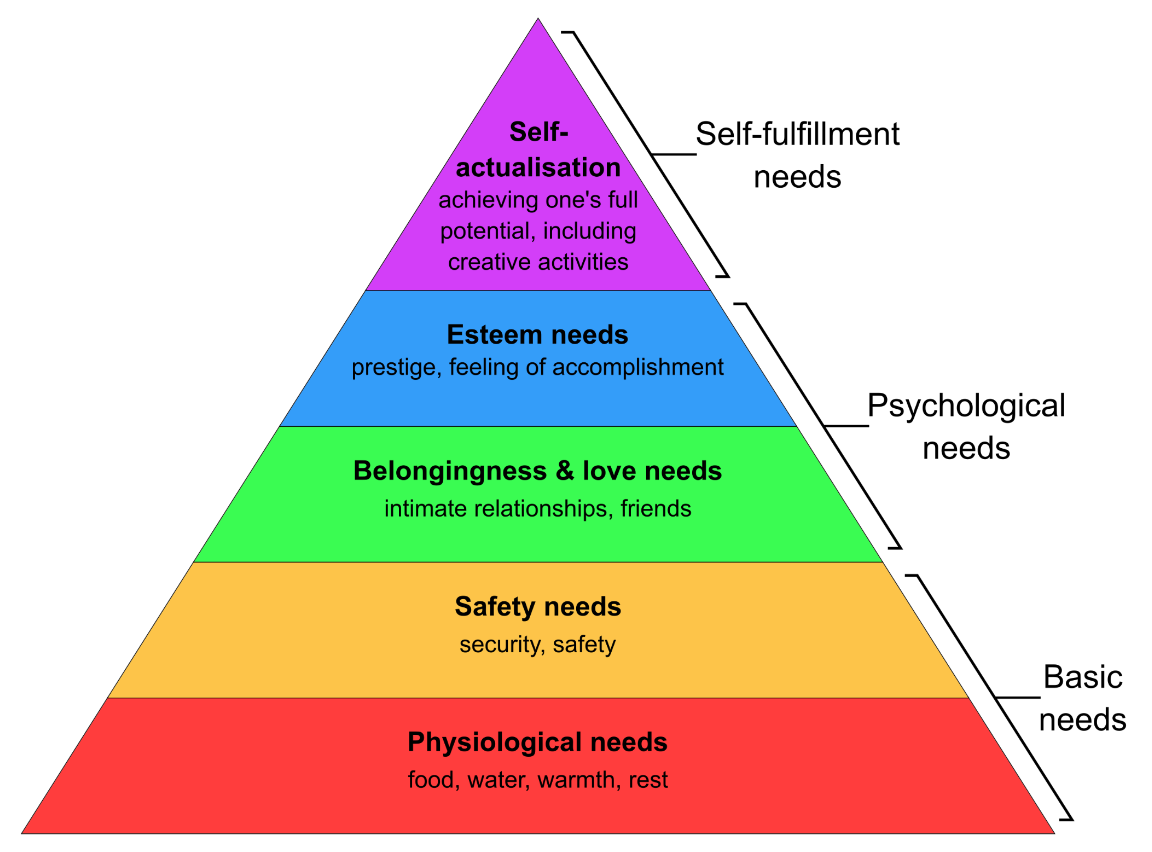
  • Acknowledge that certain needs have to be met in order for learning to occur, you cannot control everything, but you can control some things
  • Identify students who may need additional emotional support structures
  • Hone your empathy skills and provide ways for your students to develop empathy for others as well
  • Build a warm classroom environment where students feel welcome 
  • Cultivate opportunities for students to develop a sense of belonging in your classroom and with their peers with the hope that they can carry this feeling with them when they leave your classroom

I’m not saying that any of these steps are a silver bullet. But I can assure you that I’ve used each and every one of them in my classroom and it made a difference for my students. How do I know? They told me. Some of them mentioned it in passing, others wrote me letters, some emailed me a thank you, a few gave small tokens of their appreciation, while others came by for a quick hug before leaving for high school. All of these meant so much to me because I felt that all of my efforts were working. Maybe it didn’t work for every single student. But it worked for some. And that’s all that mattered.

In the words of Rita Pierson, I wanted to Be a Champion for my students. And I made that an intentional decision each and every day.

If you want to learn more, please check out a webinar that I recently hosted. The Importance of Belonging can be found on EdTechTeacher’s YouTube Channel. Please feel free to leave comments or reach out with your own stories and solutions. As I previously mentioned, I’ve always felt the need to belong to something larger than myself…and being part of the educational community is something that will always be near and dear to my heart.

Thanks for reading!

Learning Fast to Implement Well

Aside from teaching a doctoral course called Research on Effective Professional Development this summer, I think I would have immersed myself in research on the learning sciences anyway. Number 1: It’s how I geek out. Number 2: It makes me a stronger learning designer when working with children and adults.

The phrase “learning fast to implement well” is from Anthony Bryk and colleague’s (2015) book Learning to Improve: How America’s Schools can get Better at Getting Better. When I first read their book several years ago, I don’t think (actually I know) that I didn’t get as much out of it then as I have these past few months. I’m always looking for ways to make me a better classroom teacher, but I’m also looking to improve and hone my skills as a researcher. 

Needless to say, this book has become a good friend lately.

In light on the shifts we’ve had to make in how we approach the new year, I think teachers are going to need to learn fast to implement well. We don’t have time to take things slowly (on our end) since we have 100+ students who need us right nowIn fact, I’ve met with my department twice so far (we’re still technically on summer break) to discuss how we can use technology to facilitate learning for our students. We discussed ways to scaffold the learning for our English language learners and special education students. We brainstormed synchronous tools so that learning would be more engaging for our students. We still have ways to go, but I’m happy with our progress thus far. 

The technology skill and knowledge level in my department varies, and I think coming together early enough before the start of school was the perfect way for us to begin discussions on how we can hit the ground running as technology is the medium by which we are going to build connections, facilitate learning, and assess understanding. There will be mishaps (of that I am sure), but if we learn fast, we can implement wellthe next time around.

Please know that I am not saying that we are going to be throwing things at our students at a fast pace. In fact, I’m not advocating that we begin the school year at a sprint for us either. What I am suggesting is that we will be more effective teachers for our students if we have open conversations about what worked last spring, what has worked in the past (pre-COVID-19), and how can we take those experiences and make learning meaningful for our students now. We need to internalize the lessons learned to figure out how we can best serve our students—learn fast to implement well.

I will echo a comment from a colleague who said, “I’ve been doing this for 16 years, yet I feel as if this is my first year all over again.” Amen, brother! This is certainly uncharted territory for all of us. 

So, I was thinking about my big take-away from last spring, and I believe the best place for me to start is by intentionally creating activities around building a warm and supportive learning community. I just finished reading both EduProtocol (Hebern & Corippo, 2018/2019) books, and it’s already given me some ideas on how to start the school year by building and layering foundational skills for long-term success—more on that in another blog post.

What I’m thinking might be a good way to approach the start of the school year—and it doesn’t matter if you’re starting in-person, hybrid, or virtual—is to think of ways to bring humanity to the forefront. Think of it, many of our students have been isolated from friends since March; they likely haven’t been out playing in the summer like they used to; they have not had the same level of social interactions with peers, family, and other people (in general); they are probably freaked out about school starting up again (first day jitters don’t disappear even in the online environment); they are likely worried that they are somehow falling behind the academic curve; and they are probably thinking “Will everyone like me?”

To hopefully alleviate some of these fears, while also slowly introducing them to the technology tools and foundational skills they need, I created activities for my students based on several of the EduProtocols from Hebern and Corippo (2018/2019). In the forefront of those activities are ways that my students can build relationships with each other.  

This past spring posed a huge learning curve for me. But I am here…and ready to start the new school year. 

I am ready to learn fast to implement well

Bring it on 2020.

Reference

Bryk, A. S., Gomez, L. M., Grunow, A., & LeMahieu, P. G. (2015). Learning to improve: How America’s schools can get better at getting better. Harvard Education Press.

Hebern M., & Corippo, J. (2018). Eduprotocol field guide: 16 student-centered lesson frames for infinite learning possibilities. Dave Burgess Consulting.

Hebern M., & Corippo, J. (2019). Eduprotocol field guide book 2: 12 new lesson frames for even more engagement. Dave Burgess Consulting.

Brain Dumping Data Analysis

If you have been following my posts for the past year, you are aware that I have been keenly interested in retrieval practice. I regularly incorporated retrieval practice (in the form of brain dumps) with my GATE/PreAP students last semester. Their reflections revealed the value of brain dumping on their long-term retention of information. Thus, I decided that I would fully roll out brain dumping to all of my world history classes this semester.

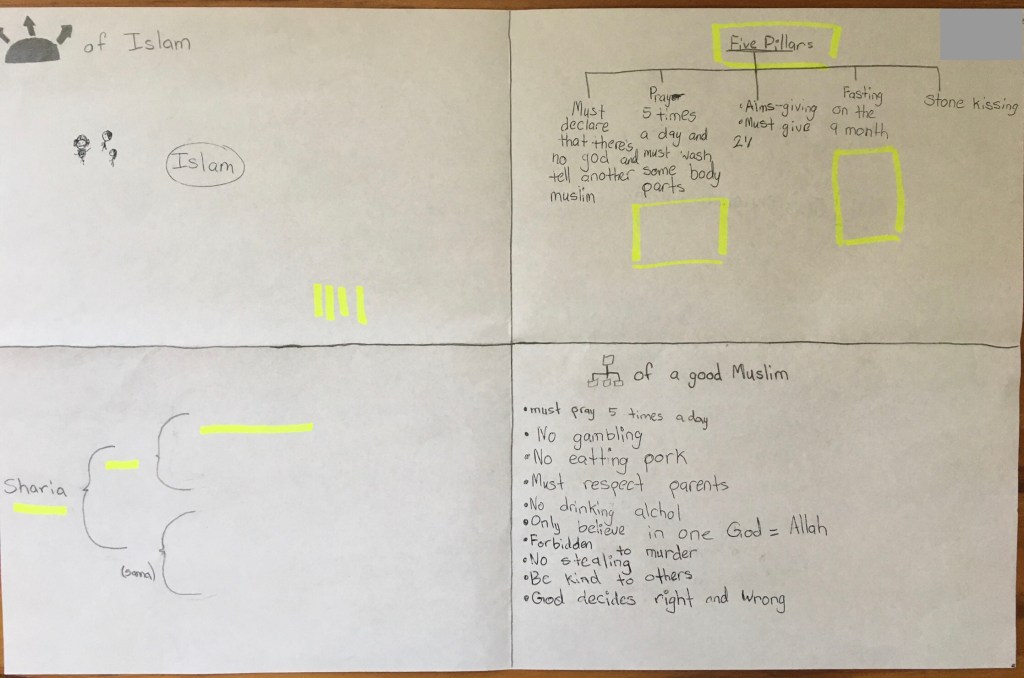
We are about five weeks into the quarter and my students have done four different brain dumps. The first three were small in nature as they focused on one main concept. The brain dump my students recently finished covered four main concepts: origin of Islam, Five Pillars of Islam, rules that guide a Muslim’s life, and a brace map of Sharia.

To recap, my students use pencil in their initial brain dump and pen for when they engage in collaborative learning with peers. NOTE: Some of my students used black pen which makes it hard to see the difference initial versus collaborative recall.

For this brain dump, I cued my students while they were discussing their learning with peers. I saw the faces of students light up as they remembered the information after my verbal cues (e.g., dates, key terms). Thus, I felt that by giving students hints without outright stating the answer was helping them to make stronger connections.

The last step was for students to pull out their notes and continue to add to the gaps in their brain dumps in pen. Luckily, the following student used red pen so it’s easier to see what they did and did not remember.

I told my students that what they wrote in pen were the things they needed to study as they were clearly not remembering those facts. Because I teach middle schoolers, I know that they don’t always have the best study skills or time management. Therefore, I stressed that they should ignore the pencil items and focus their attention on the pen.

After the quiz, I went through each student’s brain dump and looked at their performance. In the majority of the cases (approximately 90%) there was a direct correlation between what the student remembered on their own (pencil) and the questions they got right. A similar correlation was found between what students wrote in pen and the questions that they missed. I am assuming that the information written in pen or out-right missing (see first image) posed an issue for students because they:

  • Did not spend enough time studying that information
  • Did not have enough time to relearn the information
  • Did not understand the information or how it was related to the concepts
  • Were not in class when the information was presented and applied
  • . . . ?

The next step is to pass the brain dumps back to students and give them access to the quiz questions. I want them to reflect on their brain dump and the effort they put forth on the quiz. Hopefully, they will see the correlation on their own as they prepare for the unit test.

Only time will tell.