The Missing Link

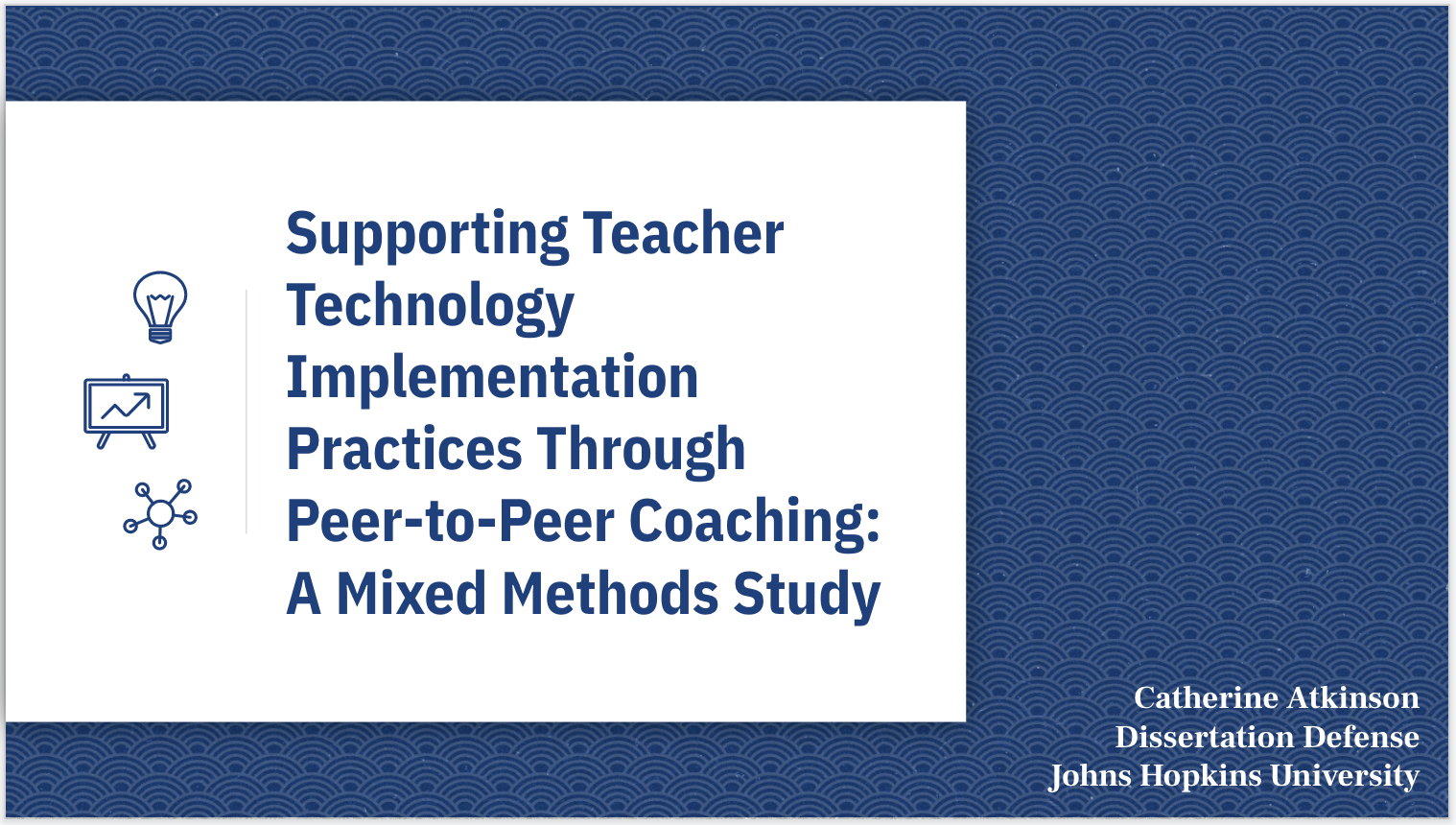
It has been approximately nine days since I defended my dissertation on my study titled “Supporting Teacher Technology Implementation Practices Through Peer-to-Peer Coaching: A Mixed Methods Study.” It was the culmination of three years of work, and it was worth every single minute.

The purpose of my study was to investigate if peer coaching would influence teacher technology practices. The focus stemmed from what I saw and heard regarding how teachers and students used technology in the classroom.

Working at a Title I school, we were able to purchase quite a bit of technology over the years. With the introduction of the SBAC, our mode of testing switched from scantrons to technology devices. Because we now had even more technology in the hands of teachers and students, I felt the need to share with teachers ways to integrate technology so that students would learn with it, instead of from it. In other words, my vision was for technology to serve as a tool for learning, and not the end itself.

But the questions remained: How to go about supporting teachers so that they see why change was necessary? And how to go about making that change?

All too often (and usually after a one-shot workshop), teachers are expected to implement the change and then student achievement scores would naturally increase. Easy, right?

Ha!

When this video came across my Twitter feed, my first thought was “This is really cute” . . . and then I realized that this is the reality of poorly-designed PD when teachers aren’t given the proper support structures.

If school leaders want teachers to change their instructional practices, then they have to provide professional learning opportunities that include the following:

  • Active Learning
  • Content-based Focus
  • Sustained Duration
  • Coherence
  • Collective Participation

These five components are from the work of Desimone and Garet (2015) and served as the framework for my dissertation study. Other researchers (Darling-Hammond, Hyler, & Gardner, 2017; Jensen, Sonnemann, Roberts-Hull, & Hunter, 2016) have offered their own list of must-haves for PD, and they more or less include the same components.

What is missing from most PD is follow-up support–sustained duration. It seems obvious that in order for change to occur, learners need a strong support structure. When you equate it to effective classroom practices with students, as teachers, we know that one lesson on a particular topic or skill is not enough to effect change. We have to provide multiple opportunities for students to practice and refine their learning. Talking at students does not equate to learning.

So why do we expect that from teachers who attend PD?

And why is this such a hard concept for school leaders, program facilitators, and PD providers to understand?

My dissertation study showed promise in using peer coaches to help teachers change their instructional practices to include meaningful learning with technology. The 8-month study included multiple opportunities for teachers to ask for and receive support from peers. Both novice and expert users of technology seemed to benefit for this symbiotic relationship. As the teachers came from multiple disciplines (i.e., English language arts, history, mathematics, science), they were also exposed to various ways that technology could be used to support student learning. The next step is to see if this informal support network can be sustained for the upcoming school year. #fingerscrossed

What I’ve learned from the research and my dissertation study is aptly summed up by a quote from George Couros:

If we want people to take risks, they have to know we are there to catch them and support them.

(Couros, 2015, p. 7)

We cannot expect change to take hold if we don’t, first, provide support for the change-makers.

References

Couros, G. (2015). The innovator’s mindset. San Diego, CA: Dave Burgess Consulting.

Darling-Hammond, L., Hyler, M. E., & Gardner, M. (with Espinoza, D.). (2017). Effective teacher professional development. Palo Alto, CA: Learning Policy Institute. Retrieved from http://learningpolicyinstitute.org/product/teacher-prof-dev

Desimone, L. M., & Garet, M. S. (2015). Best practices in teacher’s professional development in the United States. Psychology, Society, & Education, 7, 252–263. doi:10.25115/psye.v7i3.515

Jensen, B., Sonnemann, J., Roberts-Hull, K., & Hunter, A. (2016). Beyond PD: Teacher professional learning in high-performing systems. Washington, DC: National Center on Education and the Economy. Retrieved from http://www.ncee.org/wp-content/uploads/2015/08/BeyondPDWeb.pdf

Writing with a Purpose

I’ve probably mentioned this before, but I am a voracious reader. In fact, I’m most happy when I have anywhere between three to five books that I’m reading at the same time. I mean, doesn’t everyone leave a book in strategic places around their house?!?!

Having said that, I just finished rereading Vygotsky’s (1978) Mind in Society: The Development of Higher Psychological Processes. I chose to read this book again because one of the theoretical frameworks that guided the development of my dissertation study is sociocultural learning theory.

It was a quick read, and one that reminded me of some key takeaways that I need to remember come fall when a new group of middle schoolers walk through my door.

“Teaching should be organized in such a way that reading and writing are necessary for something”

(Vygotsky, 1978, p. 117)

In this case, I’m reminded to make sure that the tasks and activities that I design for my students should be authentic and meaningful. Sure, students need to know proper writing conventions; but why not make the practice of writing more meaningful to what interests middle schoolers?

I teach medieval world history (500 – 1500 C.E.), and most students come to my class hating history. I mean hating it. I think that may be due in large part to the fact that in previous grades they were forced to memorize people, places, and dates which were far removed from any context that connects to them personally. As someone who suffered through that as a student, I empathize with their plight, which is why I go out of my way to make sure that they know that memorizing people, places, and dates are not a high priority in my class. Yes, they need to know people and the general time frame but that’s a topic for another blog post.

“Writing should be incorporated into a task that is necessary and relevant for life”

(Vygotsky, 1978, p. 118)

Many of my students are on social media. Not all of them, but most of them. But even if they aren’t, being able to effectively communicate through the written word is necessary. Working with a large population of English language learners dictates that I must pay particular attention to helping them navigate the speaking and writing conventions of another language.

What this means is that the writing tasks that I give to my students need to help them practice the English language while also evoking a sense of purpose. One idea is to incorporate blogging or journaling for my students. I’ve been wanting to introduce blogging to my students for years, but I’ve yet to wrap my head around how to introduce that concept so that it’s part of the learning process instead of an add-on.

“Writing should be cultivated rather than imposed”

(Vygotsky, 1978, p. 118)

For this takeaway, I see that writing should be something that naturally occurs during the learning process. My students should want to use writing if that medium is the best form for communicating their ideas. This is where differentiation comes into play. For some students, the written word is preferable, whether it’s because it’s easier, faster, or more convenient. But the same could be said for students who choose to use visuals to convey their thoughts. So when it comes to students sharing or reflecting on their learning, I believe that this year will be the one in which I finally incorporate blogging. But I’m going to give students a choice in how they share their learning: public vs. private and blog vs. journal.

I don’t want to think too much on the logistics because I might overlook what would make this learning process meaningful for students. For now, I’m going to give them the task–reflect on their learning–but I’m going to leave the how up to them.

Reference

Vygotsky, L. S. (1978). Mind in society: The development of higher psychological processes. Cambridge, MA: Harvard University Press.

What is Professional Learning?

read-3048651_1920As a long-time educator I have participated (voluntarily and involuntarily) in a variety of professional development (PD). Not one to wait passively for something to “happen” to me, I seek opportunities to learn. Beyond attending graduate school, I’ve participated in online PD, attended EdCamps (which is a BIG deal for someone who is an introvert), and read plenty of books both on content and pedagogy.

Until I enrolled in the course Research on Effective Professional Development (at Johns Hopkins University), I didn’t really think too much about the difference between professional development versus professional learning. In fact, I used to get irked when people tried to split hairs around semantics. However, I’ve come to learn that if you don’t clearly define what you mean, then it’s entirely plausible that your intentions and efforts may be misunderstood.

So why the difference in terminology?

Well, for one thing, the term professional development has gotten a bum rap. I mean, how many of us have sat through a workshop where the presenter(s):

  • Read off their slides?
  • Treated attendees like children (talk to your elbow partners, anyone?)?
  • Promoted their latest book?
  • Clearly had no idea what actually goes on in the classroom?
  • Shared the work of others as if it was their own idea?
  • Talked about a topic in which you had no interest?

And then we shut-down. I mean arms-crossed, doodling on your paper, checking your iPhone, going to the bathroom every five minutes kind of shut-down. In this case, PD is being done to the teachers who are passive recipients of information. Don’t get me wrong. There are times when being a passive recipient is warranted and sometimes even welcomed. You know what I mean if you’ve ever been engrossed in a TED Talk or keynote presentation.

However, it’s beyond frustrating as a classroom teacher to be told that I need to make my classroom a place for active learning…to differentiate the learning process for my students…that learning should be student-centered…when I’m being forced to sit through a PD that I clearly do not need or want. This is a clear case of do what I say not what I do from the Powers-that-Be. (It’s also obvious that the PD providers have no idea about adult learning theory, but I digress.)

So what is professional learning? And why should we care?

According to Learning Forward (2011), professional learning occurs when “educators tak[e] an active role in their continuous improvmeent” with an emphais on the active part of learning (p. 13). In other words, PD is what happens to you, whereas professional learning is what good educators do. 

Professional learning is where educators actively pursue opportunities for professional growth, not just for themselves, but for their students. It entails taking a backwards approach to design beginning with what do we want our students to learn? Where are the gaps? And from there, we come together to discuss, collaborate, explore, and, yes, even analyze data, to determine what do we need as educators to best support our students? What skills do we need to learn or hone? What content do we need to learn better? Where are the gaps in our pedagogical appoaches to learning?

Teachers do not have all of the answers. And those who are claiming as such are selling snake oil. We all have areas that need improvement or refinement. But I tell you what, improvement is not going to become a reality if teachers are not empowered in their learning and that can only happen if we move away from traditional notions of PD and embrace the idea of professional learning.

Reference

Learning Forward. (2011). Standards for professional learning. Oxford, OH: Author.