The Other Side

The 2020-2021 school year came to a close for students on June 9 and for teachers on June 10. Needless to say, this was the most welcomed closure to the school year as everyone…I mean everyone…was tired.

Although I give props to my colleagues for persevering and to parents for sticking it out during a crazy, tumultuous school year—truth be told, it’s the students who truly deserve the props. After all, adults are better skilled to handle tough situations. We’ve learned from experience that with enough effort, grit, and a strong support system, we can and would survive tough situations. Children, on the other hand, do not have that experience within which to draw strength. And although many of us were dumbstruck with what was happening to us, around us, and outside of us during this pandemic, at least we were better equipped emotionally to weather this storm.

So, what was amazing to me was the depth of resilience within which my middle school students drew their strength. Their world, already topsy-turvy from being an adolescent, was completely and wholly shaken with the pandemic. As several of my students alluded to in their journal entries this past spring, they have not set foot on a school campus in over a year. 

Over a year.

Although about 55% of students eventually returned to in-person instruction starting in March 2021, a huge number still opted to continue with distance learning. Learning encumbered by wifi and device issues as well as finding a spot conducive to studying (i.e., quiet) was an everyday battle for the majority of my students. 

Our school deployed devices and hotspots until we ran out. And, if you’ve ever used a hotspot, you know how clunky they are. Add to the fact that we were using Zoom (bandwidth hogger) as the platform and you may have just an inkling of the barriers many students had to endure just to make it through the school day—let alone the entire school year.

I am sure many of my students do not realize the magnitude of their accomplishment. 

But I do.

My dissertation research focused on the barriers of technology integration into classroom practices. So, I am well aware of the barriers that challenge and, in some cases, prevent teachers from adopting technology as a medium of learning. First order barriers such as devices, access, infrastructure discourage teachers from integrating technology into their classroom practices (Ertmer, 1999). Second order barriers include beliefs, efficacy, skills, knowledge, and value to learning (Ertmer, 1999). Without overcoming the majority of these barriers, technology adoption is dead in the water.

However, due to the pandemic, technology served as the main medium by which teachers and students could connect. Thus, teachers had little choice but to quickly up their technology game, and students were met with the same dilemma.

Teachers worked diligently to prepare an engaging learning experience for their students. Parents rearranged their lives and homes to better serve as a makeshift learning space for their children. And the children logged in every day to their classes. Well, maybe not all of the children and maybe not every day. But most of them logged in every day to all of their classes—despite the wifi and device issues—in spite of the noisy shared work- and learning space—no matter how confusing the technology tools seemed to be—they logged in anyway.

That’s resilience.

If you are looking for examples of how to instill grit in students, look no further because the students learned it—they didn’t have a choice. The pandemic may have forced them to grow up much too quickly, but it also taught many of them that they have what it takes to come out on the other side. 

We made it. 
Adventure Awaits

I know that I am not alone in saying that this has been the toughest year of teaching…ever. My prior years of teaching experience along with my knowledge and skills in technology integration certainly helped with the enormous learning curve that set itself squarely in my face for the 2020-2021 school year. Even so, the varied schedules between online, hybrid, online, and hybrid again have taken its toll on me physically, mentally, and emotionally. Don’t get me started on the technology issues that have plagued both my students and me.

And that’s the just the professional side of my life.

But amidst the craziness of pandemic teaching, a ray of hope appeared…a way that will nurture my passion for working with adult learners as well as a means to utilize my skills as a researcher and learning designer.

I was offered a job as a consultant.

This position will allow me to expand my skillset as I will be working with larger organizations both within and outside of education. I am excited at the prospect of writing curriculum, mentoring teachers, and even doing a bit of data analysis, too.

I have met with my wonderful new boss, colleague, and friend several times already. So, while I am exhausted beyond measure with end-of-the-year summative assessments and report card grades looming on the horizon, I am bolstered and energized by the prospect that during the summer I will be able to work in an area that satisfies my passions for education, technology integration, and learning.

If anything, this pandemic has taught me to appreciate the things that I have and to take things one day at a time.

I plan on doing a lot of both this summer.

Silver Linings

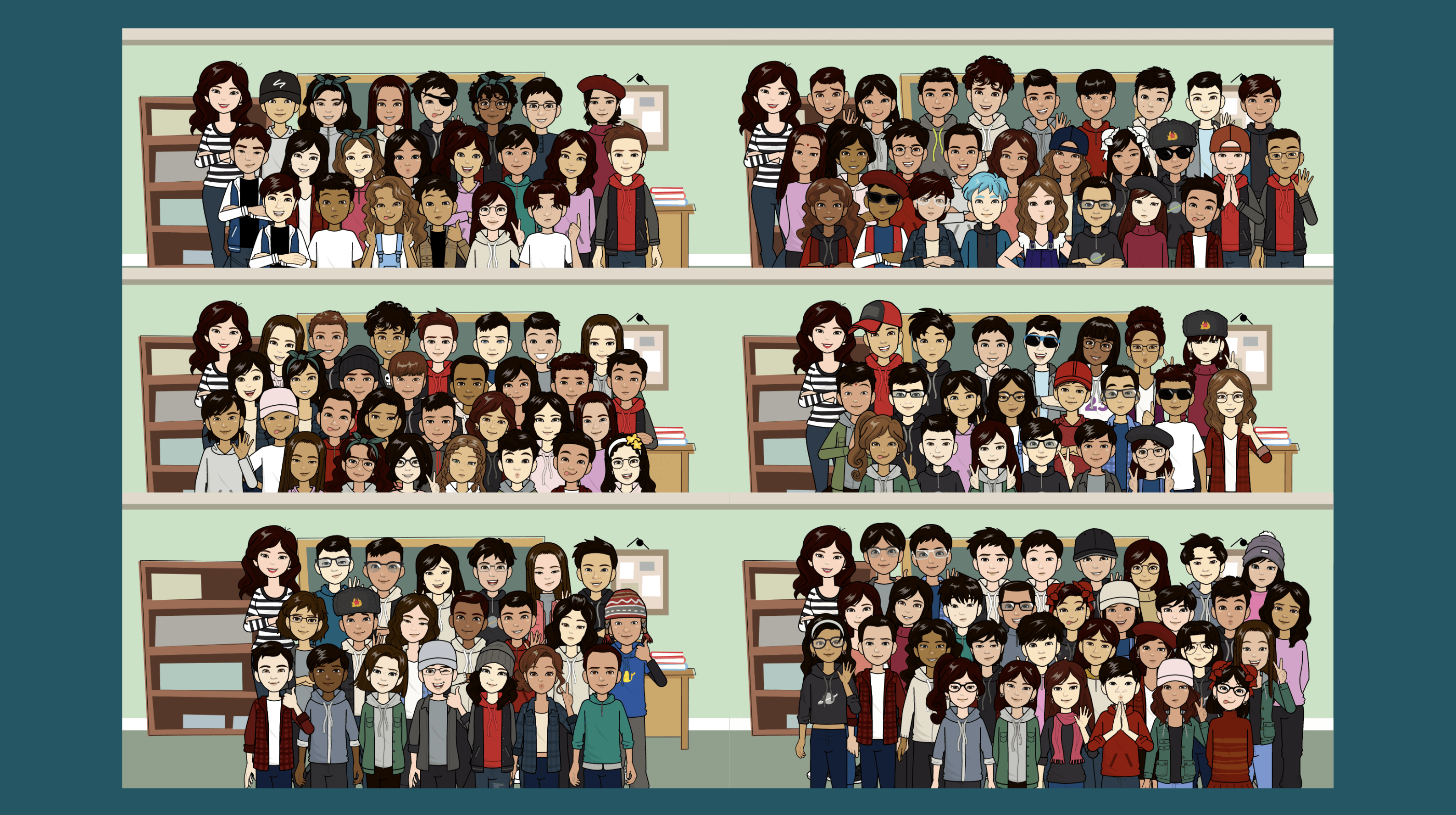
Pixton Class Photos (Spring Semester)

To begin, my students and I started this school year completely virtual with rising cases in our county and, more specifically, the zip codes for our school. We all struggled with dual challenges between school/work versus our personal lives.

As we approach the end of the weirdest school year EVER, I find myself reflecting on how far my students and I have come.

I have taught 7th grade for the past 26 years so I know the trepidation that incoming middle schoolers experience. Perhaps starting school at home was a bit more comforting since they didn’t have to worry about (1) where their classrooms were, (2) how things were going to go in the locker rooms where they changed for PE, and (3) who they were going to eat lunch with.

But with that comforting thought also likely came concerns about (1) bandwidth/Internet connectivity, (2) how online learning was going to work, and (3) whether they would still fit in or not.

I think it’s safe to say that all of these comforts and concerns occurred for both my students and me at several points throughout this school year. In fact, I think we are still navigating some of those challenges even today: May 6, 2021.

What I’m most proud of this year is the persistence of my students. This year had not been easy for them. Many of them struggled with bandwidth, access to devices, completing assignments online without the immediate help of their teachers, but more importantly concerns about their family as some parents were laid off, others contracted COVID and recovered (while others did not), and monetary issues that affected housing and food.

How do I know this?

My students wrote about them in their Living History Journals.

What I love about middle schoolers is their lack of filter. Their Living History Journals are chock full of stories about learning how to skateboard, making their first cake, learning how to perfect their artistic skills. But these journals also contain heart-breaking stories of losing family members, unbearable loneliness, and in some cases outright despair.

These journal entries were the life-line between my students and me. I was able to gauge how they were doing as well as provide encouragement and feedback.

Make no mistake, reviewing these weekly journal entries has been quite taxing. I felt like I never caught a break in the grading/reviewing/planning/executing cycle.

However, I know that I am not alone in dealing with the declining health of a parent. The legal and medical decisions that have to be made have continued to overwhelm me. But when I start to wallow in self-pity, I remind myself that I am not alone in this. Many of my students have had to deal with issues of loss and death…and they don’t have the same support system or maturity of experience like me. So these Living History Journals have helped me to stand up a bit straighter because if my students can persevere, then I most certainly can.

This has been a tough 14 months. Nothing could have prepared us for this. But what I’ve learned is that through grace, love, and patience, we can all come out stronger as a result of this trying time.

Like a phoenix rising from the ashes, I feel as if my students and I are finally able to see the light at the end of the tunnel.

We are going to make it after all. =)