#Truthbomb

Today I came across a blog post by Larry Cuban which deeply resonated with me. During my doctoral studies, I read several of his books and studies. You will find references to him peppered throughout my dissertation. And, I had a total #fangirl moment when he came to speak at Residency in summer 2017, and I was lucky (LUCKY!!!) to be able to sit down in a small group with peers from my cohort to discuss issues in education. His words of wisdom stem from his many years as a classroom teacher, administrator, researcher, and professor…and I hung onto every.single.word.
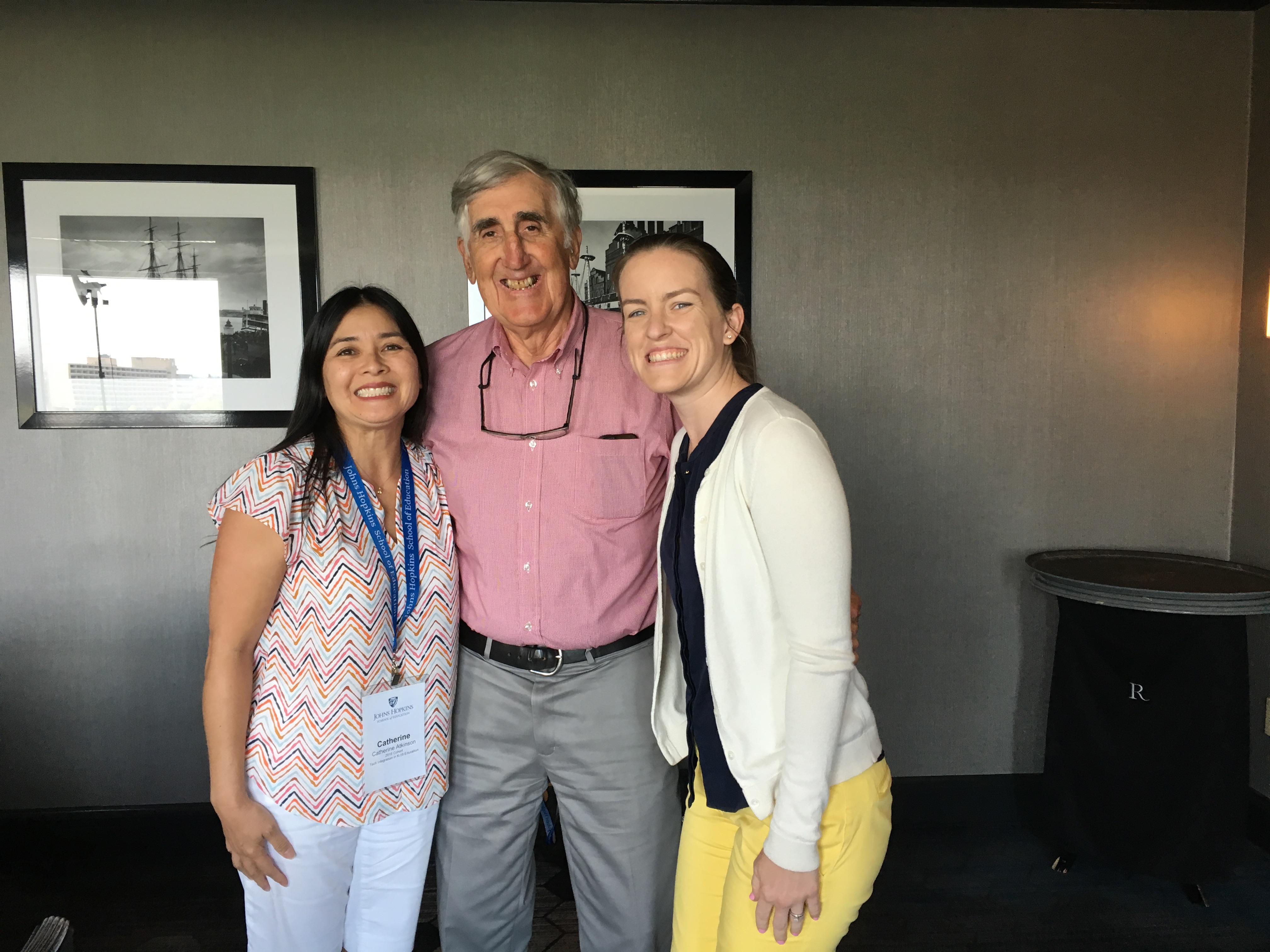
Yup. Totally #fangirling.

His latest blog post “One Way or Two-Way Traffic? The Policy to Practice Street” included a phrase that all stakeholders (e.g., policymakers, administrators, teachers) would be wise to remember:

Teachers are not passive recipients of policy but active participants in the policy-to-practice journey

Larry Cuban (August 17, 2019)

The disconnect between research and practice is only surpassed by the HUGE gap between policy and practice. Having been in the classroom for almost a quarter of a century (gosh that makes me sound old), I have seen the trends come and go. In fact, I have been in education long enough for the pendulum to swing back (almost) to where it started when I first walked into my own classroom.

I mention this because change is hard. Very few people like change. It’s easier to maintain the status quo. But what is progress without change? One cannot better themself in anything if they are unwilling to let go of past thinking, habits, etc. Now, I have not agreed with many of the restrictive policies that have come down the pipeline from legislatures far removed from the classroom. But I’m not insubordinate. I’m not going to NOT implement the policy. But I will add my own twist to it. As Cuban wrote in his blog post, “teachers are not passive recipients of policy but active participants in the policy-to-practice journey” (Cuban, 2019).

Most teachers will take whatever comes down the pipeline and add their own twist. Now, I don’t think that their twist is done out of malice, but rather it’s because of past experience and knowledge. We are not tabula rosa. Even new teachers have an idea of who they are, what they believe in, and what works for them. This reminds me of another phrase (also used in my dissertation) from Tyack and Cuban (1995) and that is the notion of the grammar of schooling.

Anyone who has gone through the American educational system believes they know how schools should work because they experienced it first-hand. Some of us experienced 12 years of American schooling as a child. So, sure, why wouldn’t we know how schools should be run? We knew which teachers were good (or bad); we knew which strategies we liked better (and hated); we knew which classes we enjoyed more (and why). So, yes, we all have an idea of how education should “look”…

But the educational experience is different when viewed through the lens of a teacher. Teaching is hard. And anyone who tells you otherwise is lying. But just because something is hard doesn’t mean that one can’t absolutely love it. I love teaching. It’s my calling, and I cannot image a more rewarding profession to be in.

Back to my point…

Teachers are not passive recipients of anything. The policies that come down the pike may be mandated (or highly suggested), but how those policies relate to practice is a whole other story. Each school is different. Every classroom is unique. Teachers are individuals and so are their students. Cookie-cutter anything does not work. It just doesn’t.

So…my point is that anyone who is in a leadership role (whether an administrator, program specialist, professional developer), please keep in mind the end-user of your policy or strategy: teachers. We are not out to thwart your efforts at change (at least most of us aren’t), but we aren’t an empty vessel waiting to be filled either. Don’t view us as passive recipients (and don’t mistake our bored looks as being passive-anything). Don’t patronize us because you’re the one standing in the front of the room. Contrary to what the media might say, we do care what happens to our students. We want the best for them. As I’m sure you do, too. Just remember that we’re the ones who will be doing the enacting, the real application-to-practice…in conjunction with 30 to 210 unique little individuals. So don’t judge or chastise us if we don’t implement your program or strategy as it was envisioned in your head. We are not robots, so it should come as no surprise that we will apply what we’ve learned…the best way we know how…keeping in mind the diverse set of individuals who walk through our doors every day.

And that’s just my two cents.

#controlenthusiast

Both gratifying and frustrating is my penchant for perfection. It began with pressure from my Japanese mom to make sure that I always gave my best in all of my endeavors. And while I can honestly say that I give my best most of the time, I have to admit that sometimes I’m so tired that I give just enough.

Don’t tell my mom.

Being the oldest sibling, I also felt (still feel?) the need to set a good example for my brother. And so I made sure to do my best for him, too. But I think…no, I know, that the pressure to excel contributed to my need for control…over basically everything.

I don’t kid myself that I can control what goes on around me. But I can certainly control my thoughts and actions. This reality comes in quite handy as a classroom teacher and doctoral student. In fact, I think one of the reasons why my dissertation adviser (@skprosser) and I hit it off so well is our innate need to control things. We are two controlling peas in the same pod.

But what does that mean for me as a teacher?

As the new school year quickly approaches (trust me when I say that I’m relishing the last few days of summer), I am reminding myself that though I need to set the standard for my students…I also need to show them the humanity behind my craziness. Though I constantly feel the need to be perfect, to give my best in all of my endeavors, I also need to be okay with giving just enough when the situation warrants. And I need to help my middle schoolers (those little perfectionists in the making) to see the same thing. Perhaps more importantly, I need to help my middle schoolers to see the humor in imperfection, no matter how much pressure parents put on us…I mean them.

The Missing Link

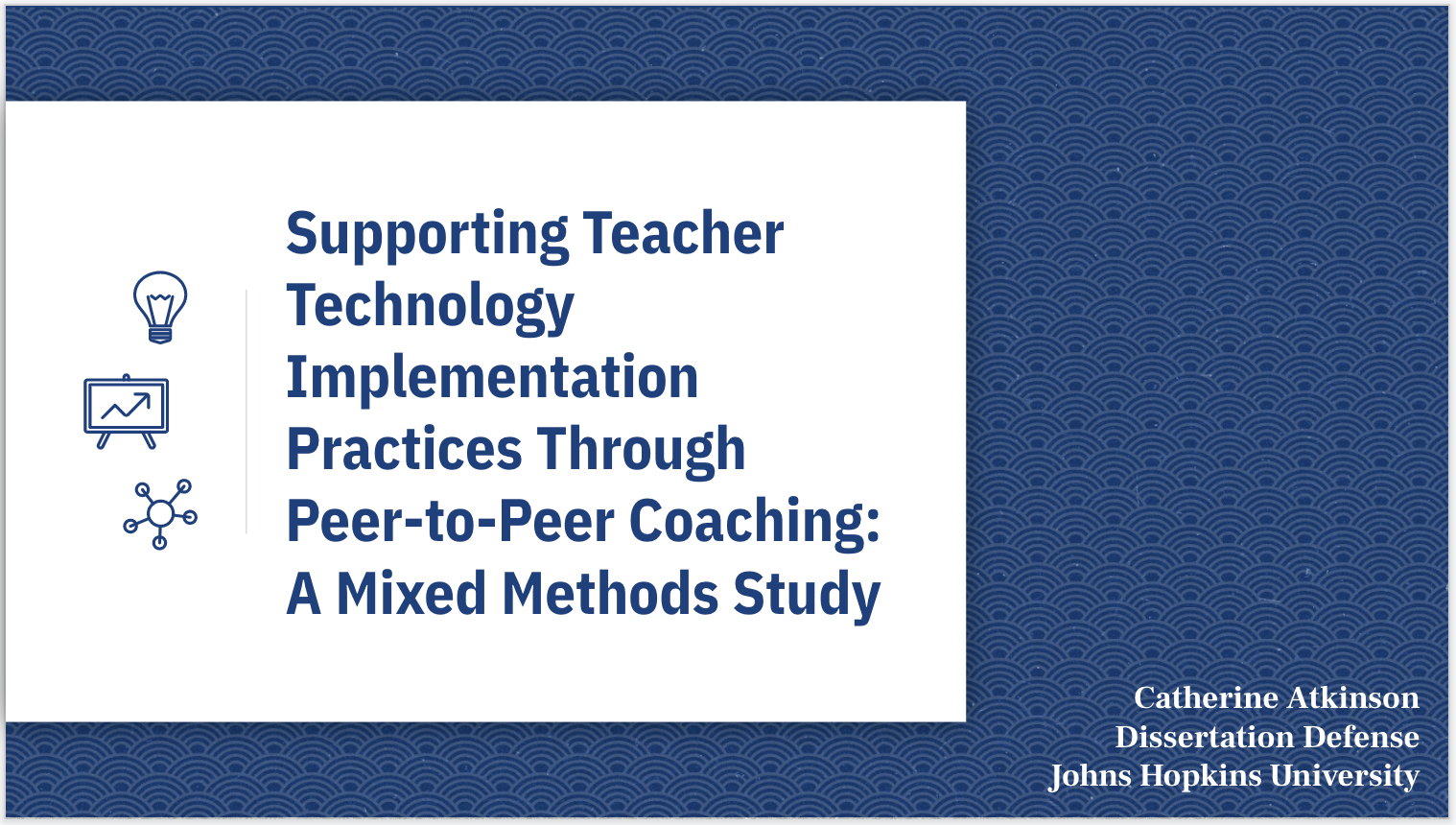
It has been approximately nine days since I defended my dissertation on my study titled “Supporting Teacher Technology Implementation Practices Through Peer-to-Peer Coaching: A Mixed Methods Study.” It was the culmination of three years of work, and it was worth every single minute.

The purpose of my study was to investigate if peer coaching would influence teacher technology practices. The focus stemmed from what I saw and heard regarding how teachers and students used technology in the classroom.

Working at a Title I school, we were able to purchase quite a bit of technology over the years. With the introduction of the SBAC, our mode of testing switched from scantrons to technology devices. Because we now had even more technology in the hands of teachers and students, I felt the need to share with teachers ways to integrate technology so that students would learn with it, instead of from it. In other words, my vision was for technology to serve as a tool for learning, and not the end itself.

But the questions remained: How to go about supporting teachers so that they see why change was necessary? And how to go about making that change?

All too often (and usually after a one-shot workshop), teachers are expected to implement the change and then student achievement scores would naturally increase. Easy, right?

Ha!

When this video came across my Twitter feed, my first thought was “This is really cute” . . . and then I realized that this is the reality of poorly-designed PD when teachers aren’t given the proper support structures.

If school leaders want teachers to change their instructional practices, then they have to provide professional learning opportunities that include the following:

  • Active Learning
  • Content-based Focus
  • Sustained Duration
  • Coherence
  • Collective Participation

These five components are from the work of Desimone and Garet (2015) and served as the framework for my dissertation study. Other researchers (Darling-Hammond, Hyler, & Gardner, 2017; Jensen, Sonnemann, Roberts-Hull, & Hunter, 2016) have offered their own list of must-haves for PD, and they more or less include the same components.

What is missing from most PD is follow-up support–sustained duration. It seems obvious that in order for change to occur, learners need a strong support structure. When you equate it to effective classroom practices with students, as teachers, we know that one lesson on a particular topic or skill is not enough to effect change. We have to provide multiple opportunities for students to practice and refine their learning. Talking at students does not equate to learning.

So why do we expect that from teachers who attend PD?

And why is this such a hard concept for school leaders, program facilitators, and PD providers to understand?

My dissertation study showed promise in using peer coaches to help teachers change their instructional practices to include meaningful learning with technology. The 8-month study included multiple opportunities for teachers to ask for and receive support from peers. Both novice and expert users of technology seemed to benefit for this symbiotic relationship. As the teachers came from multiple disciplines (i.e., English language arts, history, mathematics, science), they were also exposed to various ways that technology could be used to support student learning. The next step is to see if this informal support network can be sustained for the upcoming school year. #fingerscrossed

What I’ve learned from the research and my dissertation study is aptly summed up by a quote from George Couros:

If we want people to take risks, they have to know we are there to catch them and support them.

(Couros, 2015, p. 7)

We cannot expect change to take hold if we don’t, first, provide support for the change-makers.

References

Couros, G. (2015). The innovator’s mindset. San Diego, CA: Dave Burgess Consulting.

Darling-Hammond, L., Hyler, M. E., & Gardner, M. (with Espinoza, D.). (2017). Effective teacher professional development. Palo Alto, CA: Learning Policy Institute. Retrieved from http://learningpolicyinstitute.org/product/teacher-prof-dev

Desimone, L. M., & Garet, M. S. (2015). Best practices in teacher’s professional development in the United States. Psychology, Society, & Education, 7, 252–263. doi:10.25115/psye.v7i3.515

Jensen, B., Sonnemann, J., Roberts-Hull, K., & Hunter, A. (2016). Beyond PD: Teacher professional learning in high-performing systems. Washington, DC: National Center on Education and the Economy. Retrieved from http://www.ncee.org/wp-content/uploads/2015/08/BeyondPDWeb.pdf