#InnovatorsMindset Part 4 

“Nothing stops an organization faster than people who believe that the way you worked yesterday is the best way to work tomorrow.” — Jon Madonna

My quest to sketchnote each chapter as a reflection of Couros’ book The Innovator’s Mindset continues…

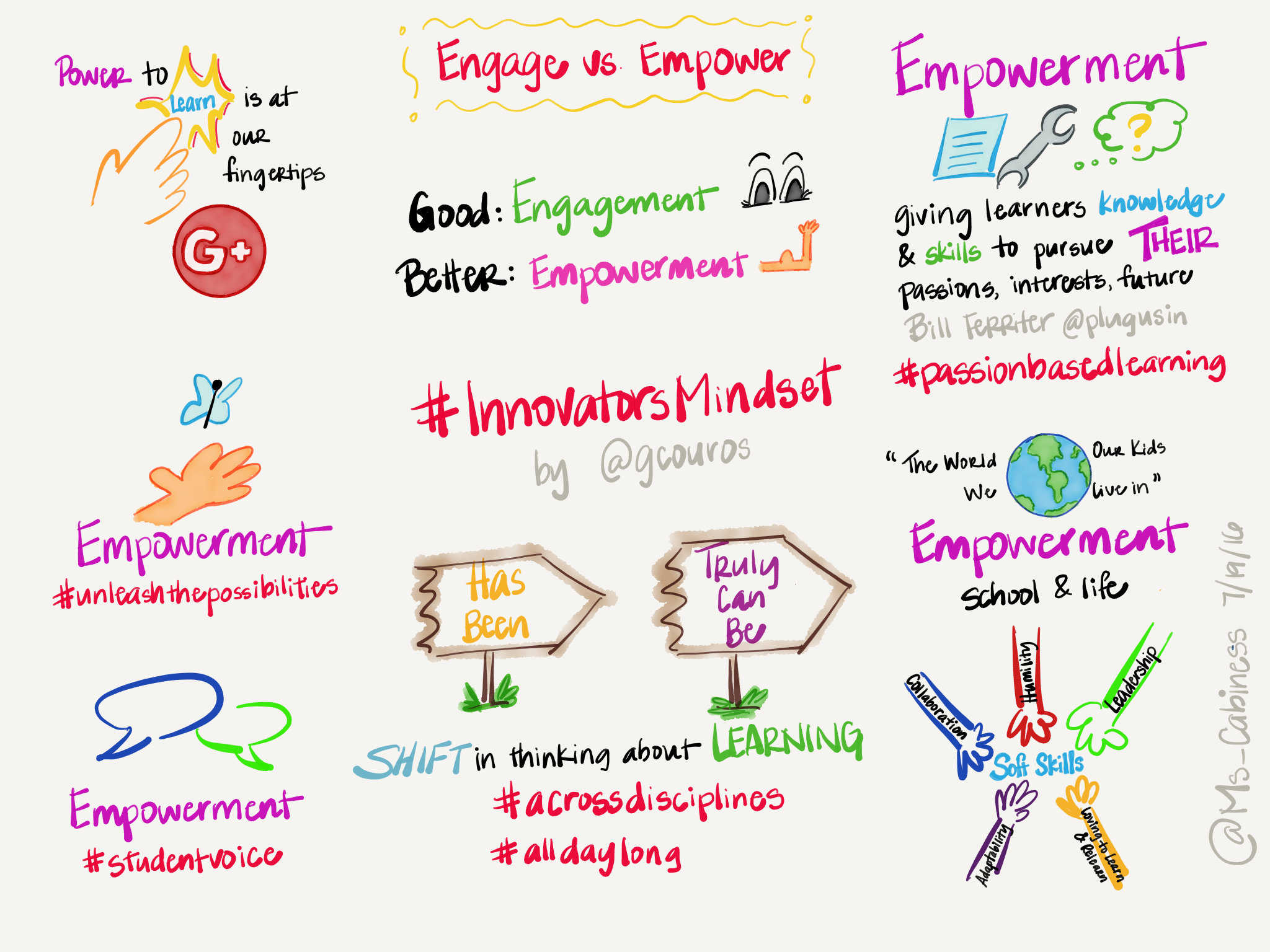
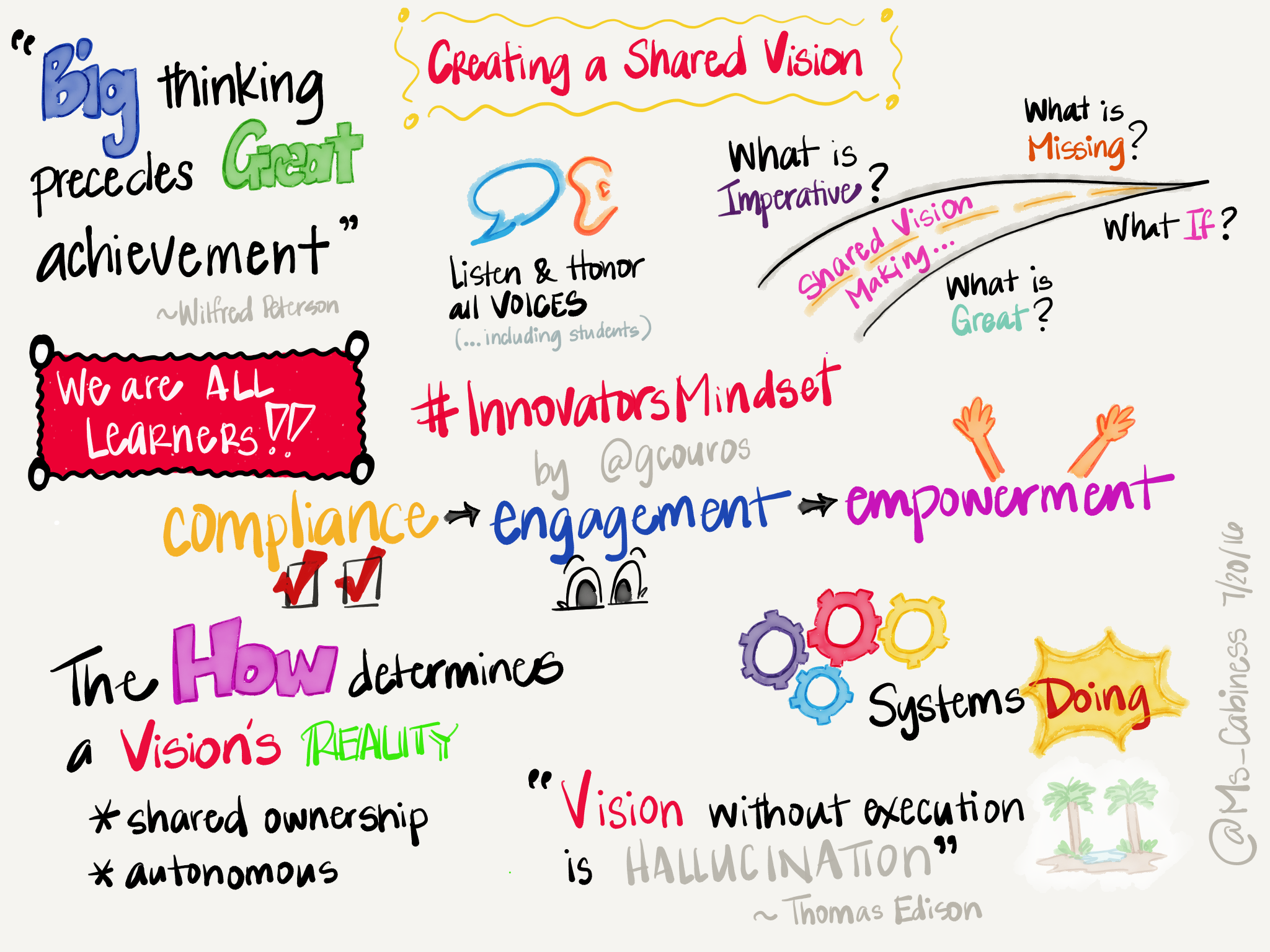
Chapter 6 focused on discerning the difference between engagement and empowerment. Truth be told, empowerment wasn’t high up on my radar because I was one of those teachers who focused more on the engagement side of learning. Oh, but I’ve had tons of conversations with my #PLN about teaching skills versus content and I understand the important role that both play in student learning. But what stood out to me from this section is the importance…no, the imperativeness (I hope that’s a word) of empowering my students to truly take charge of their learning. It’s not enough to introduce them to the tools and the content, but rather I need to make sure that each child that walks through my door understands that they have the power of choice. In my department, student choice is actually part of our classroom expectations. And we don’t merely pay lip service to the term either. Using a revised version of Marzano’s learning scales, we’ve broken down the standards by skills: Level 3 – describe/define, Level 4 – analyze, Level 5 – synthesize/evaluate/create. Students choose their level of learning for each unit and complete tasks, assignments, and activities for that level. But what I see that we need to do better is give students choice in what they want to study. Sure, we have standards that students will be tested on (district benchmarks, anyone?) but why not give students the power to choose which aspect of the content they would like to explore further? Because we use Haiku Learning for our classes, we could easily create a place for students to curate their learning. In fact, Flipbook is something that we tried last year at the 7th grade level and we (the teachers) loved it! Actually, our students really enjoyed it as well because they could see the Flipboard magazines from the other World History classes and comment/like what they saw. Hmmmm, and the wheels are turning in my head…
Now because I’m about ready to start my doctorate…and because I’m a HUGE geek when it comes to schooling, I’ve already started to read two of the books for this upcoming semester (I know, I know. Please don’t judge me).

What I found interesting is that Couros isn’t just taking about pie-in-the-sky learning experiences for students; what he’s proposing is supported by research. While Couros (2015) states that “it is imperative that we teach learners how to be self-directed and guide their own learning, rather than rely on others to simply engage them” (p. 1368 eBook), the National Research Council (2000) explains the importance of active learning, “New developments in the science of learning also emphasize the importance of helping people take control of their own learning. Since understanding is viewed as important, people must learn to recognize when they understand and when they need more information” (p. 12). Sounds a lot like empowering students is important in order for them to become self-regulated learners.

But it’s not enough to simply talk theory and what if’s. In order to truly make a difference, Couros next focuses on shared vision-making. What the admins want is nice. What the teachers want is nice. What the students want is nice. But without coming together and creating a shared vision about what learning should look like, everyone is really just out for themselves. It’s not easy bringing many stakeholders together for shared vision-making, but it’s one that is absolutely necessary. And I think that schools (mine included) may need to go back to the drawing board or stay at the drawing board until a shared-vision is created and accepted by all.
Reference:

National Research Council (2000). How people learn: Brain, mind, experience, and school: Expanded edition. Washington, DC: The National Academies Press. doi:10.17226/9853

#InnovatorsMindset Part 3

So this is my view from the deck as I finished this latest set of sketchnotes and blog post…

I would rather be out on the dock but I’m afraid I’ll either drop my new iPad Pro or Apple Pencil. 😁 But I couldn’t ask for a more serene setting with which to reflect on Chapters 4 & 5 of George Couros’ (@gcouros) book The Innovator’s Mindset.

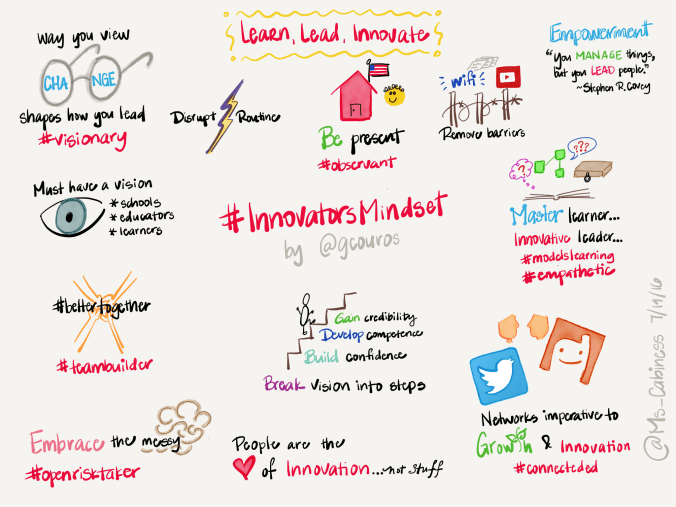
As I’ve previously mentioned, I am not an administrator but I do consider myself a leader, a change agent. I’ve always found myself in some type of leadership position even from a young age…which is a bit odd to me since I don’t like being in any type of limelight. But I do have the gift of being able to empathize and relate well with people which brings me to the main focus of Chapters 4 & 5 – relationships. George brings the issue of successful and sustainable change back to the idea of people…understanding them, empathizing with them, building a relationship with them, connecting with them. His idea of being a leader is more about servant leadership. Through consensus building of a school-wide vision, stepping into the shoes of the end-user (teachers & students), removing barriers to success, scaffolding the change process, and most importantly, keeping in mind that at the heart of innovation are the people, not stuff…not policies, not initiatives.

IMG_0012

IMG_0013

I think all too often educators at all levels feel the pressure to conform to policies and regulations…and get stuck right there. But George’s idea that we need to innovate inside the box is exactly what we need to remember when feeling discouraged or bogged down by issues that are behind our control. Innovation is happening at this moment…it’s better that it happens beyond “pockets of innovation” (p. 226) but it has to start somewhere. We’re not all fortunate to have a George Couros in our districts or at our school sites, but we do have leaders who understand the necessity of change and the importance of cultivating an innovator’s mindset.

Step aside naysayers, there’s a new mindset in town.


#InnovatorsMindset Part 2

IMG_0008

Only educators know this fact: summer vacations are rarely a vacation that doesn’t involve some type of personalized professional development. Now that PD can come in the form of EdCamps, Twitter/Voxer chats, workshops, conferences, PatioPDs, and the like. For me, my PD is definitely personalized. I’m reading what I want, when I want, and talking/sharing my thoughts on Twitter and this blog. Summer is not only a time to recharge our batteries before the new school year but it’s also a time for us to explore what truly interests us…our passions.

Earlier this summer, I finally had a chance to read a book by one of my favorite educators – Carol Ann Tomlinson – Assessment and Student Success in a Differentiated Classroom. Assessment is an integral part of education whether we are assessing our students’ or our own learning. But what draws me to Tomlinson’s work is her understanding of how to differentiate the learning for our students. I saw many parallels in Tomlinson’s work to George Couros’ book The Innovator’s Mindset. In fact, what struck me as most interesting is how both authors repeatedly brought the main focus back to the individual (whether it was the teacher or student) and how empathy plays an instrumental role in giving the learner true agency in the learning/growing process.

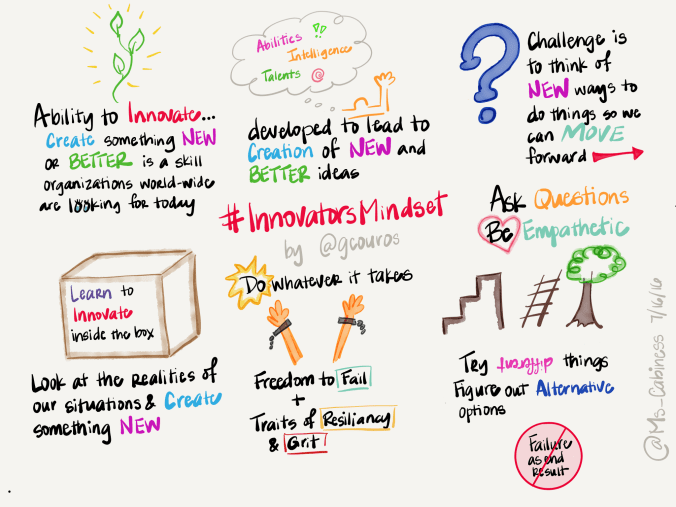
The above sketchnotes is from Chapter 2 “The Innovator’s Mindset”. It sums up how we need to change our mindset if we want to truly create an innovative learning environment at our school site. Having said that, Couros’ pearls of wisdom are not just for the individual classroom – we are no longer teaching on an island, after all – but rather his suggestions apply to school sites and beyond. For those who are familiar with differentiation, the sketchnotes contain key ideas that apply when working with gifted learners as well. But what I really like is the phrase “Learn to innovate inside the box”. For many years now, we’ve been told to think outside of the box..and for some things that works but the reality is…is that in education we are bound by constraints, such as: time, grading periods, funding, ed policy, district initiatives, etc. Trying to think outside of the box works but when it comes time to actually apply those thoughts…well, constraints is what holds many of us back…which is why I really like the idea of learning to innovate inside the box. Working within our constraints. Figuring out creative solutions within our constraints. Looking at new ways of doing things within our constraints.

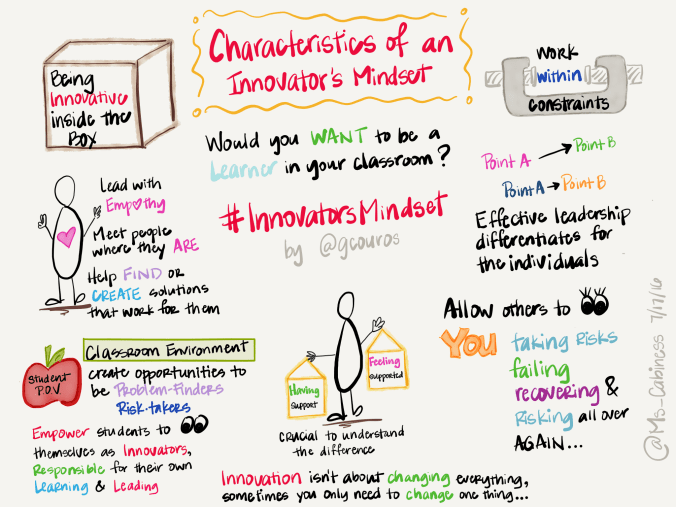
Our conversations at our school sites would be more fruitful if we keep in mind that we can learn how to innovate inside of the box. Couros is quick to point out that everyone (teachers and students) are not only learners but leaders in this process. However, in the case of Chapter 3 “Characteristics of the Innovator’s Mindset”…the information is more for administrators and teacher leaders and not so much for students.

IMG_0007

The prevalent idea from this chapter is that change is not only a process but one that must be transparent. Grassroots change agents can get the ball rolling but change needs to occur at all levels for it to truly be successful and sustainable. Leaders (administrators in this case) need to be out on the front-lines. Couros writes, “As leaders we cannot tell others they should be innovative while we continue to do the same thing” (p. 883). The same applies to teachers…we cannot tell our students that we want them to be creative and take risks if we are not willing to do the same. So you see, if we are to have an Innovator’s Mindset, it must happen across all levels. It’s a definitely mindset change…one that I’m happy to oblige.