AI in EDU Summit

A speaker presenting to a large audience at a conference about 'The Future of AI in Education', with a presentation displayed on a screen.

On March 11th, I had the privilege to attend and present at EdTechTeacher’s AI in EDU Summit at Bentley University in Massachusetts. It’s been quite some time since I’ve presented in person at a conference, and let me tell you, I’ve certainly missed the adrenaline rush and camaraderie of in-person back-and-forth conversations.

The day was a whirlwind, and there was so much to take in! I wish there was a way for me to clone myself because I wanted to attend everything. But since that wasn’t an option, I can only provide a limited review of my time there. So I hope that I do justice to the many amazing educators I had the chance to talk with and learn from.

Here are my take-aways from the day:

  • Schools and districts need an AI Policy. More importantly, this policy needs to be crafted with the voices of all stakeholders AND be flexible enough to be revised as AI platforms and capabilities change over time.
  • Student learning outcomes need to drive AI use. Aside from the many useful, innovative, and enlightening uses of AI in the classroom for teaching and learning, it is important to make sure that learning objectives drive the what, how, and why of technology integration. It’s equally imperative that educators look at student learning to see to what extent AI is helping students to engage in deeper learning as opposed to superficial knowledge.
  • Be curious and not judgmental. Okay, I totally stole that from Ted Lasso. But it’s true. AI tools can evoke a sense of excitement but also dread — sometimes both at the same time. I encourage everyone to be open to the possibilities of how AI can help level the playing field for teachers and students across demographics, regions, and socio-economic levels. I acknowledge that there are legitimate concerns with using AI (first and foremost, student privacy), but let’s begin these conversations of AI use with an open mind and sense of wonder.
  • Don’t be afraid to pivot. I can’t be the only one who was thinking one way about AI (in general) or a particular AI tool only to change my mind when more information became available. With the many AI tools and platforms available (and emerging), it is very likely that your opinion on the value of that tool for teaching and learning will change with product updates, regular use, and/or shifting priorities for student learning. My advice? Keep the conversations flowing and recognize that opinions will fluctuate with the ever-changing landscape and reach of AI.

There are so many different perspectives when it comes to AI use and the projected impact of AI for teaching and learning. But what I keep coming back to is the fact AI is a tool. It’s a medium for learning. It’s not a silver bullet. What is going to move the needle in terms of improving student outcomes is creating meaningful learning experiences grounded in research-based best practices with measurable metrics. Period.

References

Driscoll, T., & McCusker. S. (2024). Crafting AI policy for schools: A step-by-step guide [Webinar]. https://youtu.be/lxu1WS5ojzs?si=_QCot72pDDfe5xB7

Holland, B. (2025). Is it working? Building an evidence base to inform AI initiatives [Presentation]. AI in EDU Summit. Bentley University, MA.
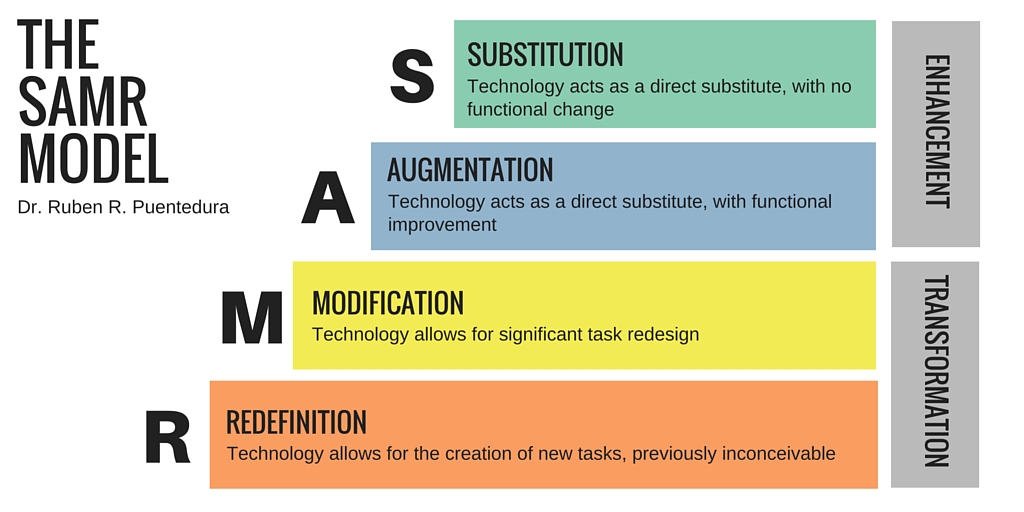

The SAMR Model & AI

AI Positioned Along SAMR Spectrum

The SAMR model (Puentedura, 2015) is a valuable framework for teachers considering technology integration. It helps us think about how and why we use technology, moving from simple substitution to transformative redefinition. Many educators are asking, “Where does AI fit in?” The answer is: Across the entire spectrum.

AI is a technology tool, and like any tool, its application can range from basic replacement to innovative redesign.

Let’s illustrate this with a practical ELA lesson:

Learning Objective: Students will be able to clearly articulate the reasons why cell phones should be allowed or banned in schools. Students will create a PSA.

  • Substitution: Students use AI-powered voice typing in Google Docs to draft a persuasive essay on cell phone use in schools. This replaces traditional typing but doesn’t fundamentally change the task. AI’s Role: Speech-to-text functionality.
  • Augmentation: Students use an AI grammar and style checker (like Grammarly or a similar feature within a word processor) to refine their essays. The AI can suggest stronger word choices, identify areas needing more detail, and check for clarity and conciseness. This enhances the writing process by providing automated feedback, making it more efficient and effective. AI’s Role: Automated feedback and analysis.
  • Modification: Students engage in a structured debate with an AI chatbot about the pros and cons of cell phones in schools. The AI can present arguments for both sides, challenge student thinking, and provide relevant data or research. Students then use insights from this debate to revise and strengthen their essays. This significantly alters the learning task by providing an interactive and dynamic learning experience. AI’s Role: Facilitating interactive learning and providing information.
  • Redefinition: Students use AI to brainstorm innovative ways to advocate for their chosen stance on cell phone use. The AI can suggest different media formats for their PSA (e.g., interactive infographics, short videos, social media campaigns), help generate creative content ideas, and even assist with basic video editing or graphic design. Students then collaborate with peers who share the same opinion to create a PSA that leverages these AI-powered insights and share it publicly on their school’s social media accounts. This transforms the task by enabling students to create something entirely new and impactful, potentially reaching a wider audience and using tools that would have been previously unavailable. AI’s Role: Creative content generation, media format suggestions, and basic production assistance.

Addressing Concerns about Skipping Levels

It’s true that some students might try to jump straight to redefinition. However, each level of SAMR offers unique learning benefits. To encourage a more comprehensive approach, teachers can:

  • Structure the lesson progressively: Require students to complete activities at each level before moving on.
  • Use formative assessments: Check for understanding and skill development at each stage.
  • Encourage reflection: Have students document their learning process at each level, explaining how the different AI tools helped them.
  • Emphasize the value of each stage: Explain how each level builds upon the previous one, ultimately leading to a richer and more meaningful final product.

AI is a Powerful Tool, not a Replacement for Teaching

AI is not the antithesis of learning. It’s a powerful tool that can enhance and transform the learning experience. Teachers play a crucial role in guiding students’ use of AI, ensuring that it’s used effectively and ethically. By understanding how AI can be integrated across the SAMR spectrum, educators can empower students to become not just consumers of technology, but creators and innovators.

NOTE: I used Gemini to provide some lesson ideas that incorporated AI use according to the SAMR model AND I also uploaded my original draft to Gemini to help me make this post concise and more to the point. With just a little bit of tweaking, this post reflects my original intent: To show how the SAMR model can help teachers determine to what extent technology can be used to transform the learning process.

References

Puentedura, R. R. (2015). SAMR: A Brief Introduction [Weblog]. http://hippasus.com/blog/archives/227 / http://hippasus.com/rrpweblog/archives/2015/10/SAMR_ABriefIntro.pdf

Flipped Learning with AI

Student uses AI at home to research a topic.

I’ve been doing quite a bit of thinking about AI and its role in education.

I’ve read my share from the nay-sayers, cautiously optimistic users, as well as those who are leading the charge with AI adoption in the classroom. I also have some insight into how the private sector is viewing AI, including those in the cryptospace. To be clear, I am not professing to be an expert in AI — I am very far from that. But I am well-versed with practical experience in how teachers can harness the power to technology to make learning meaningful and relevant for students.

Now, what I’m going to be posting here are just my thoughts which will likely change and/or be refined over time as the conversation on technology tools and AI continues to evolve. So here goes…

Remember flipped learning?

I had the wonderful opportunity to see Jonathan Bergmann speak about how to flip your classroom back in 2012-ish. What I gained from that session (besides his very informative book) was the idea that I could have my students watch mini-video lectures (no more than 9 minutes) at home, take notes, and then bring them back to class where we could apply what they learned. They did the mundane (but very important task) at home, and in class they got to actively apply what they learned with the assistance and collaboration of their peers along with my guidance.

Having students watch those short videos at home and take notes served multiple purposes:

  • Students could work at their pace ✅
  • Students could determine where and when they wanted to watch the video ✅
  • I gained about 15-20 minutes back in instructional time because I didn’t have to wait for all of my students to copy my notes down before we could move on to the application phase ✅

It was a win-win-win situation.

Now here is what I’ve been thinking about. There have been so many conversations about the benefits, challenges, and negatives when it comes to AI use in the classroom — in particular, I think the main challenge rests with AI use in the classroom itself. Meaning, students are using AI to do their work for them, including providing answers to questions that they should be trying to work through themselves. And if students are allowed to use AI while in class, I don’t see how teachers can prevent any of that happening.

But what if we took the flipped lesson approach?

What if we encouraged students to use AI at home to research a topic and/or use it as a thought-partner for generating an idea for a project AND THEN when they returned to class the very next day…they share their findings with their peers and/or collaborate on a project or activity without any AI assistance. Meaning, no access to technology. Students have their notes that they may or may not have taken when using AI at home but nothing else. This way, they have to internalize what they gleaned from their AI use at home in order to apply it in class the next day.

Here is an example…

The lesson topic is the Five Themes of Geography. Instead of reading the definitions of the Five Themes of Geography in their textbook (boring!), students have two options: (1) they can watch my flipped videos on the Five Themes of Geography and take notes or (2) they can use AI as a thought-partner or tutor to learn the definitions of the Five Themes and take notes. Students who choose the AI option will have parameters to help them create prompts so that they don’t go down a rabbit hole.

Regardless of which option they choose, when they come back to class, students will have a developing understanding of the Five Themes of Geography that they will then apply. Students would work together to draw and identify personal examples that demonstrate their understanding of Location, Place, Human-Environment Interaction, Movement, and Region before we apply that learning to our upcoming units in the following days.

Students apply their learning in class the next day with their peers.

Now, to be clear, AI may not provide the most relevant or most accurate definitions and examples for the Five Themes of Geography (e.g., ChatGPT 4o provided so-so results, Gemini offered better definitions and examples). But I think that’s okay because when students come back to class the next day, they’ll get to have those conversations with their peers and who knows what other teachable moments may come up?

In this scenario, I see AI as being beneficial for several reasons:

  • Student voice and choice — they can choose to watch teacher-created videos or use AI to help them learn particular concepts ⭐️
  • Students can engage in a conversation with AI to drill down further or to expand their scope of exploration (this wouldn’t be the case with a teacher-created video) ⭐️
  • Teachers don’t necessarily have to record videos as students would engage with the AI as a tutor (this would save teachers time because, let’s face it, recording a video using a document camera to do notes can be quite time-consuming) ⭐️
  • Students can see that AI is a tool for learning ⭐️

This brings me to the end of my thoughts on Flipped Learning with AI (for now). But I’m sure I’ll have more to share as I continue to marinate on AI in education. Stay tuned…