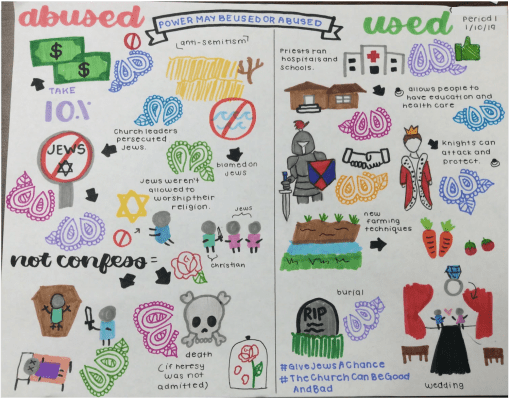
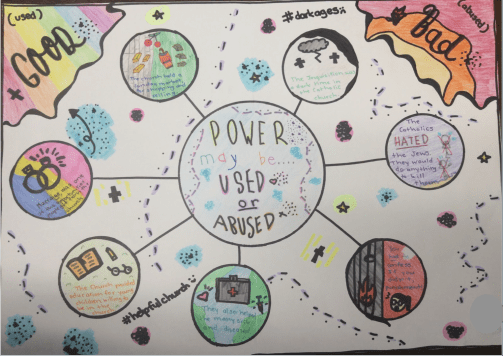
In our study of life in Europe during the Middle Ages, we explored the power of the Catholic Church. Students were given the task to choose a generalization from the Universal Theme of Power. From there, they were expected to sketchnote their understanding of the power the Catholic Church exerted over people living in feudal society.
I’m highlighting two of the exceptional sketchnotes from my talented GATE/PreAP World History class. Giving students the option to demonstrate their learning in a creative fashion allows students to showcase their talents. Not all students can draw, but some can…and these two students are among them. I am not only impressed with their work, but I can see that they are able to demonstrate their learning about the influence the Catholic Church exerted during that era.
I am firm believer in student choice in the areas of content, process, and product. Differentiation is the means to support the individual needs of my middle schoolers. Not all of my students take me up on my offer of free choice, but I think that’s the by-product of the focus on test scores to measure learning. Would a quiz on the power of the Catholic Church show how much these students could recall? Would it have been faster to administer a quiz instead of allot multiple days to complete the sketchnotes? Of course, but would a quiz have allowed students the opportunity to engage in a bit of creativity? Rhetorical I know.
As this semester comes to a close and I get ready to say goodbye to these kiddoes, I’m glad that I have their work to remember them by. They not only inspire me, but they remind me of why I chose this profession in the first place.
This has been a great summer. I spent a good deal of it enjoying #lakelife in Michigan. Anyone who’s been in the classroom knows that teachers don’t turn their brains off when school is out. I mean, our brains might shut down from sheer exhaustion but once we’ve recovered, most of us are busy catching up on things that we couldn’t do during the school year. For me, it was reading and learning about new technology tools. I also spent quite a bit of time in my #happyplace, sketchnoting the book Innovator’s Mindset. I’m working on my last one which is perfect since school starts in two weeks.
What was reinforced to me from the book is that we need to get outside of our comfort zone if we want to grow…to be innovative. Comfort is nice. After all, who doesn’t love snuggling up by a fire with a good book on a cold day?
This summer, though, I was introduced to several really cool new technology tools…one of which is featured in the image above – Momentum. As a Mac user, I used to swear by Safari; but Chrome has continued to impress me with their features…and the Momentum extension takes the cake! Thank you Caitlin McLemore (@EdTechCaitlin)! Who doesn’t love opening up a new tab and being personally greeted? Momentum also allows users to type in one focus for the day – essentially a goal, a To Do. What I like is that it only allows users to type one thing at a time so there’s not the ability to create a monster list and then feel defeated at the end of the day when there are so many unchecked boxes. Am I the only one with this problem? With Momentum, I type in one focus, do it, check it off, and then I’m on to a new one. Being that it’s summer, sometimes my focus is a little less taxing (see the image at the top). However today, I’ve already completed one focus (Review RefWorks – I know, exciting, right? But I’m back in grad school…) and I’m now onto my second one (Finish blog post). I like that because I’m only allowed to set one focus at a time, it helps me to not multi-task.
The next awesome technology tool is Grammarly. I heard about this tool from Beth Holland (@brholland) when she presented to the #JHUEdD16 cohort of doctoral students at Johns Hopkins University. I’d like to think that I’m pretty good at spelling and grammar but who couldn’t use a little bit of extra help? Grammarly can be added as an extension for both Chrome and Safari. The benefit of adding Grammarly is that it will give options for grammar and spelling as one types online. For example, Grammarly has already given me three suggestions for revision as I type this blog – I accepted two of the three so far. But you can also download Grammarly as a desktop app which will come in handy as I write and write and write in the pursuit of my doctorate. I’ve already tinkered around with the desktop app using my Classroom Expectations for my students…and yes, there were corrections to be made. #sigh
It’s the little things that make the true difference and in the case of technology, these two tools have already made their impact…I mean, I’m already at #9 (see list below). When it came to these two tools: I skipped #1-8. I’m already there. I’m all in. I mean, seriously, how did I live without these two tools?
I know that several districts are already back in session. But I’ve checked off my focus in Momentum and now I’m off to have lunch with my girlfriends from work because we don’t have to be back until August 30th…Happy summer to all!
Those thinking about or new to using technology in the classroom may be under the impression that technology is the magic potion that is going to radically change student engagement and achievement in the classroom. That is a huge misconception. Technology in and of itself is not the magic potion. If teachers simply hand students a mobile device without changing the task, it’s no better than using the more affordable alternatives – pencil and paper. In fact, the technology tool (in this case) becomes no better than a $1000 pencil.
What needs to change is the task itself. And this is where pedagogy comes in.
Dr. Ruben Puentedura is credited with defining how technology can transform learning tasks through the use of the SAMR model. John Spencer sums it up quite nicely:
Now let me be clear. There is nothing wrong with tasks at the Substitution level. After all, teachers and students need to start somewhere. But if that is all that is done…then the technology tool becomes an expensive alternative to paper and pencil. Those of us in the educational field know that money doesn’t grow on trees (remember when we used to have department budgets?) so the thought of spending vast amounts of money on technology only to have it being solely used at the lowest level of SAMR is a travesty.
But in order for teachers to understand the need to change the learning task, they first have to understand the pedagogy behind the meaningful integration of technology in the classroom. This is where the TPACK model comes in. Candace M does a great job summing up TPACK in 2 minutes.
So you see, teachers have (or should have) the content portion down pat. And some may even have differing levels of technology prowess. But without understanding the pedagogy, the learning tasks associated with technology will have little to no connection to authentic learning. And now we’re back to the $1000 electronic pencil analogy.
But I recently came across a term that is making me think more about how I structure learning tasks for my students and PD for my teachers: pedagogical content knowledge (PCK). In the book How People Learn: Brain, Mind, Experience, and School: Expanded Edition, pedagogical content knowledge is defined as “knowledge about how to teach in particular disciplines” (p. 167). In other words, it’s not enough to know the content, teachers must educate themselves on how to teach that specific content. The discipline of history needs to be taught differently than the discipline of math. In fact, the National Research Council states “expert teachers are sensitive to those aspects of the discipline that are especially hard or easy for new students to master” (p. 166). Take the discipline of history, for example. History is more than a mere list of names, dates, and places. Shocking, I know. Good history teachers will help students develop skills to critically read and interpret primary and secondary sources, corroborate evidence, as well as understand the problematic nature of historical interpretation (National Research Council, 2000).
So on top of clearly articulating the pedagogy behind meaningful integration of technology to teachers who attend my PD sessions, I also need to keep in mind the reading, writing, and thinking skills of how students should approach the study of history in my own classroom as well as how teachers should approach lesson and task design in their history classrooms.
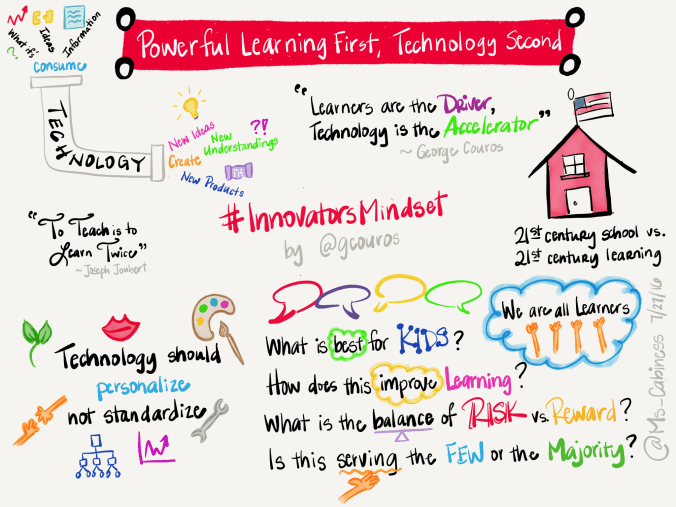
And since I’m a serial book reader, I get all excited when topics of my books come together. Having finished The Innovator’s Mindset earlier this month, I’m stoked that the book How People Learn is helping me to make more sense in how to design meaningful learning opportunities for students. The sketchnotes below is my reflection on Chapter 9 from the #InnovatorsMindset book.


 Living the Learning Curve