How Feelings Drive AI Use in Education

Imagine trying to steer a six-ton elephant with a tiny rider. This analogy, from Jonathan Haidt (2006), perfectly illustrates the often-overlooked power of emotions in behavior change, a concept I’ve emphasized in my workshops for years. As we continue to debate the pros and cons of integrating technology into our classrooms, it’s crucial to remember a fundamental truth: our brains operate with both feeling and logic. Haidt described this using the analogy of the Elephant (emotion) and the Rider (rationale).

Chip Heath and Dan Heath (2010) clarify:

“Perched atop the Elephant, the Rider holds the reins and seems to be the leader. But the Rider’s control is precarious because the Rider is so small relative to the Elephant. Anytime the six-ton Elephant and the Rider disagree about which direction to go, the Rider is going to lose. He’s completely overmatched” (p. 7).

The Rider, though seemingly in control, is easily overpowered by the far more potent Elephant.

For me, I liken it to a never-ending battle of wits.

The following video provides a compelling visual representation of this dynamic:

The reason why I bring up this concept is that I have seen so many respected educators share their thoughts about whether to adopt AI, the role it should play in K12 education, and future implications. And, I’m not suggesting that they are wrong. But what I’m hoping is that people remember that emotions drive decision-making. And ultimately, it’s the teachers who make instructional decisions in the classroom. If teachers are uncomfortable with AI, their decision of whether or not to use that tool in their classroom will be driven by the emotions that they feel regarding AI.

So, if you’re a school leader and you envision the adoption of AI [or insert any new technology tool, curriculum, initiatives, etc.] in teacher practices or for student learning, I urge you to take a step back and consider the role that emotions play in teacher decision-making processes. Sure, you can mandate AI adoption, but I think we all know that mandates have a limited effect on lasting change.

If you want change to stick, then it is worth taking into account the voice of teachers — and I don’t just mean the ones who talk the loudest or are the squeakiest of wheels — I mean, take the time to talk with all of your teachers. Listen to what they have to say. Empathize with their concerns. Be open to thoughts and opinions that may not match yours. Understand that emotions play a significant role in whether the teacher will be onboard with the change or a saboteur.

If you want to learn more about the role of emotions in decision-making, I urge you to take a look at Hall and Hord’s (2015) framework, the Concerns-Based Adoption Model (CBAM). I have written about this concept and also shared it across the workshops I have done because there are a variety of factors that determine whether and to what extent change occurs. One of the easiest ways to put your finger on the pulse of how teachers are feeling about AI is to use Hall and Hord’s idea of the one-legged interview, named for a brief or spontaneous conversation that can take place in the time it might take to shift weight from one leg to the other. These informal conversations can reveal a lot about what teachers are thinking and feeling about a change initiative. If you can address the tension between the Elephant and the Rider, then your change initiative has a higher likelihood of success.

References

Haidt, J. (2006). The happiness hypothesis: Finding modern truth in ancient wisdom. Basic Books.

Hall, G. E., & Hord, S. M. (2015). Implementing change: Patterns, principles, and potholes (8th ed.). Pearson Education.

Heath, C., & Heath, D. (2010). Switch: How to change things when change is hard. Broadway Books.

AI in EDU Summit

A speaker presenting to a large audience at a conference about 'The Future of AI in Education', with a presentation displayed on a screen.

On March 11th, I had the privilege to attend and present at EdTechTeacher’s AI in EDU Summit at Bentley University in Massachusetts. It’s been quite some time since I’ve presented in person at a conference, and let me tell you, I’ve certainly missed the adrenaline rush and camaraderie of in-person back-and-forth conversations.

The day was a whirlwind, and there was so much to take in! I wish there was a way for me to clone myself because I wanted to attend everything. But since that wasn’t an option, I can only provide a limited review of my time there. So I hope that I do justice to the many amazing educators I had the chance to talk with and learn from.

Here are my take-aways from the day:

  • Schools and districts need an AI Policy. More importantly, this policy needs to be crafted with the voices of all stakeholders AND be flexible enough to be revised as AI platforms and capabilities change over time.
  • Student learning outcomes need to drive AI use. Aside from the many useful, innovative, and enlightening uses of AI in the classroom for teaching and learning, it is important to make sure that learning objectives drive the what, how, and why of technology integration. It’s equally imperative that educators look at student learning to see to what extent AI is helping students to engage in deeper learning as opposed to superficial knowledge.
  • Be curious and not judgmental. Okay, I totally stole that from Ted Lasso. But it’s true. AI tools can evoke a sense of excitement but also dread — sometimes both at the same time. I encourage everyone to be open to the possibilities of how AI can help level the playing field for teachers and students across demographics, regions, and socio-economic levels. I acknowledge that there are legitimate concerns with using AI (first and foremost, student privacy), but let’s begin these conversations of AI use with an open mind and sense of wonder.
  • Don’t be afraid to pivot. I can’t be the only one who was thinking one way about AI (in general) or a particular AI tool only to change my mind when more information became available. With the many AI tools and platforms available (and emerging), it is very likely that your opinion on the value of that tool for teaching and learning will change with product updates, regular use, and/or shifting priorities for student learning. My advice? Keep the conversations flowing and recognize that opinions will fluctuate with the ever-changing landscape and reach of AI.

There are so many different perspectives when it comes to AI use and the projected impact of AI for teaching and learning. But what I keep coming back to is the fact AI is a tool. It’s a medium for learning. It’s not a silver bullet. What is going to move the needle in terms of improving student outcomes is creating meaningful learning experiences grounded in research-based best practices with measurable metrics. Period.

References

Driscoll, T., & McCusker. S. (2024). Crafting AI policy for schools: A step-by-step guide [Webinar]. https://youtu.be/lxu1WS5ojzs?si=_QCot72pDDfe5xB7

Holland, B. (2025). Is it working? Building an evidence base to inform AI initiatives [Presentation]. AI in EDU Summit. Bentley University, MA.

The SAMR Model & AI

AI Positioned Along SAMR Spectrum

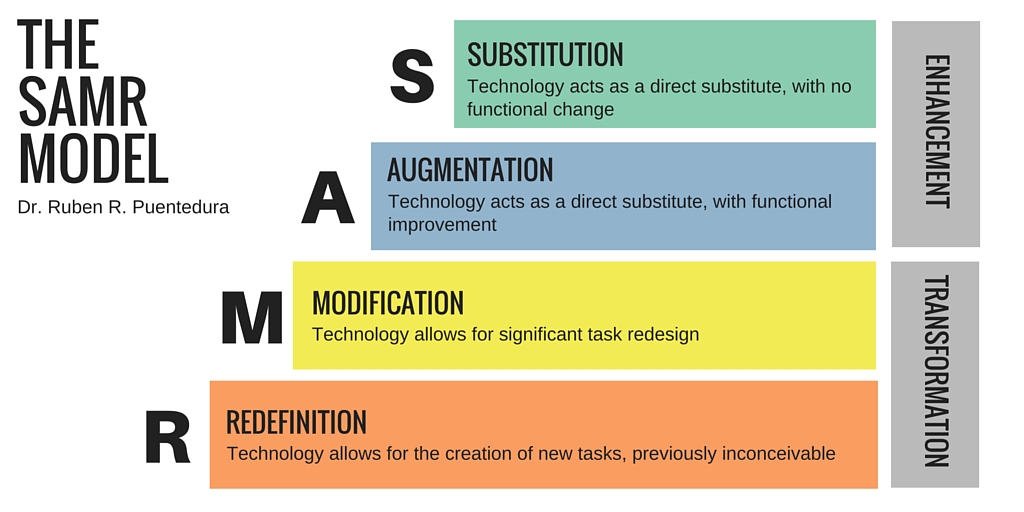
The SAMR model (Puentedura, 2015) is a valuable framework for teachers considering technology integration. It helps us think about how and why we use technology, moving from simple substitution to transformative redefinition. Many educators are asking, “Where does AI fit in?” The answer is: Across the entire spectrum.

AI is a technology tool, and like any tool, its application can range from basic replacement to innovative redesign.

Let’s illustrate this with a practical ELA lesson:

Learning Objective: Students will be able to clearly articulate the reasons why cell phones should be allowed or banned in schools. Students will create a PSA.

  • Substitution: Students use AI-powered voice typing in Google Docs to draft a persuasive essay on cell phone use in schools. This replaces traditional typing but doesn’t fundamentally change the task. AI’s Role: Speech-to-text functionality.
  • Augmentation: Students use an AI grammar and style checker (like Grammarly or a similar feature within a word processor) to refine their essays. The AI can suggest stronger word choices, identify areas needing more detail, and check for clarity and conciseness. This enhances the writing process by providing automated feedback, making it more efficient and effective. AI’s Role: Automated feedback and analysis.
  • Modification: Students engage in a structured debate with an AI chatbot about the pros and cons of cell phones in schools. The AI can present arguments for both sides, challenge student thinking, and provide relevant data or research. Students then use insights from this debate to revise and strengthen their essays. This significantly alters the learning task by providing an interactive and dynamic learning experience. AI’s Role: Facilitating interactive learning and providing information.
  • Redefinition: Students use AI to brainstorm innovative ways to advocate for their chosen stance on cell phone use. The AI can suggest different media formats for their PSA (e.g., interactive infographics, short videos, social media campaigns), help generate creative content ideas, and even assist with basic video editing or graphic design. Students then collaborate with peers who share the same opinion to create a PSA that leverages these AI-powered insights and share it publicly on their school’s social media accounts. This transforms the task by enabling students to create something entirely new and impactful, potentially reaching a wider audience and using tools that would have been previously unavailable. AI’s Role: Creative content generation, media format suggestions, and basic production assistance.

Addressing Concerns about Skipping Levels

It’s true that some students might try to jump straight to redefinition. However, each level of SAMR offers unique learning benefits. To encourage a more comprehensive approach, teachers can:

  • Structure the lesson progressively: Require students to complete activities at each level before moving on.
  • Use formative assessments: Check for understanding and skill development at each stage.
  • Encourage reflection: Have students document their learning process at each level, explaining how the different AI tools helped them.
  • Emphasize the value of each stage: Explain how each level builds upon the previous one, ultimately leading to a richer and more meaningful final product.

AI is a Powerful Tool, not a Replacement for Teaching

AI is not the antithesis of learning. It’s a powerful tool that can enhance and transform the learning experience. Teachers play a crucial role in guiding students’ use of AI, ensuring that it’s used effectively and ethically. By understanding how AI can be integrated across the SAMR spectrum, educators can empower students to become not just consumers of technology, but creators and innovators.

NOTE: I used Gemini to provide some lesson ideas that incorporated AI use according to the SAMR model AND I also uploaded my original draft to Gemini to help me make this post concise and more to the point. With just a little bit of tweaking, this post reflects my original intent: To show how the SAMR model can help teachers determine to what extent technology can be used to transform the learning process.

References

Puentedura, R. R. (2015). SAMR: A Brief Introduction [Weblog]. http://hippasus.com/blog/archives/227 / http://hippasus.com/rrpweblog/archives/2015/10/SAMR_ABriefIntro.pdf