
Fun with GHO

So today I met up with my co-presenters for the Think.Create.Share conference.  We were talking about the student work that we planned to include and how best to share that work with attendees considering the fact that we cannot share outside of our GAFE domain.

But as usual, when getting together with passionate teachers…the topic evolved into a share-faire of new technology tools and how we could use those with colleagues and our students.

First up, GHO.

A couple of us have tried using GHO on a school device using the district wifi.  It seemed to work, but the video lagged here and there.

Today?  It worked beautifully.

The three of us (@PrimoHistory @WHistTeacher) joined a GHO using our GAFE accounts.  Now anyone who knows me knows how much I HATE being on video.  I love that I can turn my camera off during a GHO and just have my profile pic on the screen.  But today amongst my friends I learned how to let go of my fear of being on camera.  In fact, there were even some points in the conversation when I even forgot that I was on video.

When we all first joined in…I shared what I learned about GHOs from last summer’s #edcamphome.  I showed my friends how customize their lower third and explained a bit about Google Effects.  I chose to wear the princess crown which went well with the devil horns from @WHistTeacher.

And then we discovered the Draw tool.

I’m not sure how long we played around with that tool on each other’s pictures, but it offered us a much needed respite from testing and end-of-the-year burnout.  In fact, I don’t think that I’ve laughed that hard at work in awhile.  In hindsight, I should have taken a couple of screenshots of our handy work.

Oh well.  Next time.

While we were laughing and playing around with adding features and text to each other’s faces in GHO, we were also brainstorming about how this tool could be used to foster collaboration with peers.

After all, it’s not just fun and games with us.  We actually do look at the practicality of things.

In fact, earlier this week I was talking with another colleague about the possibility of using GHO to replace a face-to-face PD session.  The conservative nature of my district doesn’t allow for teachers to work “at home”…it’s like we have to be physically present in order to earn a stipend or get credit.  But it’s that kind of mind-set that is preventing us from being #FutureReady.  If we’re on video…and “they” can see us…then why do we have to be physically present in a meeting?  Any seasoned teacher knows that students can be physically present in the classroom and not hear one thing that the teacher is saying.  Being physically present does not equate to active participation.  But in a GHO…if a participant is on camera then there’s not much difference where the participant is in a physical sense.

I can see the power and usefulness behind using GHO for PDs and collaboration.  First, it would allow teachers to meet with content area peers who teach at a different school.  No longer should a singleton art teacher have to sit through a collaboration with other singleton subject-area colleagues who each have a different content specialization.  Second, it would allow more opportunities for vertical collaboration.  How easy would it be to set up a 30 minute GHO to share best practices?  Think about the value of the whole process.  We’d be using a new technology tool and unleveling the PD at the same time.

Sounds good, right?
Challenge Accepted

Challenge Accepted – Created with Haiku Deck, presentation software that inspires.

My friend Jody Green (@peerlessgreen) challenged me to #makeschooldifferent. So I decided created a HaikuDeck to sum up my thoughts on how I plan to make school different.  But let me clarify on my challenge…

#1 Freedom
Give students the freedom to choose their learning journey.  Let them choose the path.  Yes we have standards to cover…but why not give students the freedom to choose how they demonstrate mastery of those standards?  Of course they will need guidance, but we need to step aside and get out of their way.   Don’t be an obstacle to their learning.
#2 Rethink
Technology forces us to rethink how we teach, but it’s easy to become complacent in the tech tools that we use.  Switch it up.  Do some app-smashing.  Collaborate with different peers.  Exchange lesson ideas.  Expand your PLN.  But more importantly, be open to new possibilities…even those that may come from students (see #1).  

#3 Slow Down
Teachers often get caught up in pacing guides, fervently rushing to cram important information down the throats of our students and for what?  A standardized test?  Slow down.  Breathe.  Give students time to explore issues that are relevant to them.

#4 Engagement
Who doesn’t want to have fun?  Life is hard enough.  Let’s give students the opportunity to learn in ways that are creative, fun, and engaging.  Tests aren’t fun.  But tests aren’t going away (at least not any time soon).  So why not make learning fun in the process?

#5 Advocate
If we don’t stand up for what’s best for our students, who will?  We can’t rely on politicians and those outside of academia to decide what needs to go on in the classroom.  Teaching is a craft and those of us in the trenches day in and day out know what’s best for our students.  Stand up.  Speak up. 

I challenge my friends Gregg (@tattedteacher), Chris (@mrhousepian), Sarah (@mrshousepian), and Adrian (@teacherlucero).  How would you like to #makeschooldifferent?

For the Love of Learning

I think that sometimes educators underestimate students’ desire to learn and better themselves.  And I’m including myself in that mix.  But I’m always trying new things in my classes to see which students will rise to the occasion.
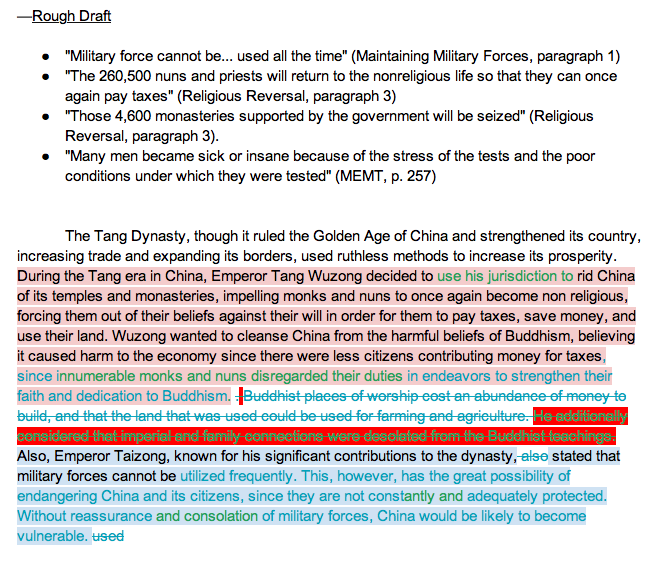
The picture I included here is one that I also posted on our class Instagram account which was pushed out to Twitter.  I wanted to shout from the mountain tops that these students were writing JUST TO WRITE!
I’m not kidding.
I told all my students that they needed practice in how to write like a historian.  Meaning…they needed to learn to cite evidence to support their statements.  But more than that, they needed to be able to analyze primary and secondary sources in order to be able to effectively use them in their writing.
So I gave them three primary sources.  I told them that as a group (self-selected) that they had to choose which Big Idea they wanted to prove:  “The Tang dynasty used (ruthless/ingenious) methods to strengthen China’s government, expand its borders, and increase its economy.”  I pushed the assignment out through Google Classroom.  Then the students decided who was going to be the owner of the document and from there he/she shared the document with their peers.
The students then tackled the primary sources, annotating as necessary as they looked for evidence to prove their Big Idea.  Some students started with bullet points, but others delved right into writing a full paragraph.  It was a site to behold.
Now keep in mind, this was an optional assignment.  Students are typically not required to do Level 4 (analysis/synthesis) or Level 5 (evaluation) writing assignments.  Student choice for leveled learning opportunities is the crux of the history program at our school.  We use a revised version of Marzano’s learning scales so that it’s VERY clear what students need to demonstrate mastery of in order to earn a specific grade.  
Click HERE to go to a wiki resource that contains the learning scales for World History.
Students who want to earn an A or B in the history classes need to write and write well.  As I tell students on their first day of World History, “We don’t give a lot of extra credit in our class.  You will not pass this class with extra credit.  You will, however, pass this class with blood, sweat, and tears…not necessarily in that order.”  There’s always a bit of nervous laughter from students that follow.
The purpose of collaborative writing assignments is to give students practice in writing with their peers.  And not just writing individual sentences strung together, but actually writing together in which they are actually editing each other’s posts and leaving comments for each other.  This type of synchronous and asynchronous collaboration is exposing students to the 21st century classroom.  Not only are students learning how analyze primary and secondary sources, but they are utilizing the thinking skills of a historian as they find evidence to prove their thesis or in this case the Big Idea.  Students are not only practicing digital literacy skills but also History’s Habits of Mind.  And we wouldn’t have it any other way.