Certainty in Uncertain Times

Bitmoji Image

Today was an interesting day. My cell phone was going off like crazy with text messages from colleagues across Orange and Los Angeles Counties. Is your school closed yet? For how long? When will our district close? What is taking so long? Why is everything moving so fast?

From early in the morning to the evening, news and social media channels updated reports on which districts were closing and for how long. My district finally sent word to teachers at 2:46PM that we would close until April 10. Well, to be clear, students are not to return to school until April 13, but teachers are to report to school on Monday and plan on working for the week.

Um. What?

First of all, why weren’t many of us told that our schools were going to close before our students left? How are students supposed to know what to do? And what happens when communication with their teachers is suddenly cut off? (Keep in mind that not all our students have devices, let alone access to the Internet). For children, teachers provide a sense of comfort and continuity. Even if students don’t particularly like a teacher or the class, they know for certain that it’s going to come at the same time, five days a week. And for students whose home life may not be the most optimal, school provides a safe haven. There’s breakfast and lunch. Time for socialize with friends and forget about troubles at home. And then there are the students who really enjoy school and their teachers. They look forward to coming to class and learning. But the sudden closure of the schools in my district (and others across Orange County) means that many teachers and students didn’t get a chance to say their long good-byes. There was no warning to let students know that the closure of schools would be temporary and that when the time was right, it would open again and things would resume as usual.

Some of you may be thinking What’s the big deal? Well, it is a big deal to me. While I use both an LMS and Google Classroom, I haven’t set the stage for students to use either of those platforms to connect with others at this point in the quarter (I teach a semester course). At best, I can hope that students will get bored and check PowerSchool to read my announcements. For the students who have already reached out to me via email, I told them to tell their peers to check PowerSchool on Monday for an update on our class situation. But that message won’t reach all of my students. #sigh

Second, I have watched via social media and news sources the proliferation of people offering help to move courses online, quickly. Many people have thoughtfully curated resources and companies have generously offered free access to platforms and tools. @joliboucher put together a list of companies offering free resources. Thank you! I took much of what she curated and created a Wakelet collection with additional offers I came across and received via email. I will be updating this collection as I come across new information.

P.S. The hyperlinked Wakelet collection is editable, so if you’re reading this and want to add something, please feel free! I’m all about collaborating.

P.S.S. I also created a Wakelet collection for COVID-19 resources. This collection will be updated as new information and studies are released.

Love

I am very grateful to the many companies stepping forward to help teachers, schools, parents, and students during this time of uncertainty.

However, I want to make clear that transitioning to online learning is not an easy endeavor. Putting activities online for students to complete without careful thought is a recipe for disaster. I’ve been teaching in a blended learning environment for over 10 years and it takes quite a bit of thinking, crafting, and technology know-how to put together a meaningful and engaging lesson that is technology-based–let alone trying to move an entire curriculum for two weeks(+) online.

My point is, for those who are scrambling for how to help students during this time of uncertainty…don’t rely solely on the technology tool itself. Sure, several companies are offering lessons so you don’t have worry about creating something. But think about this…

If your students are not used to using technology to learn, is suddenly thrusting them into this type of learning environment the best option?

If you are new to using technology to deliver lessons, are you comfortable with the quick turn-around for lessons? Would you be confident that your efforts would produce the desired end?

I don’t mean to step on anyone’s toes, but I think that administrators need to take a deep breath. I know the decision to close schools is not one that they take lightly. And believe me, I don’t want to be the one to make that decision. But forcing teachers and students to move online without the proper foundation is going to be an exercise in frustration–for everyone, teachers, students, and parents…especially teachers. Teacher efficacy plays a key role in the decision to integrate technology (Ertmer, 1999; Ertmer & Ottenbreit-Leftwich, 2013). Teachers with low efficacy who are suddenly thrust into the position of using technology to continue the learning for their students are going to have a devil of a time. And who’s going to provide the professional development? Are schools and districts ready to offer that type of support?

To be clear, there are companies and individuals out there who are offering their services in this trying time. But make no mistake. Moving learning online is going to take more time than a weekend or a few days. Creating an online course takes quite a bit of time–I’ve spent no less than 20 hours for one course and that was just the skeleton version. In this case, the videos and quizzes were already made. However, I fear that many teachers are being thrust into the role of instructional designer with little to no training, let alone support.

Now will teachers do what it takes during this trying time? Many will, of course. But even those with the best intentions are going to struggle.

However, there is good news. There are many teachers out there who will gladly lend a hand, share a lesson, and spend time helping fellow teachers set up lessons. We’ll do what it takes to support our colleagues. But to be clear, these are short-term solutions. Like Rome, creating a learning environment that utilizes technology for meaningful learning cannot be built in a day or two or even three. But together we can help each other put together short-term solutions for our students.

I am here to help. Please do not hesitate to reach out.

#bettertogether #caedchat #miched #sschat #edchat

References

Ertmer, P. A. (1999). Addressing first-and second-order barriers to change: Strategies for technology integration. Educational Technology Research and Development, 47, 47–61. doi:10.1007/bf02299597

Ertmer, P. A., & Ottenbreit-Leftwich, A. (2013). Removing obstacles to the pedagogical changes required by Jonassen’s vision of authentic technology-enabled learning. Computers & Education, 64, 175–182. doi:10.1016/j.compedu.2012.10.008

Something to Consider…

Schools and the Coronavirus — Larry Cuban on School Reform and Classroom Practice

Close the schools, an anxious neighbor says on Nextdoor (a local online bulletin board), when a parent of two school children in the community in which I live came in contact with someone who was infected with the coronavirus (see comment below: a careful reader noted that the source I used said the parent was […]

Schools and the Coronavirus — Larry Cuban on School Reform and Classroom Practice

If you’ve been following my blog or Twitter feed, then you know I am a huge fan of Larry Cuban. His post could not have come at a more opportune time as school closures have become a reality, both in the U.S. and abroad.

As a classroom teacher, I have been thinking about the impact of school closures on the students from my district. I work at a Title I school which means that the majority of my students come from low-SES households. As Larry points out, school closures disproportionately affect the poor. For some parents missing work means losing pay; while for others it means scrambling to find someone who can take care of their child while they go to work. We also provide breakfast and lunch for many students. Concurring with Larry, if my school closes, those students would have to find a different means of getting food. Closing the schools would create an economic hardship for those parents. For parents of middle school children (like the ones I teach), I suppose they could stay home unsupervised, but for children in elementary school…well, that’s another story.

I was thinking about the online learning option that several schools have chosen to do. But then again, the online option assumes that students have access to a device and the Internet which is not the reality for all students at my school, let alone my district.

So what is a school to do? How can we keep the learning going?

To be clear, I’m not worried about making sure that my students acquire the content information or skills to pass the state or district exams. That is not my concern. My concern is to ensure that my students do not fall behind in content and skills acquisition, in general. My secondary concern is to provide for my students some semblance of normalcy in a confusing and scary time. Students often look to schools as a safe-haven because it’s something they know–it’s something they are used to going to five days a week. The events of 9/11 clearly showed that.

How can I support my students when being physically present at school is not a possibility? What can I do for those who do not have access to reliable Internet connectivity?

I don’t have an answer to any of those questions. But I am currently working through some viable options for my students. I hope you are, too.

What Makes PD Worthwhile?

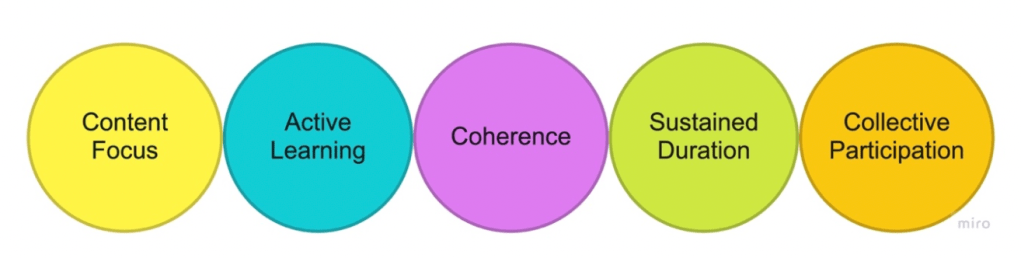
I’ve written about professional development (PD) several times over the course of the years as I’ve held both the role of presenter and audience member. Most of the PD I’ve experienced in my 25 years of teaching has followed the one-shot, sit-and-get model which research (Darling-Hammond & McLaughlin, 1995; Darling-Hammond et al., 2017; Dede, Ketelhut, Whitehouse, Breit, & McCloskey, 2008; Garet, Porter, Desimone, Birman, & Yoon, 2001) suggests to be one of the most ineffective ways to provide PD. The reasons behind the one-shot PD as an ineffective mode of professional growth is the lack of coherence, relevance, and sustainability. In addition, PD that happens to teachers as in they are talked at for the hour or so is not effective either (Appova & Arbaugh, 2017; Macià & García, 2016). This is why my dissertation study focused on examining the influence of PD that included the following:

Conceptual Map of Best Practices of Teacher Professional Development
(Desimone & Garet, 2015)

Disclaimer: While Desimone and Garet (2015) and by extension me (via the findings of my research study) believe that this PD model works, this is by far not the only model of best practices for teacher professional development.

The PD I attended this past Thursday was hosted by the Orange County Department of Education (OCDE) under the leadership of Marika Manos, Coordinator of History/Social Science. This PD was designed around a community of practices model in which educators from all levels (e.g., K12, higher education) came together to learn from other educators (collective participation). There were four sessions planned throughout the school year (sustained duration) with the theme of Environmental Principles and Concepts and application of these ideas to the History/Social Science content (coherence, content focus).

I was unable to attend the first three sessions, so I cannot speak to the level of active learning that occurred on those days. But I can attest to the level of active learning during the fourth session in which the esteemed Bob Bain presented on Surfacing & Engaging Students’ Thinking When Teaching History and the Social Sciences.

To begin, what I appreciated was the fact that he not only asked us our names and what we taught…he wrote those down so that he could speak to us on a personal level by using our names. Bob also started his session by sharing that when he teaches or presents, he asks his audience to think about three things as they reflect on their learning:

  • What supported your thinking?
  • What extended your thinking?
  • What challenged your thinking?

I loved this.

By setting us up with questions that he was going to ask us to address by the end of the day, Bob ensured that we would be actively engaged in the learning.

Throughout the day, Bob presented research, shared student examples, personal anecdotes, and asked educators to share their questions, thinking, and understanding. To anyone who walked by the room, it might have seemed as if we were all passively learning as much of the time we were listening and viewing Bob’s presentation. But that takes me back to the blog post by Blake Harvard titled The Myth of Passive Learning. For years, I erroneously believed that if learners were not physically active during the learning process, then the learning could only be categorized as passive. However, Blake points out that while the body may be physically passive, when the mind is engaged in focused cognition, the person is actively learning. But I also think that just because one is physically active does not equate to learning. I’ll expound on this in another blog post.

And that takes me back to Desimone and Garet’s (2015) conceptual model of PD. Everything about the presentation on Thursday engaged me on a cognitive level. All cylinders were firing–I could barely keep up with the amazing amount of information being presented. So yes, the PD definitely fulfilled the notion of active learning.

But here’s the most important take-away about this PD…I wanted to be there. I made the choice to go because I was interested in meeting Bob and the learning about what he had to share. This is the part of PD that I think is one of the most under-rated: participant interest.

It’s an easy hook…and one that (in my opinion) is often overlooked. This is why I love EdCamps and my network of peers. We talk about what interests us and what we know would interest others. We come together to learn from each other. Our discussions are typically content-based, aligned with what we’ve been discussing in the past, sustained over time, actively engaging, collectively participatory…but more importantly…it is of interest to us.

In closing, here is my reflection of the PD from this past Thursday:

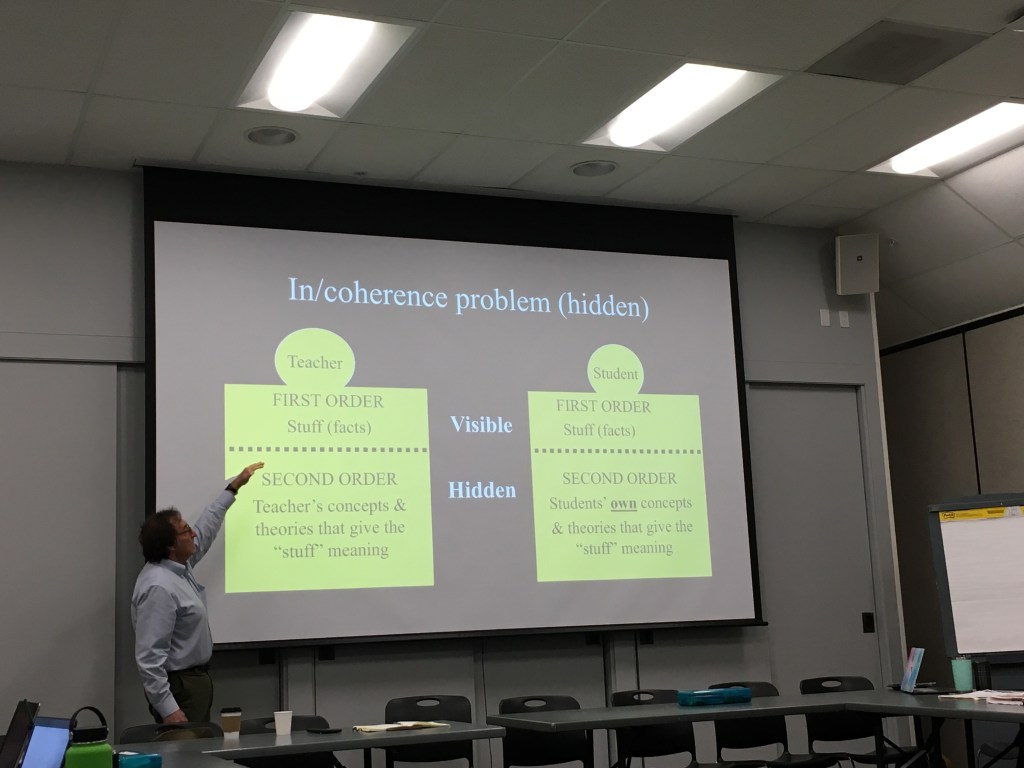
  • The information Bob shared about historical thinking and the gaps between experts (teachers) and novices (students) supported my efforts both as a classroom teacher and professional developer. It’s important to be cognizant of the in/coherence problem. But it’s more than awareness, I need to find ways to narrow the gap.
  • My thinking was extended in that I need to provide more scaffolds for my English language learners. I need to spend more time gaining a better understanding of their comprehension of the content so that I can clear up any misconceptions. In other words, I need to make the hidden visible. NOTE: This is something I am currently working on with the brain dumps.
  • I left the day challenged to be a better educator, not only for my students, but also for the people who attend my PD sessions and who are part of my PLN. I need to not make assumptions about what I think they know. I need to be better at addressing the gaps between expert and novice…teacher/student and teacher/teacher.

I can and will do better.

References

Appova, A., & Arbaugh, F. (2017). Teachers’ motivation to learn: Implications for supporting professional growth. Professional Development in Education, 7, 1–17. doi:10.1080/19415257.2017.1280524

Darling-Hammond, L., Hyler, M. E., & Gardner, M. (with Espinoza, D.). (2017). Effective teacher professional development. Palo Alto, CA: Learning Policy Institute. Retrieved from http://learningpolicyinstitute.org/product/teacher-prof-dev

Darling-Hammond, L., & McLaughlin, M. W. (1995). Policies that support professional development in an era of reform. Phi Delta Kappan, 92, 81–92. doi:10.1177/003172171109200622

Dede, C., Ketelhut, D. J., Whitehouse, P., Breit, L., & McCloskey, E. M. (2008). A research agenda for online teacher professional development. Journal of Teacher Education, 60, 8–19. doi:10.1177/0022487108327554

Desimone, L. M., & Garet, M. S. (2015). Best practices in teacher’s professional development in the United States. Psychology, Society, & Education, 7, 252–263. doi:10.25115/psye.v7i3.515

Garet, M. S., Porter, A. C., Desimone, L., Birman, B. F., & Yoon, K. S. (2001). What makes professional development effective? Results from a national sample of teachers. American Educational Research Journal, 38, 915–945. doi:10.3102/00028312038004915

Macià, M., & García, I. (2016). Informal online communities and networks as a source of teacher professional development: A review. Teaching and Teacher Education, 55, 291–307. doi:10.1016/j.tate.2016.01.021