A Time to Reflect

“We do not learn from experience…we learn from reflecting on experience.” – John Dewey
Screen Shot 2016-07-01 at 10.40.16 PM

This year my department rolled out a fully blended learning program for both World and U.S. History. Each member of my department was given an iPad cart to use with our students. We met over the summer to design our courses using Haiku Learning as our learning management system. The conversation flowed as we threw out ideas about how to make learning more student-centered while staying true to our philosophy of providing a rigorous learning environment with student choice. Integrating technology at this level with varying degrees of techxpertise (thanks @MisterCoyle for the nomenclature) was certainly something that kept us on our toes all.year.long. It forced our department to take collaboration to the next level. On a regular basis (i.e., daily, before school, in between classes), we discussed how technology could help our students practice historical thinking, reading, and writing skills. Luckily, we are all veteran teachers who know the value of flexibility and having an open-mind. Because in the end it’s the students who benefit from all of this work…we’re just the care-takers of the process.

Top 10 Things We Learned This Year

  1. BaiBoard is a awesome app for collaboration – to make it easier to follow along (and hold students accountable), have students fill in a Google Form with their BaiBoard name + password; use the desktop app to monitor progress
  2. Google My Maps though it has great potential in the history classroom, the UI on the iPads is still severely lacking – it’s a bummer to have students create slideshows on a pin only to have it show up on some iPads but not others #csuftcs
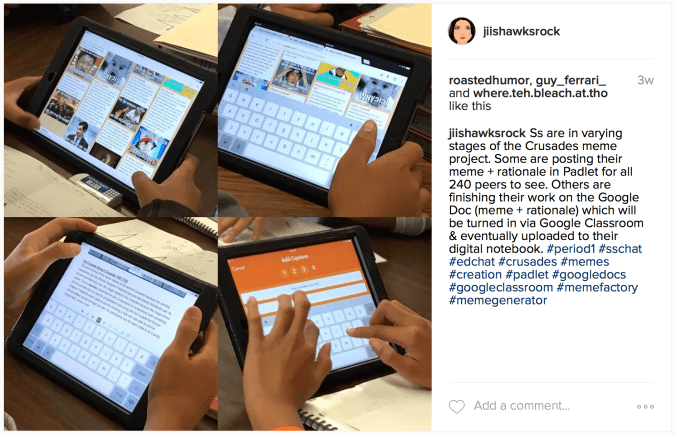
  3. Padlet is an easy way for students to display their work – to prevent cheating or stealing of ideas, we found that it was better to require students to post their work first in a discussion forum in Haiku Learning to time/date stamp the entry and then post the assignment in Padlet
  4. District’s default password for GAFE accounts needs to be changed right away – birthdays are a big deal at the middle school level…hence it’s pretty easy to figure out the default GAFE password (mmddyyyy) #duh
  5. Haiku Learning is an easy way to create a blended learning environment for students – use a linear format (e.g, Task 1, Task 2) because it helps students know what to do next and they can progress through the tasks at their own pace
  6. Memes are a fun way for students to practice critical thinking skills – students not only used memes for historical writing but also to demonstrate their creative side; middle schoolers speak memes #truestory #funnestprojecttograde
  7. Student choice is one way to personalize the learning process – using a revised version of Marzano’s learning scales, students were able to chose their learning path: Level 3 (describe/define), Level 4 (analysis), Level 5 (synthesis, evaluation) #leveledlearning #studentchoice
  8. Collaboration is key – having an open-mind is just as important
  9. Technology will work when it wants to, not when you want it to #murphyslaw
  10. Middle schoolers are inherently curious and to a large extent fearless – give them a challenge and they will rise to the occasion…how do you think we’ve learned various tips and tricks of the apps that we use?

 

Purpose Driven Meetings

Faculty meetings. Department chair meetings. Meetings, in general. We’ve all been there. But how many times have we walked away from those meetings inspired for the rest of the day? How many times have we engaged in active discourse with our peers? How many times have we said, “That was fun, I can’t wait for the next time!” I bet that you and I could count those times on one hand…together. And if you cannot, consider yourself lucky because you are not the norm.

As I’ve gotten older, I’ve become more possessive of my time. You can never, EVER get back lost time. So I have very little patience for things that do not add value to me, to my craft, to what I do with my students, or to my professional goals. I fail to see the purpose in coming together to simply be talked at. Dissemination of information does not need to be done face to face. 
I mean, we’ve spent all of this time and energy discussing ways to make learning engaging for our students. In fact, it’s an expectation in my district that the teacher is not the center of the learning process. Sure there’s a time and place for DI but that’s not what I’m talking about. In a 21st century classroom, learning is student-centered not teacher-directed. And for those of us who conduct PD, engagement is an instrumental part of the PD process otherwise all you will have are a bunch of angry teachers giving you dagger looks as you waste their time. The whole idea of bringing 21st century learning into the classroom can and should have a place in meetings. We shouldn’t simply be talked at, but rather this valuable face to face time should…no must include some of the very skills that we want our students to acquire: communication, collaboration, critical thinking, and creativity. 
Sure communication may be in the form of talking…but productive communication is a two-way street. Why not approach these meetings with the intent that teachers will be active participants? Why not bring in topics that foster collaboration between teachers and admins? Why not take the time to introduce a topic that might elicit some type of problem-solving or maybe some type of task that involves creativity?
I don’t have my administrative credential for a reason. I like being with my students but I do consider myself a leader. In fact, I’ve served as department chair for 19 years (at two different school sites). Needless to say, I’ve conducted my share of department meetings and collaborations. But when I create the agenda, it’s done after talking with department members. I take what we’ve discussed in emails or in passing and put that on the agenda to discuss when we have a formal meeting. But the key thing is…these are mutually determined topics. Anything that is purely informational is written on the agenda and my colleagues can ask for clarification (or not). The majority of our department meetings are spent working on lesson ideas, discussing common grading practices, reviewing student data/achievement, etc. We utilize our entire 60 minute collaboration meeting time and then some. And I can honestly say that when we leave, we’re revved up, inspired, and usually still discussing topics as we walk out the door to start our day. Our meeting time is collaborative, includes a great deal of communication (sometimes it’s even a bit spirited…we’re history teachers, what can I say?) and problem-solving as we continue to develop lessons and activities that are not only rigorous but engaging for our students (and to the same extent, us). 

Can “other” meetings be run the same? I ask, “Why not?” Why can’t faculty or department chair meetings be conducted more like an opportunity for PD? There’s an increasing amount of research out there about adult learning theory which is why there is a such a huge need for personalized PD. But since there’s never enough time in the day for all of the things that we want to do…that we need to do…why not change the purpose of those meetings so that we leave feeling that our time together added value to what we do with our students (Barth, 2013)? Information can be relayed via email. It’s done all of the time. And sometimes too much with the “reply all” feature, if you know what I mean. But I digress.

I think we need to move beyond bringing people together for a sit and get…and utilize that valuable time together to help each other grow professionally (Hagan, 2014). To figure out how to solve-problems that may be plaguing our campus. To discuss ways that we can help our students attain 21st century skills. Those are all value-added options and something that would give us (the participants) a purpose. 
Here’s to purpose driven meetings.
References

Barth, R. (2013). The time is ripe (again). Educational Leadership, 71(2), 10–16.

Hagan, D. (2014). Catholic school faculty meetings: A case study linking catholic identity, school improvement, and teacher engagement. Dissertations. Paper 58.

Beyond Memorization

Teaching history is one thing…teaching students how to think is a whole other beast. Gone are the days of having students memorize names/dates and color in maps. Technology has opened the doors for teachers to change the way students learn. It starts with a mindset shift. Teachers need to understand why we need to change the way we teach but also how to best integrate technology create an authentic learning environment that is engaging and meaningful for our students.
I am lucky to have a group of teachers with whom to share my thoughts about how best to create an active learning environment for my students. Most students enter my classroom (I teach 7th grade) with the idea that they hate history. H.A.T.E. I’m not sure why or how this happened…but I have an inkling that it probably had something to do with them being forced to memorize useless information that could easily be Googled today. 
In my class do students have to remember things? Absolutely. I’m of the mindset that students cannot write or articulate their thoughts without remembering certain things. But I think that if you create a learning environment that is engaging, students will remember things. They’ll do it because it’s part of the active learning process.
Creating a classroom culture and learning environment to allow for this is not impossible. I cringe when I hear my own students talking about having to memorize passages from Shakespeare’s plays. I mean, unless they are going to become a thespian focusing on Shakespearian plays…how is that in any way adding value to their learning? 
In fact, just the other day, a colleague of mine (from a different school) told me that he heard AP US history students at his school were having to memorize the order of our presidents. Seriously? In an APUSH class? 
Why not utilize technology to make learning relevant? Why not ask students to create something that demonstrates their learning? Put the onus of learning on the student. Give them a choice in demonstrating what they have learned. But don’t make them memorize things. We’re in the 21st century and our students deserve better than that.