Looking Back in Order to Look Forward

I am a big fan of reflecting on things. In fact, I tend to perseverate on too many things which isn’t helpful. But that’s a story for another time.

As the school year comes to a close (five more days!)…I decided that this would be the perfect time to collect information from my students that would allow me to know what worked and didn’t work for them during these past 12 weeks, AND I could gather information on how my 8th grade colleagues could better support them if we have to either start online in the fall or quickly transition due to rising cases of COVID-19.

The Google Form is long. But it’s a nice blend of closed- and open-ended questions. Sixty-two students have already completed the reflection which is AMAZING because it’s technically not due until next Tuesday. Could the five points extra credit have been an incentive to not procrastinate? Believe me, I’ll take it any way that I can get it. 😉
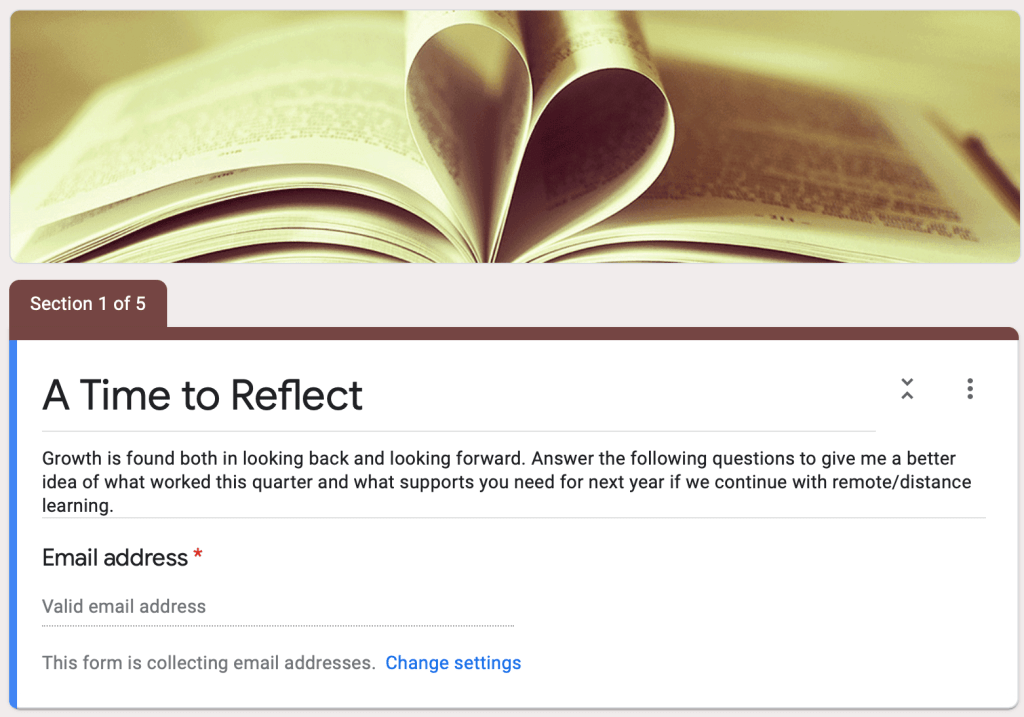
So, what kind of information was I gathering? Well, here are the main sections:

  • Technology Access
  • Learning at Home
  • Looking Forward
  • Wrapping Up

One of the main concerns I had (actually it’s a concern I’ve always had considering that I work at at Title I school) is access. What kind of access do my students have? And by access I talking about devices and connectivity. The digital divide is very real where I work.

Another concern I had was the learning environment at home. I know that many of my students live in multi-generational households, or they live with multiple families in a small space. I was curious as to whether they (1) had a place to study and (2) whether that place to study was quiet. With many people having to work from home during this crisis, I know it put a strain on space at home, in general.

Because we don’t know what the fall holds for us, I also wanted to gather information on how my 8th grade colleagues could better support our students if remote learning remains in place or if we have to quickly transition from in-person to remote learning. I was curious as to what types of communication were the most helpful, and also if the students preferred a more structured approach or independent-project approach to learning.

Wrapping up the reflection, I asked students one thing that they learned about themself during this time of remote learning as well as one thing that they could change about their study habits if we have to continue with remote learning in the fall. This harkens to my goal of making sure that socio-emotional learning skills remain in the forefront of what I do.

I appreciate the honest and quite candid answers from my students. But then again, for the most part, middle schoolers tell it like it is. The fact that they don’t have a filter (or that they don’t employ it often) is one of the things that I most enjoy about working with this particular grade level.

As of this moment, I have quite a bit of quantitative and qualitative data at my finger tips. Over the summer, I’ll be working on a longer post about what this data is telling us about the benefits and challenges of this type of learning environment, and while I don’t pretend that what we’re doing at my school is indicative of what’s going on everywhere else, I am confident that teachers, students, and parents from across the U.S. are all experiencing something similar.

At least we know we’re all in this together.

If you’re interested, here is the link to the Google Form: A Time to Reflect.

P.S. If you think of other questions that should be added, please leave a comment below or email me. =)
Pulse Check with Polls

Bitmoji Image

Prior to our rapid transition from in-person to online learning, I used polls on an intermittent level. Sometimes I polled students on their thoughts about a controversial topic prior to an in-class activity, and other times I incorporated polls to share student feedback across all six classes of world history.

But when we moved completely online, I decided to ramp up my poll use. I started by posting polls with quirky or fun questions, and other polls asked for more serious feedback. I addressed that my previous blog post so I’m not going to elaborate anymore on that here.

What I do want to share is the importance of conducting pulse checks with students. Some teachers use polls or Google Forms to collect information about students at the beginning of the week/day or at the end as an exit ticket or reflection. I first conceived of using polls as a means to see who was logging into the LMS. Because I didn’t have time to prep my students for what distance learning was going to look like, I was hoping that they would just know to log into our LMS every day.

I was wrong.

Sure, some of the students logged in right away. They were used to the routine in my class. But others either didn’t log in at all, waited for emails from teachers, and in some cases a phone call from the community liaisons. But logging in, reading emails, or fielding calls from the front office staff didn’t reveal important information about how are my students doing.

So amidst the various fun polls like what’s your favorite place to get burgers, I polled students about how they were coping with remote learning. During this crisis, my students have been juggling more than just completing assignments for six different teachers, they have been dealing with larger issues such as shelter, food, and safety. I have posted before on the whole Maslow before Bloom’s thing so you know where I stand on this matter.

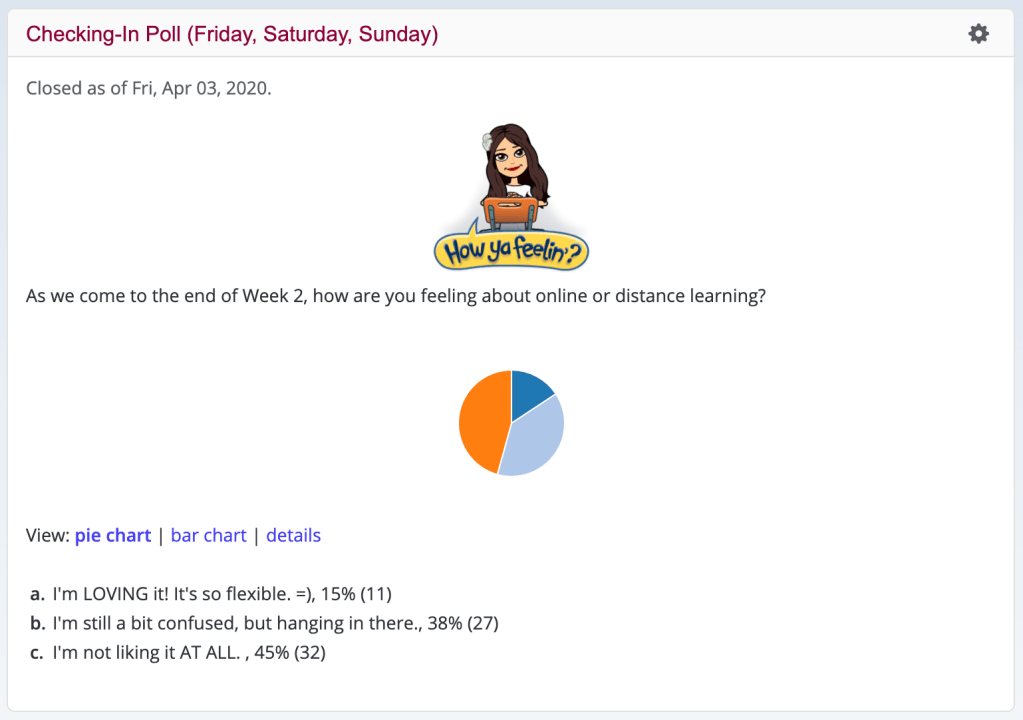
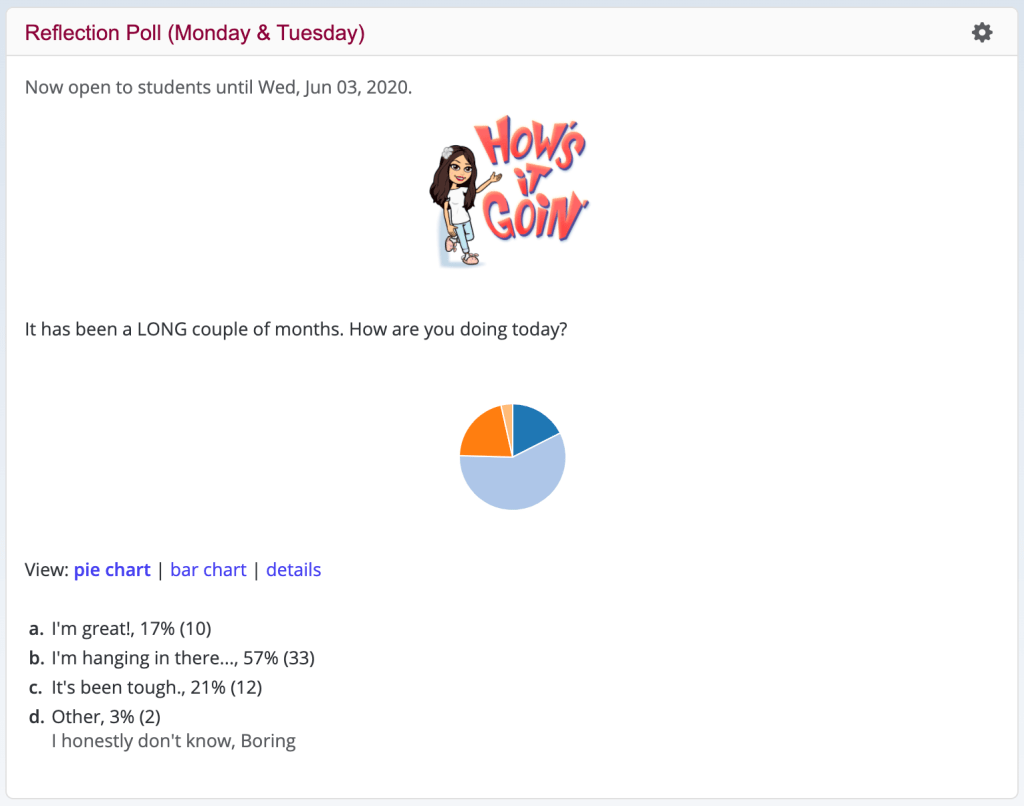
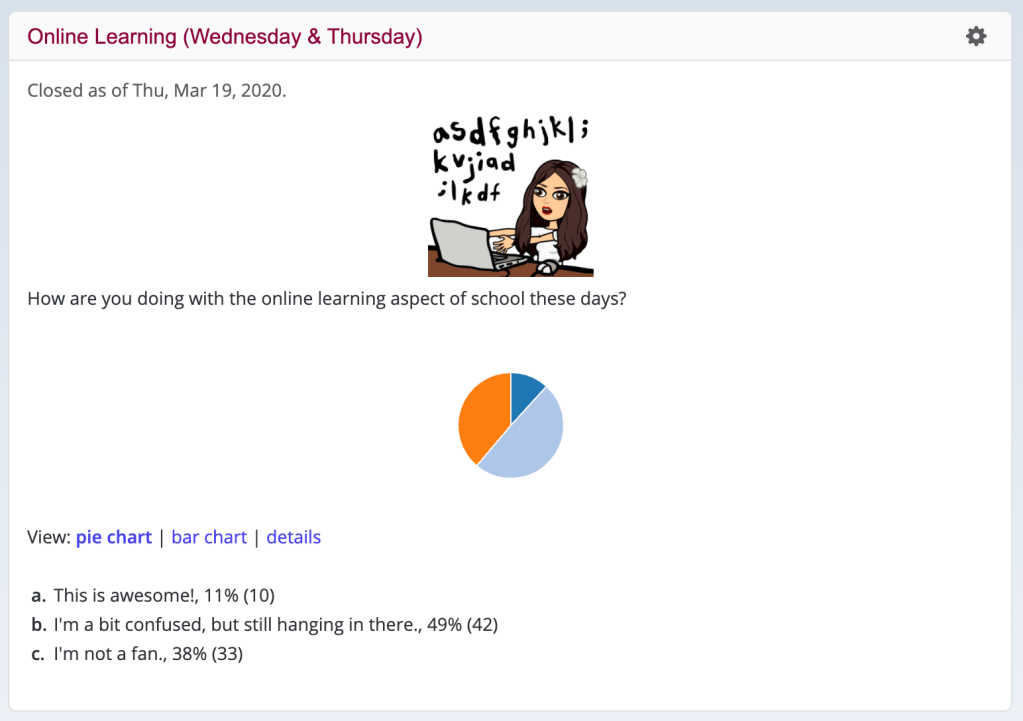
Because I couldn’t physically see their faces or their body language, I made it a point to poll my students on how they were doing. I asked them these questions in a variety of ways, but the one that was most telling was the one that asked How are you doing today?

Check out the progression of student poll responses over time…

This poll was conducted four days after in-person instruction was implemented in my district.
This poll was conducted at the conclusion of Quarter 3 on the Friday before Spring Break.
This is the most recent poll.

As you can tell, my students are getting the hang of things. Sure there’s still quite a few who don’t like online learning and are struggling, but I’m seeing an upward trend. And that’s a relief. I think middle schoolers are quite resilient so I’m glad that at this time almost 75% of them are on the positive side of the scale.

Whew.

As we close out the school year, I’m conducting one final poll. It’s a reflection of the past 12 weeks of remote learning. But that’s a post for another time.

Let’s Get Real

Bitmoji Image

When we quickly transitioned from in-person to remote learning, I started using polls with my students to see who was checking in (or not). The polls were mostly fun topics:

  • If you could be a superhero who would it be?
  • What is your favorite type of French fry?
  • What is your sleep position?
  • What is your LEAST favorite vegetable?

And then there were the ones that asked more serious questions:

  • How are you doing with remote learning?
  • How many hours are you spending online?
  • What are your thoughts about learning online?
  • How many hours a day do you spend studying?

The polls, without a doubt, provided insight into my students’ likes and dislikes while also providing some important information that they did not readily share in their Living History Project journal entries.

The poll that I did last week was one that I was curious about since there are talks about how schools are going to look in the fall.

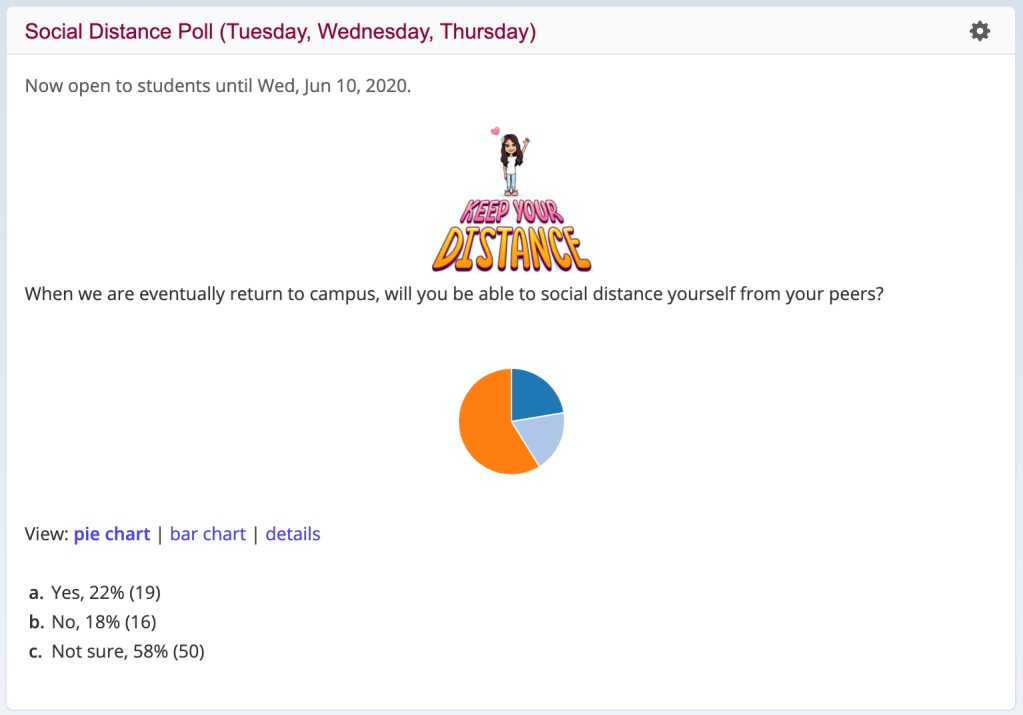
So I conducted a Social Distance Poll…

Student poll on social distancing

As you can see…only 22% of student respondents* think they can socially distance from their peers when we return to campus. Twenty-two percent!!! The majority marked not sure which I believe is closer to the truth since they know how they are.

Truth be told, so do I.

Having taught 25 years at the middle school level, I think I have a pretty good understanding on what adolescents can and cannot do…what they will and will not do.

As they flex their independence, middle schoolers like to push boundaries. While they listen to me (most of the time), if I’m not in their line-of-sight, they are going to pretty much do whatever they want.

And I don’t think that it’ll be six-feet away from their peers.

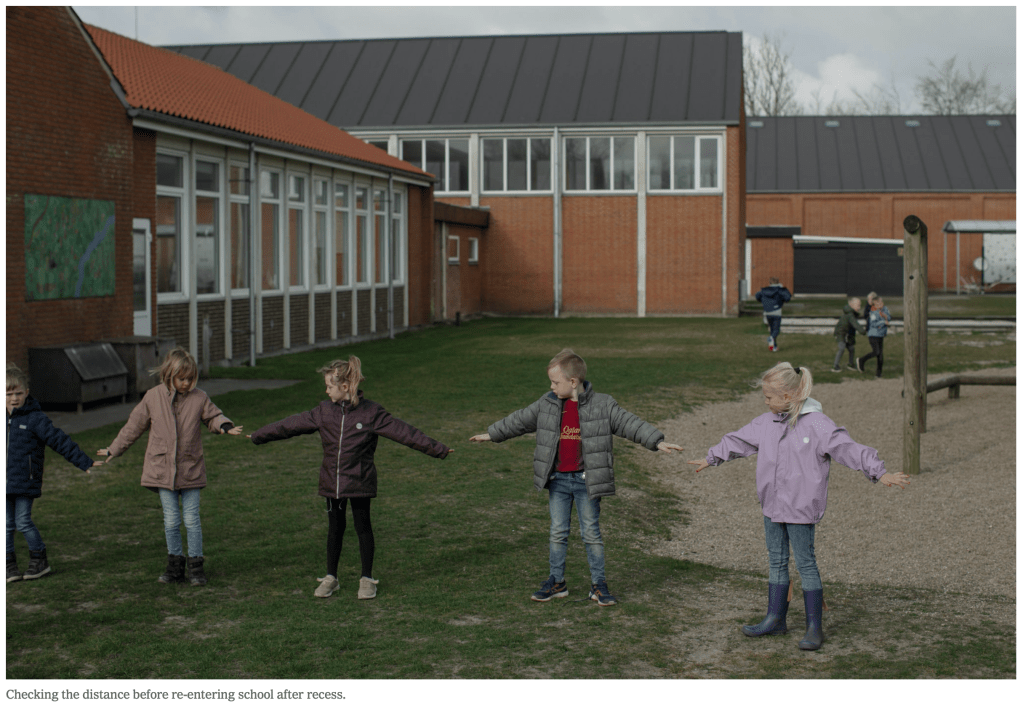
Do you recall seeing the following image from the New York Times? It came out roughly one month after transitioning into remote learning. When I saw this photo, I was both saddened and skeptical. Saddened because this is a new reality for children (and adults) and skeptical because…well, the expectation is that children will follow directions.

Recently, I was asked to participate in a focus group of alumni from Johns Hopkins University. It was a diverse group of educators from across the United States. And while it was validating to hear that I was not alone in my struggles with getting students to complete work, I was a bit surprised that some of the educators thought that social distancing was mainly going to be an issue for elementary-aged students.

But let’s be real. Students, no matter their age or grade level, expend quite a bit of energy and brain-power figuring out ways to push the boundaries. How many of us have come back to a sub note that contained numerous incidents of students pushing the buttons of the sub? Or how many of us watched our student teachers struggle with classroom management because the students saw a challenge?

I have always had control issues. It’s just my nature. So I make it very clear on the first day of school what will and will not be tolerated. But those expectations only work when I’m physically present.

When we return back to campus, I am sure that there will be policies in place so that students, teachers, and staff can socially distance from each other. But I know the reality that I can only control what happens in my classroom. So we can take out the extra tables and chairs…I can create seating charts so that students are not seated close to their peers…but once that bell rings and students are dismissed…do people honestly think that students are going to socially distance? Even if the school operated in shifts at half-capacity, is it realistic to think that students are going to follow directions and stay six-feet away from each other?

I’d like to think that they would follow the rules…but as any classroom teacher can attest…children have a hard time following directions, let alone rules.

It’s going to be an interesting school year in the fall.

*NOTE: Not all of my students completed the poll as I have approximately 150 students enrolled in my six classes.