Maslow Before Blooms

I came across the following image in my Twitter feed this past week, and I’m so glad of the reminder. My undergrad degree was in Psychology which has influenced how I approach instructional design and practices–whether its working with children or adults. So, I think the COVID-19 hierarchy of needs for schools is something that all educators need to seriously consider in the coming days, weeks, and months of this crisis.
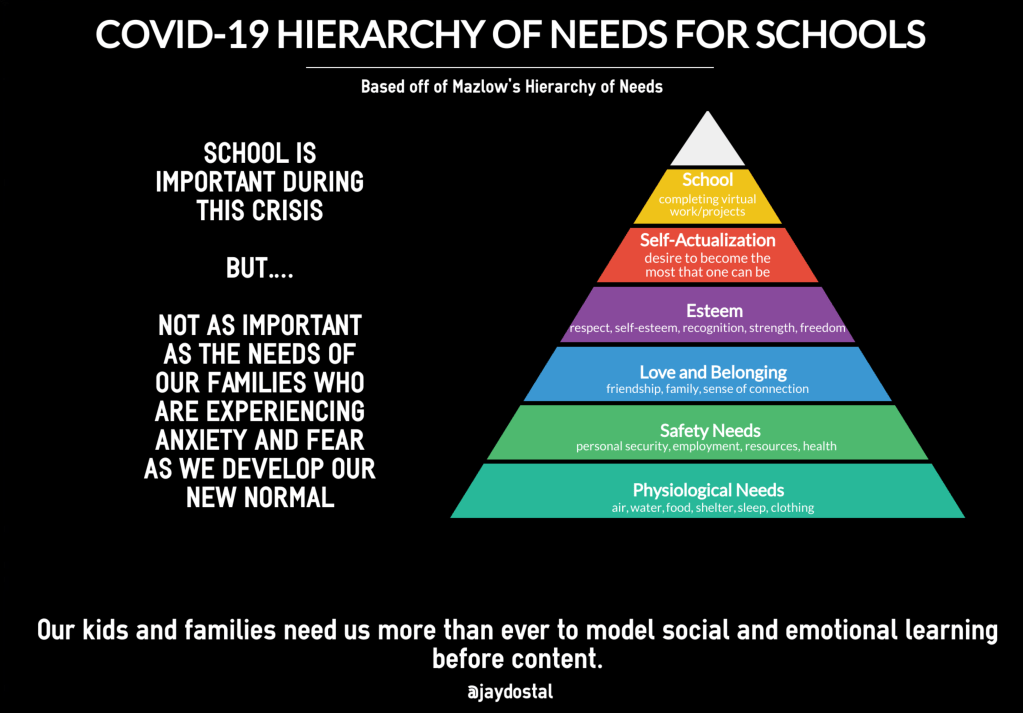
I have spoken with several colleagues who I admire and respect about our next steps. As in, how do we proceed knowing that in-person classes are cancelled for the rest of the year?

For the past three weeks (ever since our district closed in-person classes), many of us were scrambling on the how and what of teaching. How were we going to provide learning opportunities for our students and what were we going to focus those learning opportunities on?

Some of my colleagues continued with their instruction, mainly modifying the delivery but not so much the pace or content. Others created an independent learning project that still connected to the curriculum, but the pace was drastically reduced. And then there were those who did a bit of both. My point is…everyone was doing something different. But is that a bad thing?

Not necessarily.

At the time, we were thinking this would be short in duration. But now that we are looking at 10+ weeks of remote learning…our responses need to change.

In this time of crisis learning (this is the moniker I’ve adopted), I think we need to give everyone a huge dose of grace. And by everyone, I mean district personnel, teachers, students, and parents. Everyone is doing the best they can at this moment. Many of us have not had to pivot so sharply in such a short amount of time…ever.

For those who are a lamenting about the lack of time to teach the curriculum or for those who fear our students are going to fall behind, please read the following excerpt from a teacher whose planning fell to the wayside after Hurricane Katrina…

It kinda puts things into perspective, no?

This brings me back to the reason why I titled this post Maslow before Blooms. This phrase has appeared too many times to count in my Twitter feed for many years. It also appeared in discussions among my colleagues in our doctoral courses. But let’s think for a moment…if a student’s sole concern is their welfare, safety, and well-being…why would they care if a teacher assigns a reading and activity? If a student (a child) is concerned about their parent who’s in the medical field…why would they even think of checking the LMS every day to see what a teacher posted? If a student is witness to a parent suddenly losing their job and now they don’t know how they will afford rent or food…why would they be concerned about when the math test is?

I think as educators we need to shift our focus to how can we support our students–our children–during this time? I’m not suggesting that we throw out rigorous learning or the curriculum, mind you. I’m just proposing that we begin first with addressing the human aspect of learning. We need to provide support structures for our students (Borkoski & Roos, 2020). We need to figure out ways to foster self-awareness and self-management skills for our most vulnerable stakeholder: our children.

If you are looking for a place to start, may I suggest visiting the Collaborative for Academic, Social, and Emotional Learning (CASEL, 2020) website. Since we’re all scrambling for ways to support crisis learning why not take the opportunity to develop and deliver activities that support the mental and emotional well-being our students? I don’t think that’s a bad path to take…do you?

Maslow before Blooms.

Resources

Borkoski, C., & Roos, B. (2020, April 3). Cultivating belonging online during COVID-19: Helping students maintain social distancing without feeling socially isolated. Retrieved from https://ace-ed.org

CASEL. (2020). Core SEL competencies. Retrieved from https://casel.org/core-competencies

McLeod, S. (2020, March 20). Maslow’s hierarchy of needs. Retrieve from https://www.simplypsychology.org/maslow.html
No Words

Bitmoji Image

A couple of hours ago, I received an email from my district which relayed the message that we would not be resuming in-person instruction for the rest of the 2019-2020 school year. As other educators who received similar news have shared on Twitter, I am heart-broken. While I knew that the school closures might last longer than the May 8 deadline, I was hoping that I would at least be able to see my students for a few days before school let out for summer.

But that’s not going to happen.

And my heart is heavy.

I created a short video message for my kids that I just posted for them to view. I wanted to give them a human face to the message because they received this message from an email. Email is great. It’s succinct. But emotions don’t come through via email. And I wanted to give them a face to the message.

I had a hard time keeping my composure while recording. But I think it’s important that they know just how bummed I am. I’ve been reading in their Living History Project journals just how much they miss school, their teachers, and their friends. Some even admitted that they couldn’t believe that they missed the routine of being in school…but they did.

Many of students are currently struggling with remote learning. In their journals they shared their confusion about what to do…how to do it…and when to do it. They are struggling. And as I wrote in a previous blog post…they didn’t sign up for online learning.

So I’m sure many of them are bummed, too.

Yes, I know the reasons for keeping the schools closed. I understand the whole “flattening the curve” thing. I get it. My husband is an engineer. He’s been sharing plenty of statistics about this whole fiasco.

But none of that matters at this moment. Because at this moment, all I can think about is that I won’t be seeing my kiddoes in person for a long time.

This week, one of Daily Menu tasks for the Living History Project included creating a six-word memoir about their daily life and recording it in Flipgrid. I was watching a few of them earlier today. But I can’t watch any of them right now as I’m pretty sure I’m going to burst into tears. You see, when these kids recorded their six-word memoir, there was still the hope that they would be able to come back to school and things would be “normal” again.

But now we know.

And I can’t bear to see their faces and hear their voices right now.

My heart is heavy.

Living History Project: Student Excerpts Week 1

After two weeks of basically running around like a chicken with its head cut off, I can finally breathe because the weekend is here. I now have time to indulge myself by reading a good book and relaxing on the couch.

But first, I wanted to share an update on the Living History Project.

This week, I have been busy reading and commenting on the Living History Journal entries from my students. While I don’t have 100% participation, I am pleased with the number of students who have been able to adjust to this new style of learning from home. Hey, I’ll take my victories as I can get them.

My goal with this project, besides capturing the thoughts and feelings of my students, was also to find a way to help my students develop self-management and self-awareness skills (see CASEL). While developing historical empathy has been a focus of mine for years, I’ve decided to make a concerted effort to foster the development of social and emotional learning skills in the various tasks and activities I create for my students. Hence the Living History Project.

I wanted to share a few excerpts from the Living History Journals. Some of the posts were humorous, others displayed a sense of fear or worry…and then there were quite few that evoked frustration.

Excerpts on the lighter side…

  • Today, I woke up and realized there was PE homework. Like are you kidding me?
  • My second thought was that I was correct yesterday, we’re all going to die
  • One thing is that people are buying toilet paper, why do you need to buy toilet paper? It’s not going to save you from the COVID-19
From a student journal…

Excerpts that show my kids are dealing with real-life (adult?) issues…

  • What would happen if my mom wasn’t able to work anymore? How would we make money to support the family? What would happen if everyone wasn’t allowed work…?
  • My mom showed me a paper of where in case the police ever stops her from going anywhere she just shows them that paper. That scared me even more my mom works in a medical needs place so she isnt gonna stop working.
  • Yet, on the other point of view, people who have the coronavirus are still seriously on the edge of life or dead. I’m worried for my friends. I don’t keep contact of all of them, but are they sick? Are some of them being contaminated right now away from everybody? The thought of it scares me, even makes my heart thump faster…
  • The fact that my brother and I only have a limited amount of food and water  is scary to me, because if we run out we can possibly die.

Excerpts that reveal remote or distance learning is not their cup of tea…

  • I am super stressed with all of the homework my teachers are sending in. I hope it will get easier but only time can tell. At this point I wish I was in school.
  • I woke up and i head a bunch of messages on cell phone i was starting to hate the online homework because the teachers are spamming messages over and over.

Excerpts of how my kiddoes are trying to cope with the situation and find the brighter side of things…

  • As my anxious self continues to wander around I decided to ignore my anxiety as I baked goods for my family
  • This has changed my daily routine because now I do not go to school, can not hang out with my friends, and online schooling is difficult for me, because it is new to me. My parents are helping me navigate through my classes and i am doing my best

I was apprehensive, at first, about assigning the Living History Project. Part of me was thinking that we should just continue with what we were learning in class (for continuity)…but then I thought this would be the perfect opportunity to capture real-time experiences and reactions to the COVID-19 pandemic. Their journal entries make me laugh, cringe, and sometimes tear up. Their honesty is part of their DNA. Middle schoolers don’t typically use a filter so I’m able to capture their raw emotions, thoughts, and feelings. They may not understanding at the moment why I’m asking them to put their hearts down on paper (or in this case a Google Doc)…but as a historian…I know that future generations will appreciate having a primary source from children who lived during this trying time.

I am so proud of my middle schoolers.