Look Within, My Friends

It’s easy to point fingers while telling others what they need to change, but little good does that do for your credibility if you are not making the change yourself. It’s the whole pot calling the kettle black thing.

I did a Google search to see what kind of tools were out there for one to use as a self-assessment. Some surveys were the full-on-research-study-probably-someone’s-dissertation survey while others looked quite simple. Then there were the surveys that you could fill out, but the question was…where are your answers going? I mean, what’s the point if you don’t receive any feedback?

Scouring my library (it’s not exactly the George Peabody Library), I came across a book from my master’s studies. In it was a self-assessment survey that allowed the user to examine both classroom and school-wide practices. I reached out to the author of the book (Carl S. Grant) and he graciously gave me permission to use the survey as part of my blog series.

I created the surveys in two different Google Docs and I challenge you to complete the survey(s) honestly. No one is going to see your answers. In fact, the Google Docs are view only so you’ll have to make your own copy if you want to assess the level of multicultural components within your instructional practices or across your school.

P.S. Speaking of the George Peabody Library, I wanted to share that I totally geeked out there last summer with a friend who is also a doctoral student with me in the program. Below is a picture of us right before we hit the books…

P.S.S. Yes, the library is just as amazing in person.

IMG_3762

Inquiry-based Reflection

It’s been a few years since I’ve been to ISTE, but I love the fact that I can follow the sessions through snapshots posted by those in attendance. If you are interested in following along do a search in Twitter using #iste18 or #notatiste18.

I’ve been following Eric (@E_Sheniger) for I don’t know how many years, and I have to say that what he posts is #spoton. Take the image above as an example. Without a doubt, these are great questions to use as educators reflect on their teaching and role in whatever capacity they serve within their organizations. But what resonated with me is the fact that these questions can also be applied when considering culturally relevant teaching.

In particular, I like the first three questions. Let me tweak them a bit:

  • What evidence do we have to demonstrate the impact of technology and innovation within our multicultural school environment?
  • How are we making learning culturally relevant for our diverse student body population?
  • How do we implement and support rigorous and culturally relevant learning tasks that help our students become future ready?

Going back to my previous post regarding the total school environment, the “curriculum should recognize and reflect students’ multiple identifications” (Banks, 2016, p. 30). Because my doctoral research focuses on technology integration, I think we need to consider how technology and innovation can be used to support a multicultural learning environment. An interesting article I recently read highlighted the fact that immigrant students are using technology to develop their own identities as well as cultivate a strong connection with families from their home countries. Lam (2012) challenges educators to develop an understanding of “role of digital media in immigrant students’ learning experiences outside of school…[in order to] develop digitally connected forms of pedagogy that are also culturally responsive” (p. 63).

We cannot deny the role of technology in the lives of students today. So why not harness that power for educational use? The literature reveals a significant gap between how students use technology outside of school versus inside of school (Bryant, Coombs, & Pazio, 2014; Ertmer, Ottenbreit-Leftwish, Sadik, Sendurur, & Sendurur, 2012; Hall, 2010). Perhaps the development of culturally responsive teaching practices can help bridge that gap for our culturally diverse and immigrant students?

Let’s put that discussion on the table, shall we?

References

Bryant, P., Coombs, A., & Pazio, M. (2014). Are we having fun yet? Institutional resistance and the introduction of play and experimentation into learning innovation through social media. Journal of Interactive Media in Education, 2014, 1–8. do:10.5334/jime.ad

Ertmer, P. A., Ottenbreit-Leftwich, A. T., Sadik, O., Sendurur, E., & Sendurur, P. (2012). Teacher beliefs and technology integration practices: A critical relationship. Computers & Education, 59, 423–435. doi:10.1016/j.compedu.2012.02.001

Hall, G. E. (2010). Technology’s Achilles heel: Achieving high-quality implementation. Journal of Research on Technology in Education, 42, 231–253. doi:10.1080/15391523.2010.10782550

Lam, W. S. E. (2013). What immigrant students can teach us about new media literacy. Phi Delta Kappan, 94, 62–65. doi:10.1177/003172171209400416

Total School Environment

If you are familiar with research behind educational reform movements, then you are aware that in order for change to occur and be sustainable, it must be systemic (Tyack & Cuban, 1995). Change that happens in a vacuum will not last (Fullan, 2007). Grassroots change can only go so far. Top-down change, well…I’m sure we’re all well aware about how that goes. My point is, in order to change to occur, and I’m talking about real educational reform, then all stakeholders must be part of the process from the very beginning. True reform is not about implementing policy, but rather it “means changing the cultures of classrooms, schools, districts, [and] universities” (Fullan, 2007, p. 7). When considering educational reform issues such as technology integration (my dissertation focus) or multicultural education (focus for my summer blog series), well then it’s even more important to look at the entire system. My limited knowledge of systemic change on a broad level prevents me from being able to offer much in that area. However, because I have been a classroom teacher for 23 years and have held various leadership positions both at the school and district level, I believe I can offer some suggestions on how to go about starting the process at the school site (more to come on that in subsequent blogs).

Multicultural education (as mentioned in a previous blog) has a variety of meanings which may differ depending on the organization. However, what one cannot deny is the fact that the definition of multicultural education is quite broad (Banks, 2016). As such, when considering what multicultural education looks like (or should look like) at a school, then one must begin by examining to what extent does the total school environment reflect monoethnic or monocultural practices of the dominant group (Banks, 2016; Nieto, 2008)?

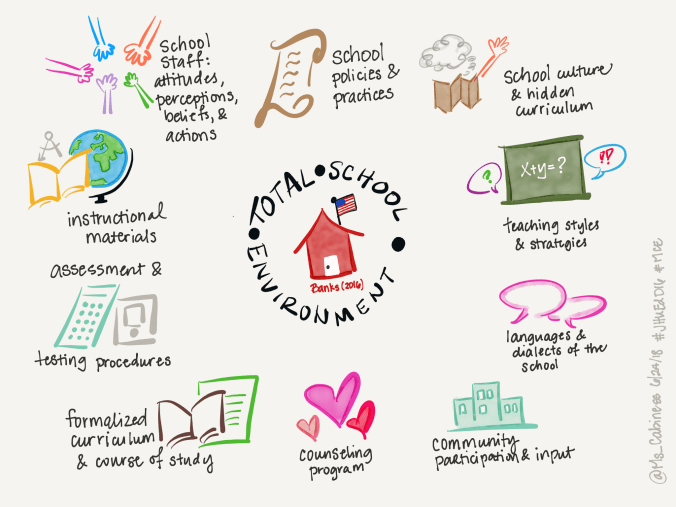
The following image displays the elements that influence the total school environment (Banks, 2016):

Paper.JHU Sketchnotes.5.png

Thus, when considering where to begin when integrating or implementing multicultural education, the answer is…everywhere. The process involves change across the total school environment. So, take a look at the sketchnotes to determine, where can you help influence the process? What other stakeholders do you need to include? How can you get them on the same page? Without a shared meaning or understanding of multicultural education across all stakeholders, believe me, your efforts will feel more like herding cats. And that’s a whole different profession.

References

Banks, J. A. (2016). Cultural diversity and education: Foundations, curriculum, and teaching (6th ed.). New York, NY: Routledge.

Fullan, M. (2007). The new meaning of educational change (4th ed.). New York, NY: Teachers College Press.

Nieto, S. (2008). Affirmation, solidarity and critique: Moving beyond tolerance in education. In E. Lee, D. Menkart, & M. Okazawa-Rey (Eds.). Beyond heroes and holidays (pp. 18–29). Washington DC: Teaching for Change.

Tyack, D., & Cuban, L. (1995). Tinkering toward utopia: A century of public school reform. Cambridge, MA: Harvard University Press.