10 More Weeks…(I’m Ready).

Bitmoji Image

I took Spring Break off…well most of it anyway. I didn’t grade one assignment. I didn’t make any progress towards finalizing report card grades. But I did quite a bit of thinking about how I was going to approach the next 10 weeks with my students. And I’ve spent the past two days putting together lessons for our new unit. Monday marks the start of 4th quarter…so I have 10 weeks left to make learning fun and engaging for my students…from afar.

I have been wanting to try out the various resources from the Big History Project for quite some time now…and like many before me have stated, “There’s no better time than the present.”

So, I’ve decided that for the last quarter of the school year, the last quarter of my semester class…I am going to explore with my students the ideas of Expansion and Interconnection. The primary and secondary sources for this unit tie nicely with the content standards for 7th grade world history. But more importantly, historical literacy skills–tools of a historian–are deeply embedded in the tasks.

Of course, since I rarely take lessons or activities as is…naturally, I have put my own spin on things. I’ll be sharing more on those revised lessons in upcoming posts. =)

This week, however, we are easing back into this new-style of learning with students getting to know how to use two new platforms while exploring the ideas and influences of emojis. The two new tools are: Listenwise and Newsela. Listenwise provides listening comprehension practice which is sorely needed for my English language (EL) learners. Newsela is a reading comprehension tool which is also equally important for my EL learners. I’m not new to Newsela. I used to integrate Newsela articles into my instructional practices…but for some reason, I stopped. I’m a newbie to Listenwise, but my good friend Scott Petrie (@scottmpetrie) has been sharing about this resource for quite some time now on Twitter, and since I have to revise my instructional practices anyway, I decided that this was the perfect time to try this new tool.

Although I was a bit hesitant to introduce new technology tools to my students since I cannot show them how to log in or use the site in-person…both sites are pretty easy to navigate and the Google Classroom integration is awesome! I was able to quickly import my rosters from Google Classroom and push out the assignments from the respective sites to Google Classroom with the link for students to log in. I am excited that more sites are adding Google Classroom integration because it makes it so easy for teachers and students. Gone are the days when my students had to use their personal emails to sign up for accounts to sites that I wanted to use with them.

We’ve come a long way, baby. =)

The culminating activity for this week is a Create-an-Emoji mini-project. Students are tasked with creating an emoji that says something about them, their heritage/culture, or even how they are feeling about the whole coronavirus pandemic. Students will be sharing their Create-an-Emoji projects on a Padlet wall that will house all six sections of world history.

Now if you’re wondering about the Living History Project, I assure you that is still alive and well. Since we are starting a new quarter, I created a new journal in Google Slides for them with a directions page–revised from lessons learned from the first Living History journal I assigned. While most students are completing the journal entries well (and some are outright AH-ma-zing), I’m not sure if they all truly understand why I created the Living History Project for them, and why I’m having them record details about their day. To hopefully enlighten students, they are starting the first day of 4th quarter watching a TED-Ed video Let’s make history…by recording it. I’ve always been fascinated by oral histories and someday after I’ve retired perhaps I’ll have time to indulge my passion in helping to archive the oral histories of fellow Americans.

But for now…I’m busy working, planning, revising, and double-checking the activities I have been creating for my middle-schoolers. I hope they enjoy our new adventure with examining the Big History of Expansion and Interconnection.

I’m excited.

I’m ready.

Deep breaths…
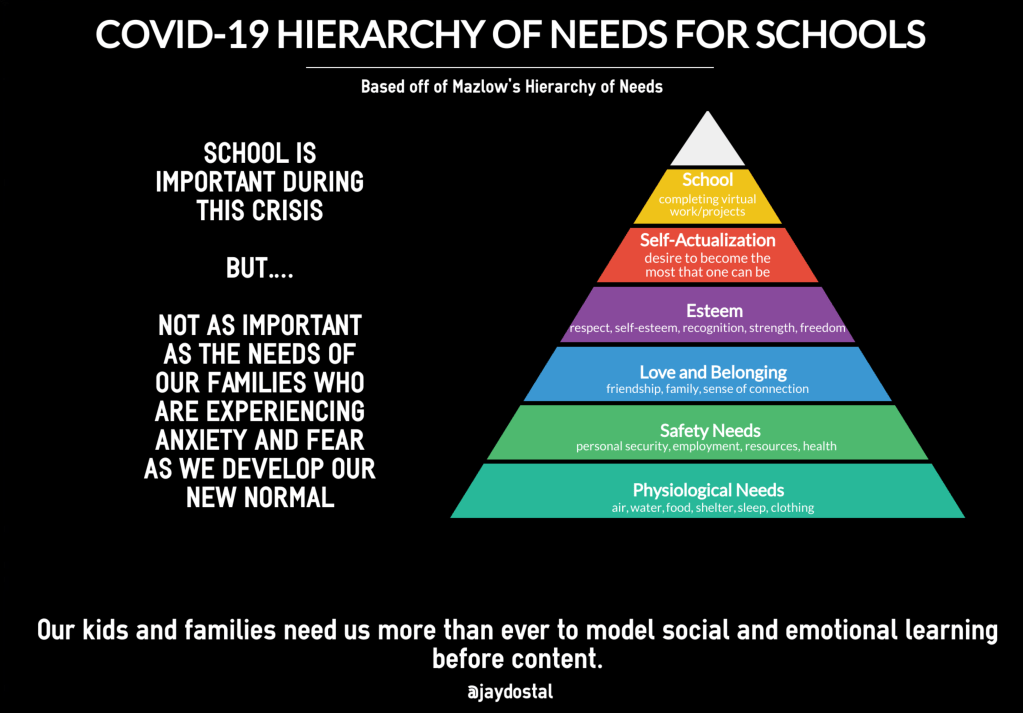
Maslow Before Blooms

I came across the following image in my Twitter feed this past week, and I’m so glad of the reminder. My undergrad degree was in Psychology which has influenced how I approach instructional design and practices–whether its working with children or adults. So, I think the COVID-19 hierarchy of needs for schools is something that all educators need to seriously consider in the coming days, weeks, and months of this crisis.

I have spoken with several colleagues who I admire and respect about our next steps. As in, how do we proceed knowing that in-person classes are cancelled for the rest of the year?

For the past three weeks (ever since our district closed in-person classes), many of us were scrambling on the how and what of teaching. How were we going to provide learning opportunities for our students and what were we going to focus those learning opportunities on?

Some of my colleagues continued with their instruction, mainly modifying the delivery but not so much the pace or content. Others created an independent learning project that still connected to the curriculum, but the pace was drastically reduced. And then there were those who did a bit of both. My point is…everyone was doing something different. But is that a bad thing?

Not necessarily.

At the time, we were thinking this would be short in duration. But now that we are looking at 10+ weeks of remote learning…our responses need to change.

In this time of crisis learning (this is the moniker I’ve adopted), I think we need to give everyone a huge dose of grace. And by everyone, I mean district personnel, teachers, students, and parents. Everyone is doing the best they can at this moment. Many of us have not had to pivot so sharply in such a short amount of time…ever.

For those who are a lamenting about the lack of time to teach the curriculum or for those who fear our students are going to fall behind, please read the following excerpt from a teacher whose planning fell to the wayside after Hurricane Katrina…

It kinda puts things into perspective, no?

This brings me back to the reason why I titled this post Maslow before Blooms. This phrase has appeared too many times to count in my Twitter feed for many years. It also appeared in discussions among my colleagues in our doctoral courses. But let’s think for a moment…if a student’s sole concern is their welfare, safety, and well-being…why would they care if a teacher assigns a reading and activity? If a student (a child) is concerned about their parent who’s in the medical field…why would they even think of checking the LMS every day to see what a teacher posted? If a student is witness to a parent suddenly losing their job and now they don’t know how they will afford rent or food…why would they be concerned about when the math test is?

I think as educators we need to shift our focus to how can we support our students–our children–during this time? I’m not suggesting that we throw out rigorous learning or the curriculum, mind you. I’m just proposing that we begin first with addressing the human aspect of learning. We need to provide support structures for our students (Borkoski & Roos, 2020). We need to figure out ways to foster self-awareness and self-management skills for our most vulnerable stakeholder: our children.

If you are looking for a place to start, may I suggest visiting the Collaborative for Academic, Social, and Emotional Learning (CASEL, 2020) website. Since we’re all scrambling for ways to support crisis learning why not take the opportunity to develop and deliver activities that support the mental and emotional well-being our students? I don’t think that’s a bad path to take…do you?

Maslow before Blooms.

Resources

Borkoski, C., & Roos, B. (2020, April 3). Cultivating belonging online during COVID-19: Helping students maintain social distancing without feeling socially isolated. Retrieved from https://ace-ed.org

CASEL. (2020). Core SEL competencies. Retrieved from https://casel.org/core-competencies

McLeod, S. (2020, March 20). Maslow’s hierarchy of needs. Retrieve from https://www.simplypsychology.org/maslow.html

No Words

Bitmoji Image

A couple of hours ago, I received an email from my district which relayed the message that we would not be resuming in-person instruction for the rest of the 2019-2020 school year. As other educators who received similar news have shared on Twitter, I am heart-broken. While I knew that the school closures might last longer than the May 8 deadline, I was hoping that I would at least be able to see my students for a few days before school let out for summer.

But that’s not going to happen.

And my heart is heavy.

I created a short video message for my kids that I just posted for them to view. I wanted to give them a human face to the message because they received this message from an email. Email is great. It’s succinct. But emotions don’t come through via email. And I wanted to give them a face to the message.

I had a hard time keeping my composure while recording. But I think it’s important that they know just how bummed I am. I’ve been reading in their Living History Project journals just how much they miss school, their teachers, and their friends. Some even admitted that they couldn’t believe that they missed the routine of being in school…but they did.

Many of students are currently struggling with remote learning. In their journals they shared their confusion about what to do…how to do it…and when to do it. They are struggling. And as I wrote in a previous blog post…they didn’t sign up for online learning.

So I’m sure many of them are bummed, too.

Yes, I know the reasons for keeping the schools closed. I understand the whole “flattening the curve” thing. I get it. My husband is an engineer. He’s been sharing plenty of statistics about this whole fiasco.

But none of that matters at this moment. Because at this moment, all I can think about is that I won’t be seeing my kiddoes in person for a long time.

This week, one of Daily Menu tasks for the Living History Project included creating a six-word memoir about their daily life and recording it in Flipgrid. I was watching a few of them earlier today. But I can’t watch any of them right now as I’m pretty sure I’m going to burst into tears. You see, when these kids recorded their six-word memoir, there was still the hope that they would be able to come back to school and things would be “normal” again.

But now we know.

And I can’t bear to see their faces and hear their voices right now.

My heart is heavy.